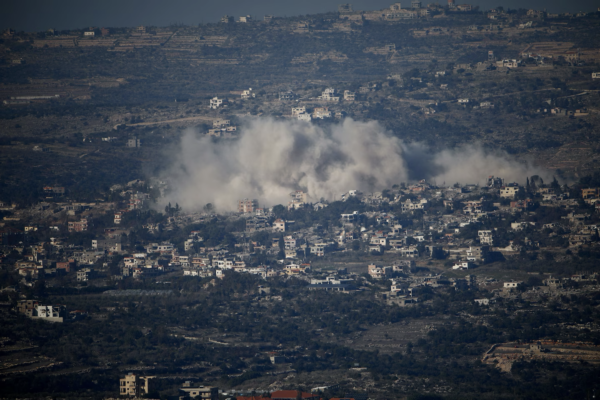
Smoke rises after an explosion in southern Lebanon, as seen from northern Israel on Monday. (Shir Torem/Reuters)
Despite a 60-day ceasefire with Hezbollah, the Israeli military advanced into dozens of new positions across southern Lebanon in the first 40 days of the deal, damaging or destroying hundreds of buildings as it searched for weapons and other infrastructure, according to a Washington Post review of previously unreported satellite data and open-source imagery, as well as interviews with U.N., Western and Lebanese officials and diplomats.
Middle East conflict
Lebanon’s new president has demanded that Israel must withdraw from his country’s south by the January 26 deadline agreed in last year’s Israel-Hezbollah ceasefire as he met the United Nations chief visiting the country devastated by war.
“The continued Israeli violations on land and in the air, especially in terms of blowing up houses and destroying border villages, completely contradicts what was stated in the ceasefire agreement and is considered a continuation of the violation of Lebanese sovereignty and the will of the international community,” President Joseph Aoun’s office said on Saturday after his meeting with Antonio Guterres in Beirut.
Guterres has said he will “exert utmost efforts” to ensure the “secure” withdrawal of the forces within the January 26 deadline set by the agreement reached on November 27.
Guterres said a “more hopeful future” awaited Lebanon under Aoun’s leadership in which the country could become stable and a hub in the Middle East.
Aoun was elected in January after an agreement between political parties in Lebanon ended a two-year power vacuum that was further destabilizing the country as it faced Israeli attacks and a turbulent economy.
The president, who is the former army chief, has also emphasized his support for the UN Interim Force in Lebanon (UNIFIL), who are tasked with securing the southern part of the country as part of Resolution 1701, which ended the 2006 war between Israel and Hezbollah.
The message delivered by Guterres in Lebanon was one of support for the new president and new Prime Minister Nawaf Salam, said Al Jazeera’s Zeina Khodr, reporting from Beirut.
“What Guterres is saying is that the international community will stand by them and help them in their recovery efforts. Lebanon has had a difficult few years. The economy has all but collapsed, the state is nearly bankrupt, there’s a financial crisis and the currency has lost 99% of its value.”
As part of the ceasefire, Hezbollah is supposed to retreat beyond the Litani River, which lies some 30 kilometers (20 miles) from the border with Israel, and dismantle any remaining military infrastructure.
The Lebanese army has been gradually deploying in further areas in the south along with UN peacekeepers, as Israeli military troops have gradually withdrawn
French President Emmanuel Macron, who was on a visit to Beirut on Friday, said the total Israeli withdrawal from the area must be “accelerated” and the Lebanese army strengthened.
In late 2024, Israel and Lebanon’s Hezbollah agreed to a ceasefire deal, bringing a tenuous halt to more than a year of hostilities that included an Israeli invasion of southern Lebanon. Israel’s airstrikes into Lebanon had been intense and deadly, killing over 1,400 people including Hassan Nasrallah, Hezbollah’s longtime leader. The Israel-Lebanon border has a history of violence that dates back to Israel’s founding in 1948.
WP/YL
