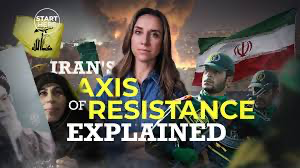
For decades, Iran has propagated the concept of an “axis of resistance” to position itself as the vanguard of opposition to Western imperialism and Israeli aggression. This so-called alliance, consisting of groups like Hezbollah in Lebanon, the Popular Mobilization Forces in Iraq, Syrian-backed militias, Hamas in Gaza, and the Houthis in Yemen, is presented as a united front resisting oppression. However, a closer examination reveals that this narrative is not only misleading but serves as a facade for Iran’s regional ambitions and hegemonic designs.
Resistance Against Whom?
Resistance, in its purest form, implies a struggle against oppression or occupation within a specific context, usually on one’s own soil. By this definition, the groups Iran labels as the “axis of resistance” fail the basic test of legitimacy. If their purported cause is to resist Israel, one must ask: why are they entrenched in Lebanon, Iraq, Syria, Yemen, and Gaza, rather than actively engaging in occupied Palestinian territories?
Iran’s proxies are not autonomous entities fighting for national or regional justice. They are mercenary armies, created, funded, trained, and armed by Iran to further its interests.
Over the 45 years since the Islamic regime came to power in Iran, neither Iran nor its proxies have liberated even a square inch of Palestine. Instead, these groups primarily operate within their host countries, destabilizing them and exacerbating internal divisions. The so-called resistance is more of a power play than a principled movement.
Proxies, Not Partners
Iran’s proxies are not autonomous entities fighting for national or regional justice. They are mercenary armies, created, funded, trained, and armed by Iran to further its interests. These groups pledge allegiance to Iran, not to the nations they claim to represent or to the cause of resistance.
- Hezbollah in Lebanon: Far from being a Lebanese nationalist movement, Hezbollah functions as Iran’s arm in Lebanon. Its priority is not Lebanon’s sovereignty but Iran’s regional agenda.
- Popular Mobilization Forces in Iraq: Ostensibly created to combat ISIS, these militias have since been co-opted into Iran’s strategy to consolidate influence in Iraq.
- Syrian Militias: Iran’s backing of Syrian militias is less about supporting the Syrian people and more about securing a foothold in a country crucial to its regional strategy.
- Hamas and the Houthis: While presenting themselves as defenders of Palestinian rights or Yemeni sovereignty, their actions often align with Iran’s geopolitical goals rather than their local contexts.
The Reality of Iran’s Ambitions
Iran’s claim to lead a resistance is a smokescreen for its expansionist goals. By cultivating loyal militias in multiple countries, it seeks to project power far beyond its borders. These groups are less about resistance and more about creating leverage for Iran in regional and international politics.
This strategy has disastrous consequences for the host countries. Instead of strengthening their sovereignty, these militias undermine it, plunging nations into cycles of instability, sectarian strife, and economic ruin. Lebanon, Iraq, Syria, and Yemen are all examples of how Iran’s influence has eroded national unity and weakened state institutions.
The Deceptive Use of the Term “Resistance”
The term “resistance” is perhaps the biggest lie of all. By branding its proxies as resistance movements, Iran deflects scrutiny of its actions while co-opting the struggles of Palestinians and other oppressed peoples. This narrative appeals to global audiences sympathetic to anti-imperialist and anti-Israeli causes, but the reality on the ground tells a different story.
If Iran’s true aim were resistance against Israel, its efforts would focus on direct support for Palestinians in occupied territories rather than entrenching itself in the political and social fabric of unrelated countries.
It’s Time to Expose the Myth
Iran’s “axis of resistance” is not a movement for justice but a tool for domination. The world must reject the myth of resistance and hold Iran accountable for the destruction its proxies bring to their host nations. True resistance seeks liberation and justice, not the imposition of foreign agendas.
For the people of Lebanon, Iraq, Syria, Yemen, and Gaza, this manufactured resistance has brought only suffering. It is time to expose this phenomenon for what it is: a strategy to expand Iranian influence at the expense of regional peace and stability.
By unraveling this myth, we can focus on empowering the people of these nations to reclaim their sovereignty and pursue genuine paths to justice and development. The region does not need a manufactured “axis of resistance.” It needs unity, stability, and freedom from foreign domination.
