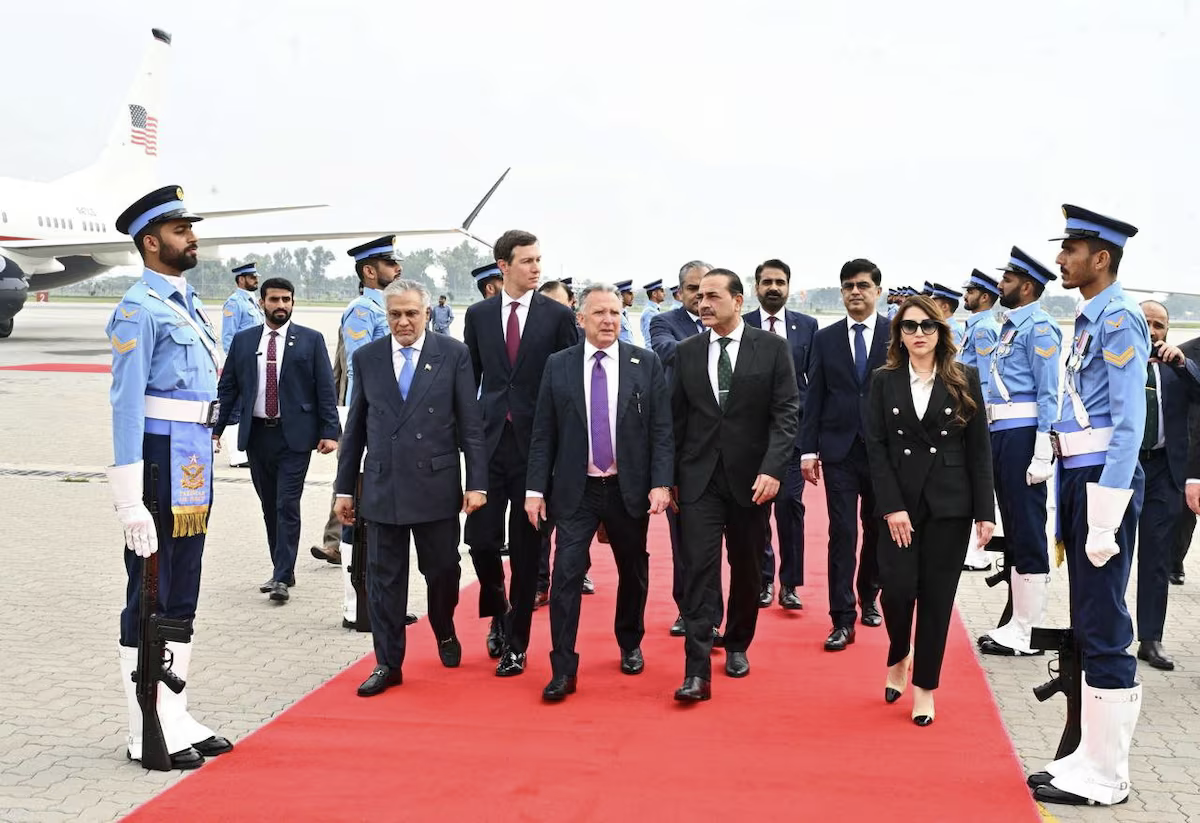
U.S. Special Envoy Steve Witkoff and Jared Kushner walk with Pakistan’s Chief of Defence Forces and Chief of Army Staff Field Marshal Asim Munir, and Pakistani Deputy Prime Minister and Foreign Minister Mohammad Ishaq Dar after arriving for peace talks with Iranian officials in Islamabad, Pakistan, Saturday, April 11, 2026
A senior Iranian source said on Saturday the U.S. had agreed to release Iranian frozen assets held in Qatar and other foreign banks, but a U.S. official swiftly denied the assertion.
The senior Iranian source welcomed the purported U.S. move as a sign of “seriousness” in reaching a deal with Washington in talks in Islamabad. The source said it was one of Iran’s demands “in messages conveyed to the U.S. side” and that Tehran had received a U.S. agreement to release the assets.
The source, who declined to be named due to the sensitivity of the matter, told Reuters that unfreezing the assets was “directly linked to ensuring safe passage through the Strait of Hormuz”, which is expected to be a key issue in the talks.
The senior source did not give a value for the assets that Washington had agreed to unfreeze. A second Iranian source said the United States had agreed to release $6 billion of frozen Iranian funds held by Qatar.
Qatar’s Foreign Ministry did not immediately respond to a request for comment.
FUNDS ORIGINALLY FROZEN EIGHT YEARS AGO
The $6 billion, originally frozen in 2018, had been due for release in 2023 as part of a U.S.-Iranian prisoner swap but the funds were again frozen by the administration of President Joe Biden following the October 7, 2023 attacks on Israel by Iran’s ally, the Palestinian militant group Hamas.
U.S. officials said at the time that Iran would not be able to access the money for the foreseeable future, stressing that Washington retained the right to completely freeze the account.
The funds stem from Iranian oil sales to South Korea and had been blocked in South Korean banks after President Donald Trump reimposed sanctions on Iran in 2018 – during his first term in the White House – and scrapped a deal between world powers and Tehran over its nuclear program
Under the September 2023 U.S.–Iran prisoner swap mediated by Doha, the money was transferred to Qatari bank accounts. The prisoner swap involved the release of five U.S. citizens detained in Iran in exchange for the funds’ release and the release of five Iranians held in the United States.
U.S. officials said at that time that the money was restricted to humanitarian use only, to be disbursed to approved vendors for food, medicine, medical equipment and agricultural goods shipped into Iran under U.S. Treasury oversight.
‘Big mistake’
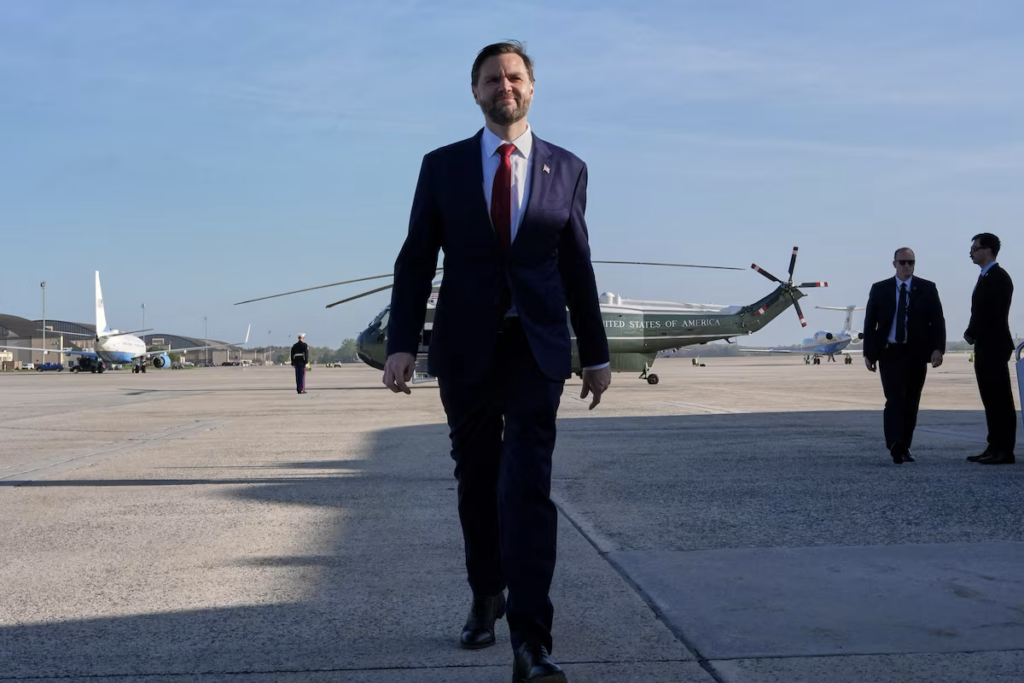
U.S. Vice President JD Vance walks to speak to the media before boarding Air Force Two for expected departure to Pakistan for talks on Iran, at Joint Base Andrews, Maryland, U.S., April 10, 2026.
Commenting on the negotiation team with Iran , John Bolton feels Vice President JD Vance being part of the negotiating team makes no sense.
“I think it’s a big mistake to send out the vice president to meet some unknown Iranian, maybe the speaker of their parliament,” the former national security adviser during President Trump’s first term said during a Thursday appearance on “Elizabeth Vargas Reports.” “Vance is, by definition, the next thing below the president. And the stakes that are there are made much higher by his presence.”
Iran, Israel and the U.S. have all signed on to a fragile two-week ceasefire agreement that hinges on the reopening of the Strait of Hormuz. Iran again closed the vital waterway Wednesday in response to Israel’s attacks on Lebanon.
Bolton points out the Hormuz facet of the negotiations might be pointless unless the U.S. takes the waterway by military force. It all relates to how the regime operates, he explains.
“I don’t think you can trust this regime as far as you can throw it,” Bolton said. “They’ll agree to almost anything and then ignore it.”
“If this was resolved by diplomacy, and I doubt that it will be, what happens the next time Iran closes the Strait? The Saudis, the Emiratis, all the Gulf Arabs are there saying, we’re not happy to suffer under Iran as a hegemon. It’s been a principle of American foreign policy since World War II that no power, no outside power, no power in the Gulf controls access to all the oil. That’s what the Iranians are claiming, and it is utterly unacceptable.”
Iran wanted Vance
Among those who have advocated for Vance to take a leading role, according to a senior regional diplomat, was Iranian parliamentary Speaker Mohammed Bager Qalibaf, who will be representing Iran in Islamabad alongside Foreign Minister Abbas Araqchi.
From Tehran’s perspective, Vance brought more political weight as a top-ranking elected official than Witkoff and Kushner, according to regional diplomats
Reuters/ News National
