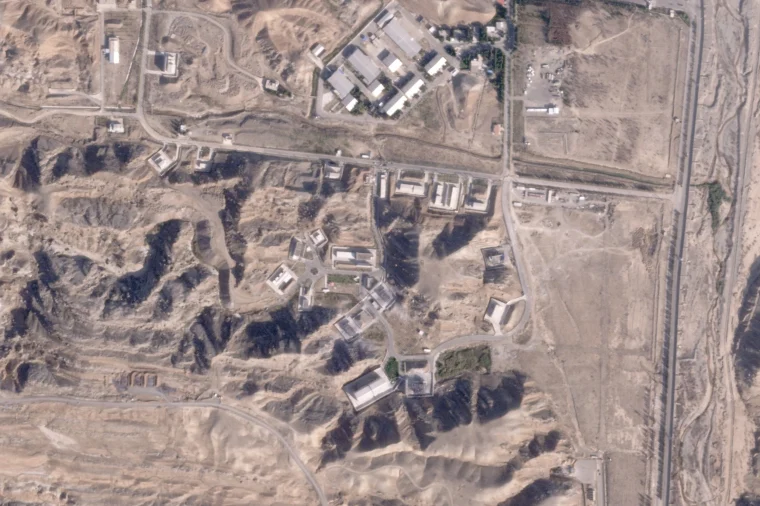
Damaged buildings at Iran’s Khojir military base outside Tehran on Saturday.
What we know about the Iran war today:
- President Trump will deliver an update on the Iran war Wednesday night after saying he expects to end U.S. operations in two to three weeks. Mr. Trump is also expected to say that the U.S. military is meeting or exceeding its operational benchmarks, a White House official told CBS News.
- Energy and stock markets reacted positively to Mr. Trump’s remarks about the war, with oil falling back below the $100 per barrel despite Iran’s threat to target U.S. tech companies and warnings that leaving the Strait of Hormuz under Tehran’s control could cause lingering pain for the global economy.
- Mr. Trump has told Britain’s Telegraph newspaper he could attempt to pull the U.S. out of the transatlantic NATO alliance it’s led for more than seven decades, as he vents frustration at America’s closest allies for declining to join the U.S.-Israeli war on Iran. Mr. Trump is expected to criticize NATO in his prime-time address, a source told CBS News.
- Mr. Trump said earlier Wednesday that Iran wants a ceasefire, but he’s made it clear he could end U.S. operations without reopening the Strait of Hormuz, leaving other countries to deal with Tehran’s chokehold on the critical shipping lane. Al Jazeera reported that Iran’s foreign minister denied making a ceasefire request.
U.S. labor market
The Iran war is adding fresh pressure to a slowing U.S. labor market, with consumer goods giant Unilever telling CBS News it plans to freeze hiring for the next three months.
Oxford Economics senior U.S. economist Matthew Martin told CBS News that companies are “in a period of uncertainty” and may be “looking for ways to reduce overall spend” amid rising prices and uncertainty about when the war will end.
The war’s impact on hiring may not be immediately reflected in the March jobs report, set to be released on Friday, experts said, but it could result in a higher unemployment rate. The United States’ GDP could also be affected, leading to lower hiring rates.
Iran may target universities
Iran and its proxies “may intend to target universities in Kuwait,” the U.S. State Department warned Wednesday.
Iran has previously threatened American universities across the Middle East.
Six U.S. service members were killed early in the war when an Iranian drone struck a tactical operations center in Kuwait.
The State Department has recommended Americans in Kuwait shelter in place. Americans looking to leave Kuwait should reach out to the government for aid.
NATO– President Trump is set to give an operational update on the progress of Operation Epic Fury during his prime-time address to the nation on Wednesday night
Trump is expected to reiterate that the operation will conclude in two or three weeks, a timeline he also shared Tuesday. An official said Mr. Trump will also say the military is meeting or exceeding all operational benchmarks, including destroying ballistic missiles and production facilities, annihilating Iran’s navy, keeping the country from destabilizing the region with proxy groups, and preventing Iran from acquiring a nuclear weapon.
Trump is also expected to criticize NATO, echoing comments he made to Reuters earlier Wednesday, a source told CBS News.
Hormuz -The United Kingdom will hold a virtual summit to discuss reopening the Strait of Hormuz on Thursday, Prime Minister Keir Starmer said.
The meeting will be led by Foreign Secretary Yvette Cooper, Starmer said. It will include “key partners” including the signatories of a joint statement addressing the strait’s closure last month.
The group will “assess all viable diplomatic and political measures we can take to restore freedom of navigation, guarantee the safety of trapped ships and seafarers and to resume the movement of vital commodities,” Starmer said.
Starmer’s office said in a statement that the U.K. will also host a meeting of defense leaders next week to “look at how we can marshal our capabilities and make the Strait accessible and safe after the fighting has stopped.”
The U.K. and the U.S. are working together on the initiative, the statement said.
Enriched nuclear material in Iran- In a phone interview with Reuters, President Trump said he doesn’t “care about” the enriched nuclear material in Iran, insisting the U.S. can monitor the situation from a distance.
Asked about Iran’s enriched uranium it still has, Mr. Trump said, “That’s so far underground, I don’t care about that.”
“We’ll always be watching it by satellite,” he added.
Iran’s enriched uranium, hidden in deep underground tunnels, would likely require further enrichment to be able to be used for nuclear bombs.
The president and his top administration officials have repeatedly said a goal of the war is preventing Iran from acquiring a nuclear weapon.
Securing Iran’s enriched uranium would likely require a risky and dangerous operation of U.S. troops. The White House hasn’t ruled out putting U.S. boots on the ground, but also hasn’t committed to such a plan.
Ceasefire– Iran’s foreign ministry has denied President Trump’s claim that Tehran asked the U.S. for a ceasefire, Al Jazeera reported Wednesday.
“There is no truth to Trump’s statements that we requested a ceasefire,” Al Jazeera, which is owned by the government of Qatar but broadcasts globally, quoted ministry spokesman Esmail Baqaei as saying.
CBS
