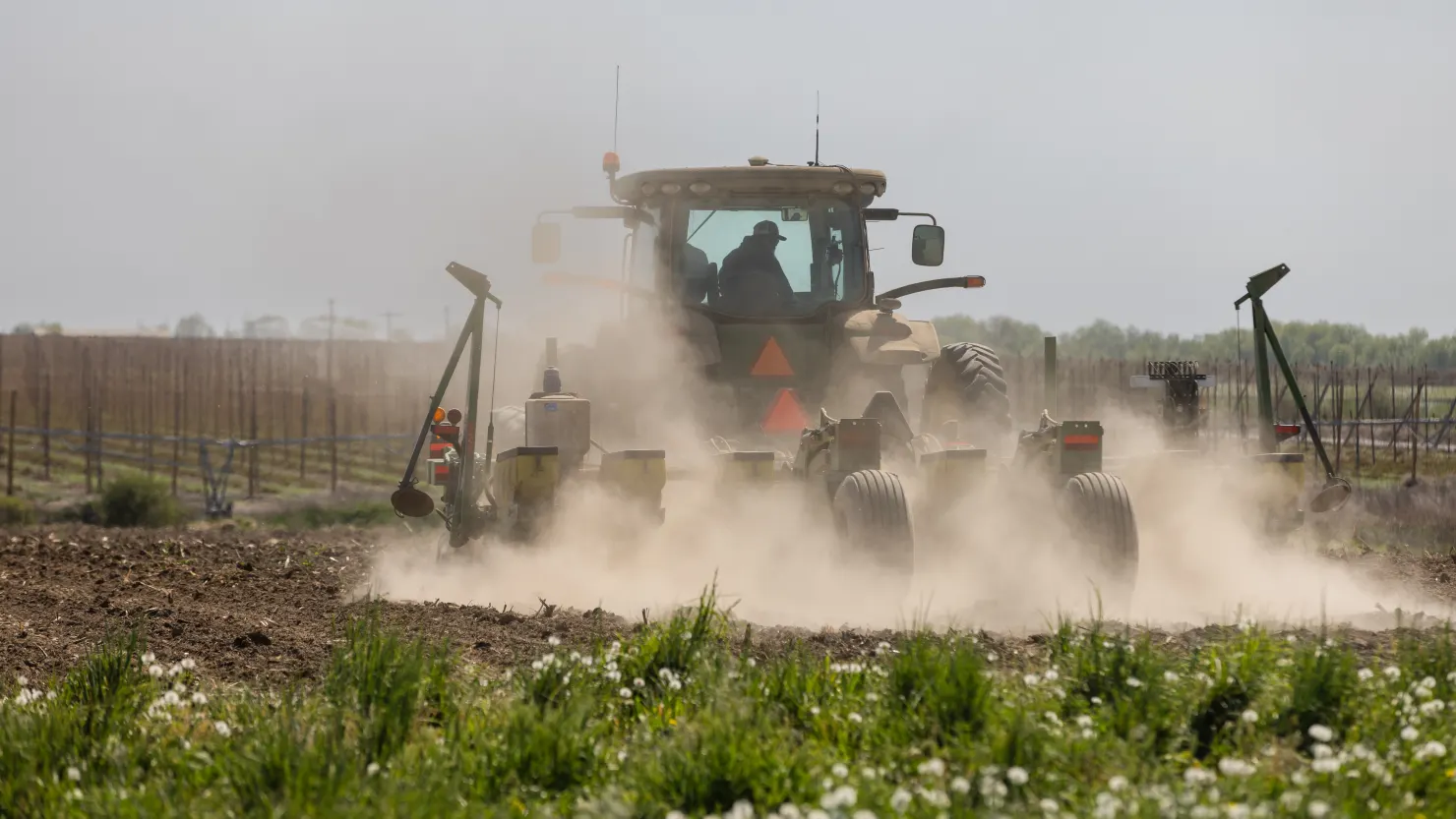
Photo- A worker operates a tractor to plant and fertilize corn at a farm in Wapato, Washington, U.S., on May 2, 2025. Emree Weaver | Bloomberg | Getty Images
Farmers in the Northern Hemisphere are heading into the crucial spring months, during which major fieldwork must begin. Their peers in the south, meanwhile, are busy harvesting crops before the winter sets in.
However, their work now takes place as the Iran war creates serious supply constraints for essential fertilizer products — fueling massive price spikes and warnings of looming food insecurity.
Around one-third of the global seaborne fertilizer trade passes through the Strait of Hormuz, according to the United Nations.
The waterway, a critical shipping route that runs along Iran’s southern border, has been severely disrupted since the start of the war, with traffic effectively coming to a halt and several ships being hit by projectiles in or near the waterway.
Since the U.S. and Israel launched strikes on Iran on Feb. 28, the price of fertilizer — much of which is produced in the Middle East — has skyrocketed.
Fertilizer futures contracts are less liquid than other commodities, making prices more opaque. But analysts working in the sector told CNBC that they had seen the cost of FOB granular urea in Egypt — a bellwether of nitrogen fertilizers — jump to around $700 per metric ton, up from $400 to $490 before the war began.
In a Monday note, Oxford Economics’ Alpine Macro said urea and ammonia prices had surged by around 50% and 20%, respectively, since the war began. Other fertilizers, like potash and sulfur, have also risen in price.
The Middle East is a particularly large exporter of urea and nitrogen products, according to Chris Lawson, vice president of market intelligence and prices at CRU.
“With the Strait of Hormuz essentially cut off, there’s a big chunk of global trade that isn’t able to move right now,” Lawson said. “We estimate around 30% of exportable suppliers are not really available to the market right now, that is Saudi Arabia, Qatar and Bahrain, but that also includes Iran.”
Iran, Lawson said, is an important producer of nitrogen-based fertilizers and one of the largest exporters globally.
“There’s a lot of traded supply that is at risk — 30% of global urea trade comes out of Iran and the Hormuz-constrained countries,” he told CNBC.
“It’s a long supply chain — if farmers aren’t able to get the urea that they need, crop yields will inevitably go lower. Nitrogen is the main nutrient that a crop needs to grow, [and] there will be inventories that can be drawn down, so you’re not really going to see an impact on crop yields and a loss of crop production until later in the year.”
‘You can’t skip a season of nitrogen’
Dawid Heyl, a co-portfolio manager for the global natural resources strategy at Ninety One, told CNBC that nitrogen fertilizers like urea were at the forefront of the Middle East crisis because — unlike other fertilizer groups like potash and phosphates — nitrogen is “the one element that you need to get to the plant every single year.”
“You can skip a season of potash, you can skip a season of phosphates, but you can’t skip a season of nitrogen,” Heyl said.
With farmers in the Northern Hemisphere due to begin fertilizing their fields, the supply constraint has intersected with cyclical demand. Urea, one of the world’s most used fertilizers, is used in the growth of various crops, including maize, wheat, rapeseed, and some fruits and vegetables.
“There’s a direct correlation to your nitrogen application and your agricultural yield in the end,” Heyl said. “That’s why I’m a lot more concerned about the current crisis than I was when Russia-Ukraine happened four years ago.”
When Moscow launched its full-scale invasion of Ukraine in early 2022, the two countries were major exporters of fertilizers, with Russia accounting for a significant proportion of global potash production. Sanctions on Russian exports added pressure to a market that was already experiencing shortages, pushing prices higher.
“This, to me, is starting to feel like it could be worse, because it could really have an impact on agricultural yields across a lot of geographies, and across the major crops such as maize [and] other big ones,” Heyl added, noting that most fertilizer futures had seen double-digit price growth in the weeks since the war began.
Sarah Marlow, global head of fertilizer pricing at Argus, agreed that the unfolding crisis in the Middle East would have a bigger impact on the fertilizer trade than the Russia-Ukraine war.
“Almost 50% of all globally traded sulfur comes from that region. For urea, it’s around a third of all globally traded urea that comes from that region and for ammonia, it’s close to 25%,” Marlow told CNBC on a video call. “So, it’s huge. It’s very significant — and more significant in some ways than the impact of Ukraine because it is affecting multiple producers.”
“You’re not just talking about one or two,” she added, noting that exports from Saudi Arabia, Kuwait, Qatar, Iran and the United Arab Emirates were all being affected.
“The sulfur market was already structurally tight before this began and we’d already seen a peak in price in January,” Marlow said. “We’ve now seen more production go offline and exports unable to get out and to leave the region, so there’s even more of a shortage and we could see further price spikes as a result.”
Fertilizer production is also taking a hit due to a lack of storage options for products that cannot be shipped and a shutdown of some energy facilities in he Middle East.
Earlier this month, QatarEnergy announced it would stop downstream production of urea following its decision to bring liquefied natural gas production to a halt.
Meanwhile, China — another large exporter of fertilizers — has put restrictions on exports to protect its domestic market from shortages, news agency Reuters reported last week.
Food security fears
Ninety One’s Heyl said that markets had entered 2026 with fairly high stocks of basic food commodities that were reliant on fertilizer deliveries, meaning there were “buffer stocks” that might help offset some shortages of corn, wheat, soybeans and rice.
“If agricultural yields were [hypothetically] impacted by 5% this year, I don’t think we’ll be looking at starvation, but it would certainly cause food inflation,” he told CNBC, noting that emerging market countries were more likely to feel the brunt of the impact.
“Unfortunately, the poorer countries in the world are quite often more exposed to these crises,” Heyl said. “I think some of the African nations that import a lot of grains, for instance, are going to be impacted.”
India, which imports nitrogen fertilizers as well as natural gas to produce them domestically, also faces high exposure to the shortages, Heyl added.
“I’m more concerned for [a country] like India, for regions like East Africa, which are going to be more vulnerable,” he said. “Emerging markets east of Suez and the global south are quite often the sort of last to be able to afford [inflated prices].”
But he noted that the U.S. was not completely insulated from the implications of a fertilizer price shock, noting that while America produces a lot of its own nitrogen fertilizer, the country “has not got self-sufficiency.”
According to the U.S. Fertilizer Institute, around a third of nitrogen, phosphate and potash fertilizers used in the United States are imported.
“It’s going to be inflationary for the farmer,” Heyl said of rising fertilizer prices trickling through to the United States. “Are there going to be certain regions that can’t get their hand on the fertilizer or have to ration?”
A total of 54 agricultural groups recently wrote to U.S. President Donald Trump to call for “much-needed market relief for America’s farmers” amid surging fuel and fertilizer prices.
“As planting season began in earnest across much of the U.S., the closure of the Strait of Hormuz sent fuel and fertilizer prices skyrocketing,” they said. “Maritime freight disruptions from the ongoing conflict in Iran pose significant consequences to food security here at home and around the world.”
CNBC
