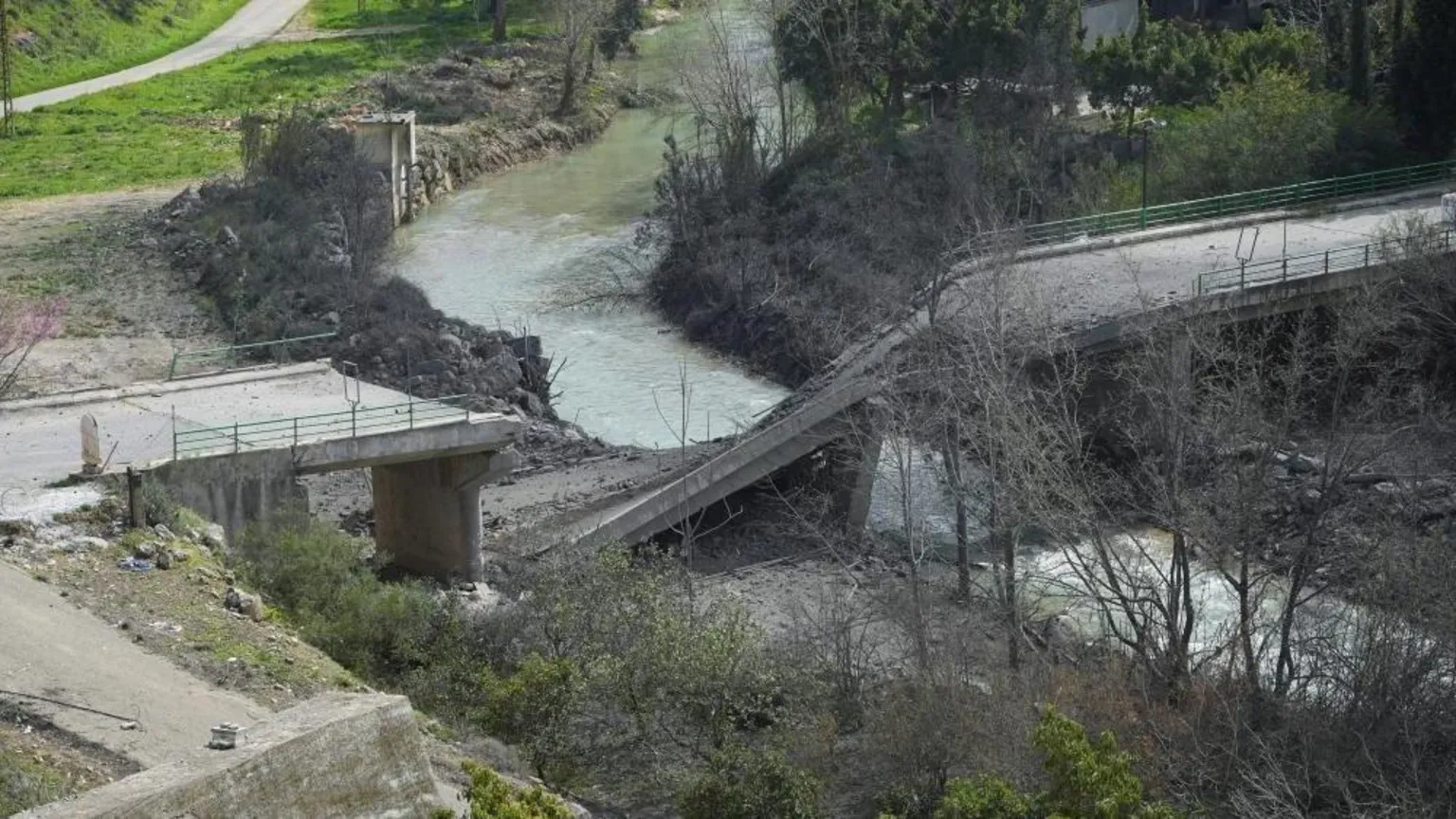
The Zrarieh Bridge over the Litani river was damaged in an Israeli strike on Friday, followed by other strikes on other bridges on Wednesday
Israeli forces are intensifying airstrikes and ground operations in southern Lebanon, as well as hitting targets in Beirut neighborhoods. Israeli officials say they’re targeting the infrastructure and personnel of Hezbollah, an Iran-backed Lebanese militant group. Nabih Bulos, the Middle East bureau chief for the Los Angeles Times, tells The World’s Host Carolyn Beeler that Israel’s decision to hit bridges in southern Lebanon is a marked escalation.
Israel has been sharply escalating its attacks in Lebanon with airstrikes hitting central Beirut, in parts of the city previously considered safe.
An airstrike on March 18 collapsed an entire 22 floor apartment building in the Bachoura neighborhood, with residents only given a one-hour advance warning from the Israeli military to grab their belongings and flee.
Israel has also been intensifying its operations in southern Lebanon, where it’s sending limited ground troops and ramping up airstrikes. The Israeli military says it’s targeting the infrastructure and personnel of Hezbollah, the militant group backed by Iran. One million people have now been displaced by the fighting in Lebanon, according to aid groups.
Attempts by Lebanese officials to enter into direct negotiations with Israel to halt the fighting have been unsuccessful. Neither Hezbollah nor Israel appears to have any immediate desire to stop the war.
Nabih Bulos, the Middle East bureau chief for the Los Angeles Times, who’s based in Beirut, spoke with Host Carolyn Beeler about the insecurities in once-safe parts of Beirut.
Carolyn Beeler: Nabih, what are you seeing and hearing in Beirut today?
Nabih Bulos: In the Bachoura neighborhood, in Hamra, in the places where the displaced have gone, there’s, of course, a real fear that this building that they’re in will be the next target, and what that would imply. Now, of course, we’re seeing traffic in those areas. I mean, it’s already stalled because of the influx of the displaced, and you can imagine that if something were to happen, it would be, of course, absolute bedlam. So yes, there is a fear there. There is a sort of electricity and tension right now. The question is: Where will these people go if something else happens?
These are people displaced from the south who are now flooding into Beirut?
Well, south, but also from the southern suburbs of Beirut itself, which is also a Hezbollah-dominated area. So, you’re talking about a lot of people, really hundreds of thousands at this point in Beirut, alone.
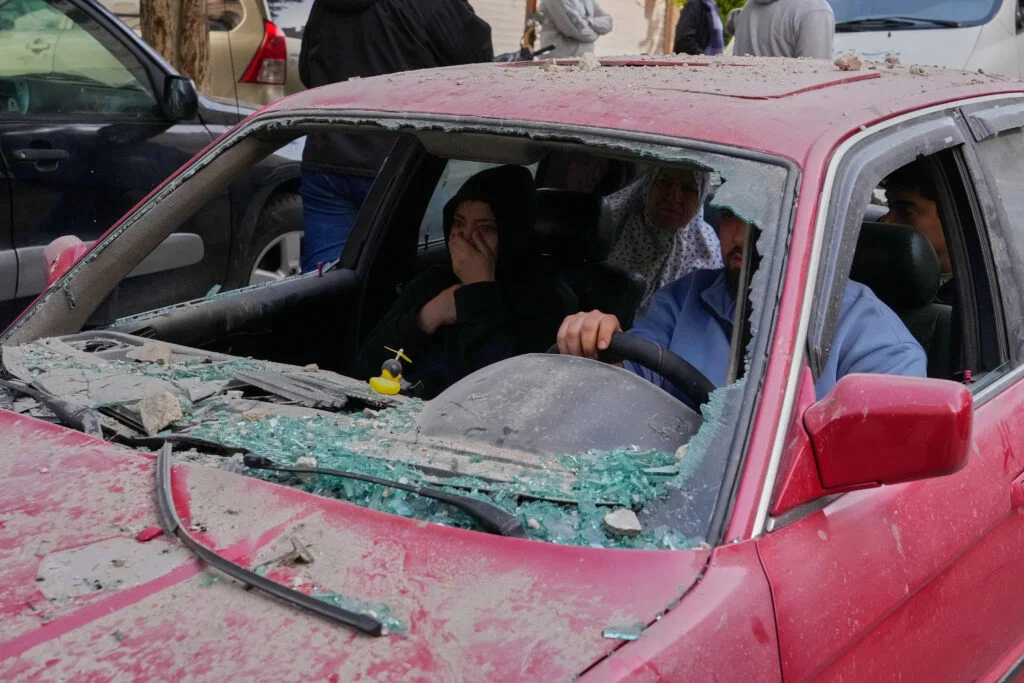
Family members ride in a damaged car, as they flee the site of an Israeli airstrike that hit an apartment building in the southern port city of Sidon, Lebanon, March 13, 2026.
Does this feel different than previous conflicts with Israel?
In the last war, you could sort of feel somewhat safe in the neighborhood I’m in, for example. But increasingly, because the scope of these attacks has increased, there is a feeling that nowhere is safe. So, once that happens, then the question is, OK, will those areas, for example, require that anyone from the south is not allowed to visit? Will it become sort of more sectarian, that if you’re of a certain sect, you cannot come to this area? I mean, it becomes a very ugly situation when you try to think of those things and what they’re going to mean in the future.
Becoming more sectarian, do you mean that people living in certain areas will bar people from the south from resettling there because they’re concerned about being targeted by Israel?
Well, for one thing, I mean quite openly the other day, the Israeli Defense Minister said that as long as the Shias of the south of Lebanon are fighting, he said that the Shias of the south of Lebanon won’t be able to return home. Now, this is a clear situation where you’re seeing them actually call out the Shias by name, right? I mean, before it was said that if you were Hezbollah, etc. Now the rhetoric is such that they are talking about an entire sect. I mean, you can obviously see the problem brewing here. And the country right now has this influx of Shia Muslims from the south. At the same time, there is a real fear of them, and turning the place into a target. So, obviously, you have this, I suppose, ratcheting up of sectarian tensions.
So, let’s go back to the south where you just were. Can you give me an overview of what the Israeli military is doing there right now?
Well, actually, today I went to the city of Tyre, and this is the largest city in the south of Lebanon, and there was a blanket evacuation order for it last night, in fact. I wanted to go see what was happening there today. And as you can imagine, the city, I mean, it was already partially empty, but now, there are people who are just trying to find some place to shelter at this point. They’re, of course, terrified of an impending Israeli invasion. At the same time, actually, as I was leaving, the Israeli air force was starting to bomb bridges into south Lebanon. So, we are seeing the start of the isolation of south Lebanon as a region from the rest of the country.
The Israeli military has been already occupying parts of the south even before this particular conflagration began. Let’s be clear. Now, how much they have advanced is a matter of debate. There is talk that they have reached the second line of border villages, right in border areas, which would imply that they’re in for like three kilometers or so. But again, it’s really quite unclear. At the same time, there has been a ramping up of airstrikes, and the targeting has widened to include infrastructure like roads, hospitals and things of that nature … things that sustain life. Civilian infrastructure. And so, what that means is that people cannot stay. I mean, if your intention is to empty out an area, you’re going to hit that kind of infrastructure to get them out. For example, today in Tyre, there was talk of a targeting of gas stations, [and] there are four gas stations that have been hit. And you can imagine how important that is, as well. Now, again, in all this, Israel is saying that it’s targeting Hezbollah infrastructure, but at the same time, if, for example, a gas station is owned by someone who is perhaps peripherally-aligned with Hezbollah, or related to someone in Hezbollah, you can see how that spreads and becomes a bigger issue. This is where we are now.
And Tyre is a city in southern Lebanon where Israel has said everyone needs to leave. What did you hear today from civilians in that area about their need to flee, what they’re thinking right now?
Well, I mean, I was staying in this one area near this resort, actually. There were a few families who had bunkered there. And just talking to them, they were unsure of where to go. I mean, the fact is, they could have gone to a city called Sidon, which is a bit north and is in theory in the safe zone of Lebanon. But at the same time, the problem there is that you won’t find a place to stay. There’s no place to rent. Even if a landlord accepts to have you rent at this exorbitant price, they still might be worried about your origin, background, etc. And these are people with a very strong southern accent. So, that would also be an issue. So, they actually went to Sidon for the night to try to find a place to stay. They ended up sleeping on the streets, and then came back to Tyre again, despite the evacuation order. And there are quite a few others like them.

Where do these attacks on Hezbollah leave the Lebanese government? There was a discussion about normalizing relations with Israel. I mean, is that totally out of the question now?
Let’s be clear: This whole issue of normalization with Israel, that came under the duress of war. I mean, there’s a desire for a ceasefire, that’s for sure.
Among Lebanese people.
Correct. That’s a whole different situation. Now, with that being said, the government has been trying to offer everything under the sun. It has offered direct negotiations with Israel, which it had not accepted at all in the past. It’s offering this idea of normalization, which, as I said, is, of course, a red line for many people already in the country. And then tack on that, it has already said that Hezbollah’s military activities have all been outlawed. So, again, we are talking about the government doing all the things that Israel had wanted it to do before the war. But Israel has said, you know, it’s too little too late, and this is where we are now.
So, you’ve said that, in general, normalizing relations is not something the Lebanese public wants. Is there a common desire to disarm Hezbollah?
I would argue there isn’t a common desire. I think that desire has certainly increased, right? I think it’s become a more dominant desire, especially in recent months, and especially this time around, because people were already so battered and exhausted by the last war, that this one really just came at a very, I think, difficult time for a lot of people. So, for sure, the party has lost even more popularity. Especially because it should be noted that it said that this was a vengeance strike for [Israel’s killing of Iranian Supreme Leader Ali] Khamenei. And so, the feeling here is that Iran can take care of itself. It’s a far bigger country, with far more resources. There was no need to embroil Hezbollah in this war. And Hezbollah, of course, has been trying to spin it differently since then, right? To say that this was a necessary war, etc., and that it was done only for Lebanon, not for anyone else.
But as you can imagine, there is now a growing consensus among many Lebanese that they want Hezbollah to be disarmed. And certainly the government has, so far, moved towards the idea of outlawing Hezbollah’s military activities. So, we have seen some progress. Now, what that means in practice, of course, is the big question. Because the government has proven unable to apply any of these rules regardless. The fact is that Hezbollah is a stronger force than the Lebanese army, and the Lebanese army refuses to actually engage with Hezbollah by force because that would risk a civil war.

Well, if Hezbollah is not disarmed, what does Lebanon’s future look like?
The fact of the matter is, Hezbollah had actually avoided fighting Israel for about 15 months before this war started — and this despite, I think, about 12,000 violations by Israel of the ceasefire. So, Hezbollah had mentioned before that it was willing to maintain the ceasefire, it was willing to continue with disarmament, etc., and all those other things, if it saw some reciprocal move from Israel. And of course, that wasn’t seen. So, we’re in this Catch-22 situation, right? And this continues.
What would Israeli officials say about your point that Hezbollah hadn’t struck for about 15 months?
They would say that it was trying to reconstitute itself at that time, and that it still had the ability to wage war, and that it couldn’t be trusted to disarm. And so, that brings us to where we are now.
What will you be watching in the days ahead to tell you whether de-escalation between Hezbollah and Israel is possible?
I think in the short term, that’s not going to happen. The question is, how much escalation we’re going to see. You know, perhaps we’re seeing a situation where the Israeli army proceeds to go up to a certain point in the country, and I suppose it will take over that area in a security fashion and try to have a mini-invasion, right? I don’t think Israel would want to have a long-term occupation of that area just for various reasons, but I think for now it would be happy to have some kind of security presence, and then it would remove Hezbollah and have the Lebanese army come and work in concert with it in some fashion.
Nabih, it is the holy month of Ramadan. We are nearing Eid, the celebration that marks the end of the fast. How is this fighting impacting the way that people are celebrating or experiencing Ramadan?
As you can imagine, people are not going to be having much of Eid in this situation right now. I mean, at some level, it’s a blessing because people are, of course, naturally more generous, and perhaps people will be more amenable to helping others. But with over a million people who are now in the streets or in these shelters, it’s going to be a very, very sad one indeed, especially because there is no horizon to this ending. It’s unclear what the endgame is … whether it’s in Iran or here, right? There simply is no clarity.

Are you seeing increased generosity because it is Eid, or people coming together more?
Of course, you hear stories of the situation here where people are opening up their homes. I’m on several WhatsApp groups where people are just going around gathering whatever they can, you know, charity. Of course, it should be said that the government really is unable to handle the situation. The Lebanese government is already dysfunctional, already has no money. And then, to add to the situation of a war, people have, as usual, taken up the slack left by the government, and they’ve been trying to help in various community ways. So, for example, even yesterday I was in this WhatsApp group with a bunch of friends. They work in a bar together, and they decided to just come together and bring diapers, blankets and jackets … things of that nature … to people who are now staying in the Corniche seaside area, the seafront area of Beirut. So, again, this is tiny and, of course, irrelevant in many ways, but you know, I suppose every little bit helps.
The World
