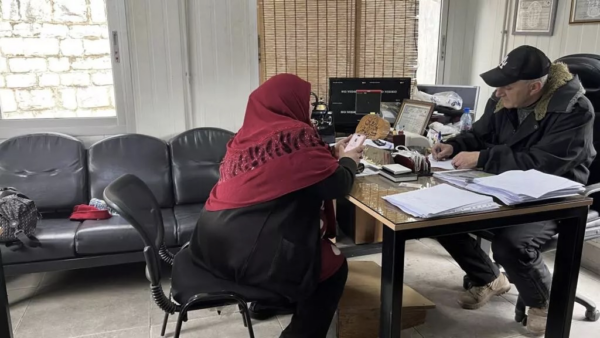
PHOTO- Akram Abu Fakhr fills out a municipal form for displaced people from southern Lebanon in Aley, March 16, 2026. © Assiya Hamza, FRANCE 24
In the predominantly Druze city of Aley, located on Mount Lebanon, authorities scrupulously check the identity documents of the many displaced who seek refuge there. They hope the measures will reassure a population fearful of inciting Israeli strikes over the potential presence of Hezbollah militants among arrivals fleeing southern Lebanon.
“Your name? Phone number? City of origin? Current address?” Holding an identity card, Akram Abu Fakhr noted the answers provided by the man seated in front of him. The official of Aley, a city in Mount Lebanon which is 20 kilometres uphill from Beirut, is responsible for registering the civilians displaced by the war with Israel.
“I work every day from morning to evening, to record the necessary information for monitoring purposes,” said Abu Fakhr, following the same procedure used during Covid and set up for Syrian refugees. “Knowing how many people are in each family allows us to provide each of them with the appropriate humanitarian assistance.”
A man and woman sitting on the worn sofa wait patiently for their turn to meet the official in the small room where he works. The procedure is mandatory for each new arrival in Aley. “They are very cooperative, but they don’t have a choice,” said the blue-eyed man as he filled out a form. “The data is later entered into a computer system by other agents.”
Abu Fakhr registers the information of 50 to 70 people each day. Only one member of every family is required to declare themselves to city officials. The needs of each family is later calculated depending on the number of children they have. Aley has already welcomed over 6,000 displaced people. As Israel expands its ground operation in southern Lebanon, even more people could soon arrive. According to Lebanese authorities, a record number of more than one million people have been displaced since March 2.
Police officers check the identity of a truck driver in Aley, March 16, 2026. © Assiya Hamza, FRANCE 24
A growing defiance toward southern Lebanon’s displaced people
Lebanese society has been shaped by a painful and tortured history. The latest war has brought its share of fear and torment. Hotel owners, landlords and even cities are now refusing to house residents from southern Lebanon for fear of being eventually targeted by the Israeli army.
The Israeli strikes, long limited to the bastions of Hezbollah, are now targeting neighbourhoods, cities, and villages with no ties to the militant group. The heart of Beirut has been repeatedly struck over the past ten days in residential areas such as the neighborhood of Aisha Bakkar and the Ramada Hotel in Raouche. Israel said that it targeted Islamic Revolutionary Guard Corps operators hiding among the displaced in the Lebanese capital.
Joumana, originally from Dahiyeh, a Hezbollah stronghold in Beirut’s southern suburbs, brushed away all thoughts of fear.
“You must believe in destiny. After all, it is God who decides when you’re going to die,” she said. “Israel targets everyone: civilians and Hezbollah members alike. We are all children of the same country. We need to stay united in these circumstances.”
The young woman has tired features. Her gaze is both hard and sad. After arriving in Aley on March 8, she moved into a house that a former university classmate generously lent her. “Look at my friend, she gave me her house. All Lebanese people should be like this,” said Joumana. “I studied, became a lawyer, and taught. Now I’m a displaced person.”
‘No one should feel like they are in danger’
Aley’s officials are doing everything in their power to reassure the city’s inhabitants and avoid potential tensions. “We have set up a hotline for residents to contact if they see someone strange in a neighbourhood or building,” said Fady Chehayeb, in charge of security. “We proceed by immediately verifying the file on the person in question.”
The task is entrusted to 70 police officers on duty 24 hours a day, seven days a week. “The calls have become increasingly numerous since the hotline was established,” said Imad Halime, a member of Aley’s municipal council. “We have already lived through these two or three times; we are prepared. Everything is under control. No one should feel like they are in danger.”
Mohammed, from a village near Lebanon’s border with Israel, hoped this was true. He recently crossed half of the country for his six children, who all exhibit psychological wounds from Israel’s intense bombing of southern Lebanon.
“I understand that the inhabitants want security; it’s also what I want. I’m 50 years old and I have lung cancer that has spread to my esophagus. I don’t have much time left. The most important thing is that my children are safe and that they can return to the village one day.”
France24/ AFP
