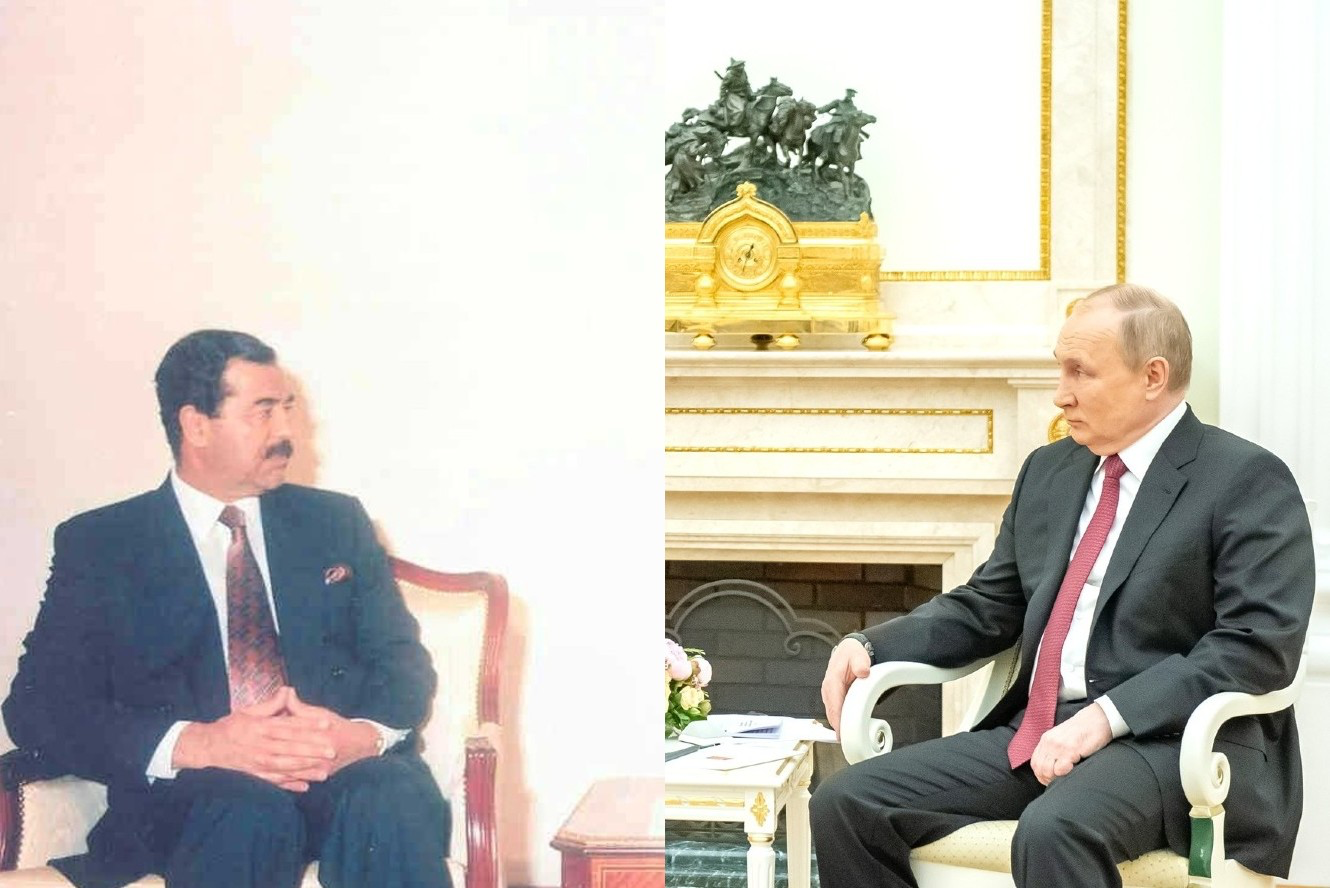
Composed photo- Saddam Hussein and Vladimir Putin
History warns us what happens when leaders under pressure turn to conflict
By : Ya Libnan Editorial Board , Op.Ed
Political scientists have long debated a troubling phenomenon known as diversionary war theory — the idea that leaders facing serious domestic political pressures sometimes turn to external conflicts to rally national unity and divert attention from problems at home.
History offers several examples that continue to be studied today.
In 1982, Argentina’s military ruler Leopoldo Galtieri invaded the Falkland Islands, hoping to ignite nationalist fervor and shore up a collapsing dictatorship. Argentina at the time was facing economic crisis, political unrest, and widespread public anger toward the regime.
The gamble backfired. The United Kingdom responded militarily, defeated Argentina, and the dictatorship soon collapsed.
A similar dynamic has been debated in other conflicts. When Saddam Hussein invaded Kuwait in 1990, Iraq was suffering from severe economic pressure after years of war with Iran. The invasion triggered the Gulf War and ultimately weakened Saddam’s regime.
More recently, analysts have discussed how Vladimir Putin’s annexation of Crimea from Ukraine in 2014 dramatically boosted his popularity at home during a period of economic stagnation and growing domestic dissatisfaction.
These examples do not prove that leaders always start wars for domestic reasons. But they illustrate why scholars remain cautious when domestic political crises and external conflicts appear at the same time.
Today, similar questions are being asked in different parts of the world.
Israel’s Prime Minister Benjamin Netanyahu faces an ongoing corruption trial that could determine his political future. At the same time, tensions with Iran have escalated into open conflict.
In the United States, President Donald Trump is navigating intense political battles at home while dealing with major international crises.
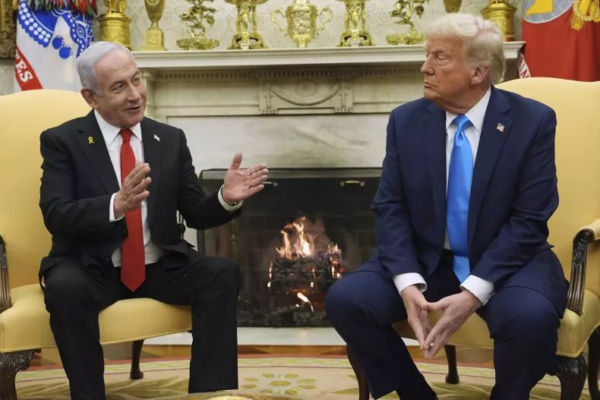
None of these realities prove that conflicts are driven by domestic political motives. But history reminds us why citizens and analysts often ask difficult questions when wars erupt during moments of political vulnerability.
Because when leaders are under pressure, the temptation to rally the nation through external confrontation can become politically powerful.
The danger is that wars rarely remain tools of political convenience.
They cost lives.
They reshape regions.
And once started, they can spiral far beyond the control of those who launched them.
The consequences of today’s conflicts already extend far beyond the battlefield.
The war with Iran has sent oil prices sharply higher as threats to shipping through the Strait of Hormuz disrupt global energy markets. In the process, one country stands to benefit enormously: Russia.
Higher oil prices pour billions of dollars into Moscow’s treasury, strengthening the very government that continues its war against Ukraine. The longer instability persists in the Middle East, the more Russia profits from the global energy shock.
That is why the stakes of such conflicts extend far beyond regional rivalries. They reshape the global balance of power.
History teaches a sobering lesson: when wars are influenced by domestic political pressures, the consequences rarely remain limited to the leaders who made those decisions.
They ripple across continents, strengthen adversaries, weaken alliances, and place the burden of conflict on ordinary people who had no role in creating it.
War must never become a political escape hatch.
Because when leaders gamble with war, it is nations — and innocent civilians — who ultimately pay the price.
Democracies depend on citizens asking difficult questions — especially when war, power, and political survival intersect.
