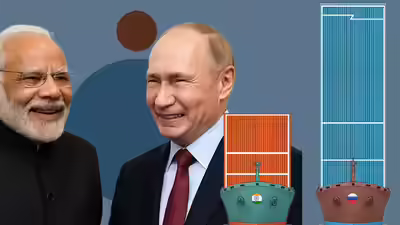
File: Russian President Vladimir Putin ( R) and Indian Prime Minister Narendra Modi are shown with a barrel of oil on the right representing the volume of trade. between the 2 countries . India imported in 2025 0ver $56 billion worth of Russian crude oil , which is financing the war on Ukraine
America must not reward an adversary while pressuring an ally
By : Vlad Green, Op-Ed
The war with Iran has sent shockwaves through global energy markets. Oil prices have surged following Tehran’s threat to disrupt shipping through the strategically vital Strait of Hormuz, a narrow waterway through which a significant portion of the world’s oil supply passes every day.
Any restriction of that flow immediately drives prices upward — and that is exactly what has happened.
Yet one troubling consequence of this crisis is now emerging: Russia may become the biggest economic beneficiary of the conflict.
In response to the oil shock, President Donald Trump reportedly asked the U.S. Treasury to allow India to purchase additional Russian oil in order to stabilize markets. On the surface this may appear to be a pragmatic move designed to ease global supply pressures.
But strategically, it sends the wrong message.
Russia is not a neutral energy supplier. It is a country that has been waging a brutal war against Ukraine for more than four years — a democratic nation that has worked closely with the United States and its European allies in pursuit of peace and ceasefire negotiations.
Allowing Russia to profit from a new geopolitical crisis effectively rewards an aggressor.
Instead of enabling India to buy more Russian oil, Washington has other options. The United States could redirect alternative supplies already available in global markets, including oil obtained through arrangements with countries such as Venezuela.
Selling or redirecting those barrels to India would help stabilize energy markets without strengthening the Kremlin’s war economy.
Russia already benefits from rising oil prices. Increasing global demand for its crude only pours more money into Moscow’s coffers — funds that could help finance the very war the United States and its allies oppose.
Even more troubling is the broader diplomatic contradiction.
While Russia benefits from higher oil revenues, the Trump administration has also been pressuring Ukraine’s president, Volodymyr Zelenskyy, to consider territorial concessions in order to bring the war to an end.

Ukraine has repeatedly shown willingness to engage in negotiations and ceasefire discussions. Russia has not.
Pressuring the victim while rewarding the aggressor is not a strategy for peace.
It is a strategy that encourages future aggression.
The United States has long claimed to stand for a rules-based international order — one in which countries cannot invade their neighbors and then profit from the chaos they help create.
If Washington truly believes in that principle, it must ensure that the economic consequences of global crises do not strengthen those who undermine it.
The war with Iran should not become an economic windfall for the Kremlin.
America has the energy resources, the diplomatic influence, and the global leadership necessary to prevent that outcome.
What it needs now is strategic clarity.
Because justice — and credibility — require one simple rule:
Justice loses its meaning when the aggressor is rewarded and the victim is asked to compromise.
Do not reward the villain while asking the victim to surrender.
