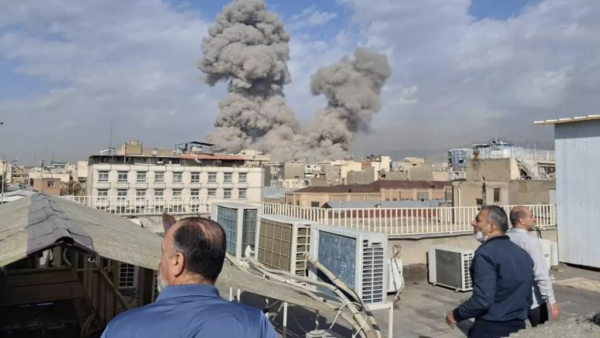
Smoke rises over the skyline after an explosion in Tehran on February 28, 2026. AP
The United States and Israel launched a wave of air strikes against targets in Iran on Saturday, triggering explosions and columns of smoke to rise over the capital Tehran.
The first strikes appeared to target the compound of Iran’s 86-year-old Supreme Leader Ayatollah Ali Khamenei in downtown Tehran. It wasn’t immediately clear if he was there at the time.
“The strike targeted dozens of military targets and was carried out as part of a broad, coordinated, and joint operation against the regime,” the Israeli army said in a statement.
“In the months preceding the strike, close and joint planning was conducted between the IDF and the US military, enabling the execution of the broad strike in full synchronisation and coordination between the two militaries,” it added.
Iran’s paramilitary Revolutionary Guard said it had responded by launching a “first wave” of drones and missiles targeting Israel. Washington ally Bahrain also said that a missile attack targeted the US Navy’s 5th Fleet headquarters in the island kingdom.
“The United States military began major combat operations in Iran,” US President Donald Trump said in a video message posted on his social media site while he spent the weekend at his Florida golf club.
Trump said Washington’s goal was “eliminating imminent threats” from Iran. Israeli Prime Minister Benjamin Netanyahu said the operation was to remove an “existential threat” to Israel.
‘Near-total internet blackout’
Internet access appears to have been cut off in Iran following the strikes, according to the Netblocks network monitor.
“Network data show Iran is now in the midst of a near-total internet blackout,” Netblocks said on social media, adding the disruption “matches measures used during last year’s war with Israel”.
The strikes come after Trump expressed frustration on Friday at Iran’s stance in negotiations this week over its nuclear and missile programmes. The Islamic Republic is “not willing to give us what we have to have”, Trump said.
Iran insists that it is not pursuing nuclear weapons and in 2015 agreed to restrictions on enrichment in a landmark multilateral deal that Trump ripped up during his first term in office.
US and Iranian envoys this week held another round of indirect talks in Geneva, negotiations Iranian officials said had made “good progress” with more “technical” talks set for next week.
Donald Trump says US will destroy Iran missile forces
US and Israel call for Iranians to rise up
“We are going to destroy their missiles and raze their missile industry to the ground. It will be totally, again, obliterated. We’re going to annihilate their navy,” Trump said.
He offered the Iranian military “immunity” should they surrender, or “certain death” if not, and told Iranians the “hour of your freedom is at hand”, urging them to rise up and “take over your government”.
Israel’s Netanyahu echoed this call, telling Iranians that the time had come to “cast off the yoke of tyranny”.
Trump acknowledged that there could be American casualties following the strikes, saying, “that often happens in war”.
Iranian state television reported that President Masoud Pezeshkian was “safe and sound” while the Fars news agency said “seven missile impacts were reported in the Keshvardoost and Pasteur districts” of Tehran.
“I saw with my own eyes two Tomahawk missiles flying horizontally toward targets,” an office worker told AFP on condition of anonymity. “At first we heard a dull noise and thought it was a fighter jet.”
AFP journalists in Tehran heard blasts and saw smoke rising over the city centre. The health ministry said ambulances had been dispatched but there was no immediate word on casualties.
Iran, Iraq and Israel all closed their airspaces to civilian traffic once the strikes were under way, and US embassies in the Gulf urged American citizens to take shelter.
Blasts were also heard over Jerusalem after air-raid sirens sounded, with the Israeli military reporting that “an additional barrage of missiles was launched towards the State of Israel”.
Sirens also sounded in Bahrain, home to a US fleet, and in the Jordanian capital Amman, with Jordan‘s air force saying it was conducting an operation “to defend the kingdom’s skies”.
As the strikes were under way, the exiled son of Iran’s last shah voiced confidence in victory against the Islamic Republic.
“We are very close to final victory. I want to be by your side as soon as possible so that together we can take back and rebuild Iran,” Reza Pahlavi said in an online video address. Pahlavi has been touted as a possible future leader if the regime should fall.
Building pressure
The attack comes after the United States assembled a vast fleet of fighter jets and warships in the region to try to pressure Iran into a deal over its nuclear programme. The military build-up is the largest the region has seen in decades, with the world’s largest aircraft carrier, the USS Gerald R. Ford, approaching the coast of Israel.
Iran has said it hasn’t enriched uranium since June, but it has blocked international inspectors from visiting the sites the US military bombed during last year’s Twelve-Day War with Israel.
Satellite photos analysed by the Associated Press have shown new activity at two of those sites, suggesting Iran is trying to assess and potentially recover material there.
Iran currently has a self-imposed limit on its ballistic missile programme, limiting their range to 2,000 kilometres. That puts all of the Middle East and some of eastern Europe within range. There is no public evidence of Iran seeking intercontinental ballistic missiles, although Washington has criticised its space programme as potentially allowing it to develop such capabilities.
(FRANCE 24 with AFP and AP)
