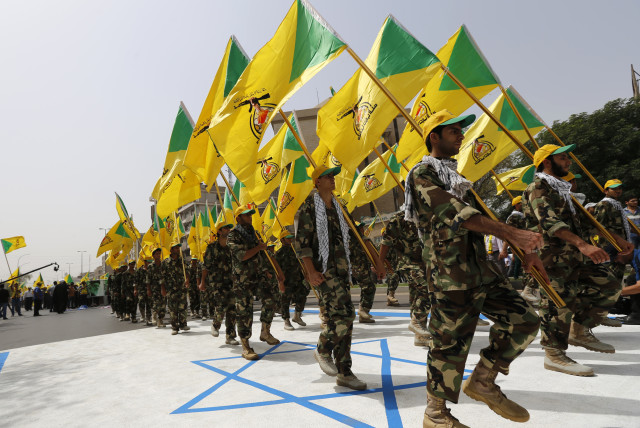
File photo of a parade by Kataeb Hezbollah , one of the most powerful pro -Iran militias in Iraq.
A powerful Iran-backed Iraqi armed group told its fighters to prepare for the scenario of a long war in neighbouring Iran should the United States launch strikes.
Kataeb Hezbollah warned the US on Thursday of “immense losses” were it to start a war in the region, while a commander in an armed faction told AFP his group was “highly likely” to intervene in case of strikes.
“Amid American threats and military build-up indicating a dangerous escalation in the region, it is necessary” for all fighters “to prepare for a potentially long war of attrition,” Kataeb Hezbollah said in a statement.
The commander told AFP that his group sees Iran as strategic to its own interests, and therefore any attack on the Islamic republic “directly threatens us”.
US-sanctioned Iraqi armed groups did not intervene during the 12-day war between Israel and Iran last year.
This time, the commander said they would be “less restrained”, especially in the event of strikes seeking to overthrow the regime.
For months during the Israel-Hamas war in Gaza, Iran-backed groups carried out attacks against US troops in the region and mostly failed attempts against Israel.
Under mounting US and domestic pressure, these attacks came to a halt, while pressure on the groups to disarm has grown.
Iran-backed groups are part of the so-called “axis of resistance”, which also includes Lebanon’s Hezbollah, Hamas in Gaza and the Houthis in Yemen.
A Hezbollah official told AFP this week that the Lebanese movement would not intervene militarily in the event of “limited” US strikes on Iran, but would consider any attack against supreme leader Ayatollah Ali Khamenei a “red line”.
US President Donald Trump has deployed warships and fighter jets near Iran to back up his threats of strikes should ongoing negotiations over Iran’s nuclear program fail to secure a deal.
US and Iranian negotiators met for a third round of talks on Thursday, with Iranian Foreign Minister Abbas Araghchi telling state TV that the talks “made very good progress.”
But a UN nuclear watchdog report says Iran blocks inspectors from checking nuclear sites hit in the June war, leaving big gaps in what the world can verify
Iran has not allowed the United Nations nuclear agency access to its nuclear facilities bombed by Iran and the United States during a 12-day war in June, according to a confidential report by the watchdog circulated to member states and seen Friday by The Associated Press.
The IAEA report on Friday warned that due to the continued lack of access to any of Iran’s four declared enrichment facilities, the agency “cannot provide any information on the current size, composition or whereabouts of the stockpile of enriched uranium in Iran.”The agency also said that Iran has not provided access to IAEA inspectors to the Isfahan Fuel Enrichment Plant since Iran first made available information about the new facility over eight months ago. The confidential report warned that therefore the agency does not know whether this facility “contains nuclear material or is operational.
The U.S. State Department announced on Friday that it started evacuating “non-emergency” government personnel from the embassy in Israel and their family members, citing “safety risks” amid growing tensions with Iran.
The decision signals that a joint U.S.-Israeli military campaign against Iran could be imminent. In such a case, Iran could launch ballistic missiles toward Israel and U.S. targets in the region.
Ya Libnan/ News Agencies
