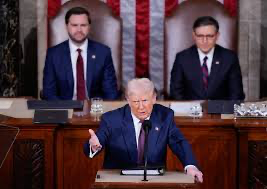
State of the Union: Trump expected to tout achievements ahead of midtermsPresident Donald Trump will make his case during Tuesday’s State of the Union address to Americans amid controversy over his domestic and foreign policies.
President Trump on Tuesday will address a joint session of Congress, where he will reflect on the first year of his second term in the White House, report on the state of the union and lay out his vision for what’s ahead.
The president’s approval numbers have noticeably dropped since the American people voted to send the president back to Washington.
Shortly after Trump took office in 2025, the president’s approval rating hovered around the 50 percent mark, according to the Decision Desk HQ polling average. Today, it sits at just less than 42 percent.
Americans have soured on the president across demographics; but, among young voters in particular, Trump’s approval ratings have fallen. Immigration, similarly, stands out as an issue on which Americans are increasingly losing faith in the president’s vision.
Here’s a look at Trump’s standing in recent polls, ahead of his State of the Union address Tuesday evening.
Overall approval
A recent CNN poll, conducted by SSRS, shows Trump’s approval rating fell 11 points from last year — from 47 percent to 36 percent.
Two other recent polls — one from The Washington Post/ABC/Ipsos and another from NPR/PBS/Marist Poll — found Trump’s approval rating down 6 points from shortly after taking office.
Both polls found 39 percent of Americans approve of Trump’s handling of the presidency, down from 45 percent shortly after he took office.
CNN’s polling found less than a third of respondents say Trump has the right priorities for the country — a 13-point drop from last February. Meanwhile, more than two-thirds say Trump hasn’t paid enough attention to the country’s most important problems, an increase from 55 percent last February.
In the latest Post/ABC/Ipsos poll, fewer people say Trump has acted within his authority as president, dropping from 40 percent last February to 33 percent today. Similarly, 65 percent say he’s gone beyond his authority, up from 57 percent last February, around a month after taking office.
It’s standard for approval ratings to fall in the year after getting elected. In CNN’s polling, former President Biden’s approval rating fell 10 points in his first year, from 51 percent to 41 percent, ahead of his first address to Congress.
By age
Trump has arguably seen the most dramatic fall in approval among young voters, who supported the Republican presidential candidate at the highest rate in recent history.
In the latest CNN polling, adults ages 50-64 are the sole age group that show no statistically significant change in support for the president.
Those ages 18-34 expressed a decline in support by 16 percentage points, from 41 percent last year to 25 percent today. Similarly, among those ages 35-49, approval is down 14 points from last year, to 35 percent today. And among seniors, approval of the president has declined 11 points, from 53 percent to 42 percent.
The NPR/PBS/Marist Poll survey found similar results among young Americans.
Among adults 18-29, Trump’s approval is 30 percent, down 10 points from last year. Meanwhile, approval has declined by 3 points among adults ages 30-44; by 4 points among adults ages 45-59; and by 6 points among adults ages 60 or older.
By party
The latest polls show mixed results on approval ratings across parties.
CNN’s latest poll shows a 6-point decline in approval among both Republicans and Democrats — with 82 percent of the former and 5 percent of the latter now backing the president.
Approval among independents, however, dropped by a whopping 17 percentage points in CNN’s polling, from 43 percent in February 2025 to 26 percent this February.
NPR’s polling saw similar numbers for the two major parties — with support among Republicans dropping 3 points to 85 percent and support among Democrats dropping 5 points to 8 percent. But among independents, whose support in NPR’s poll last year already hovered around 34 percent, support declined by just 4 points in the latest survey.
Race and education level
Across race and education levels, approval declined relatively consistently across subgroups. In CNN’s poll, approval among white Americans declined by 10 points, to 45 percent. Among people of color, support dropped by 13 points, to 23 percent.
Approval among college graduates is down 12 points in CNN’s poll, while approval among non-college graduates declined by 10 points.
NPR’s polling shows those with a college degree and those without a college degree souring on the president by 6 points.
On immigration
Trump’s overall approval rating on immigration dropped 10 points in the Post’s survey, to 40 percent.
Trump saw a similar 10-point uptick in those who say he is “going too far” in “deporting undocumented immigrants” — with 58 percent now holding this view, up from 48 percent last April.
This shift largely happened in the last few months. In late October, only 50 percent of respondents held this view.
Approval of the “immigration situation at the U.S.-Mexico border” is Trump’s strongest category in the Post’s poll, at 47 percent approval. The question was not asked last year.
On the economy
Trump’s overall approval on the economy dropped 4 points, in the latest Post poll, from 45 percent last year to 41 percent today.
The latest NPR/PBS/Marist Poll has Trump’s approval on the economy down 3 points, from 39 percent last April to 36 percent today
The Post found 32 percent of Americans approve of Trump’s handling of inflation — a data point not included in last year’s survey. The result, however, is consistent with Biden’s previous performance on inflation when it was last surveyed in 2024.
Trump’s approval rating on tariffs has been consistent at 34 percent, according to the Post.
On foreign policy
In the Post’s poll, the share of those who say they approve of Trump’s handling of relations with other countries dropped 3 points to 35 percent this year.
In the NPR/PBS/Marist poll, Trump’s approval rating on his handling of foreign policy similarly dropped 3 points from 39 percent last April, to 36 percent today.
THE HILL
