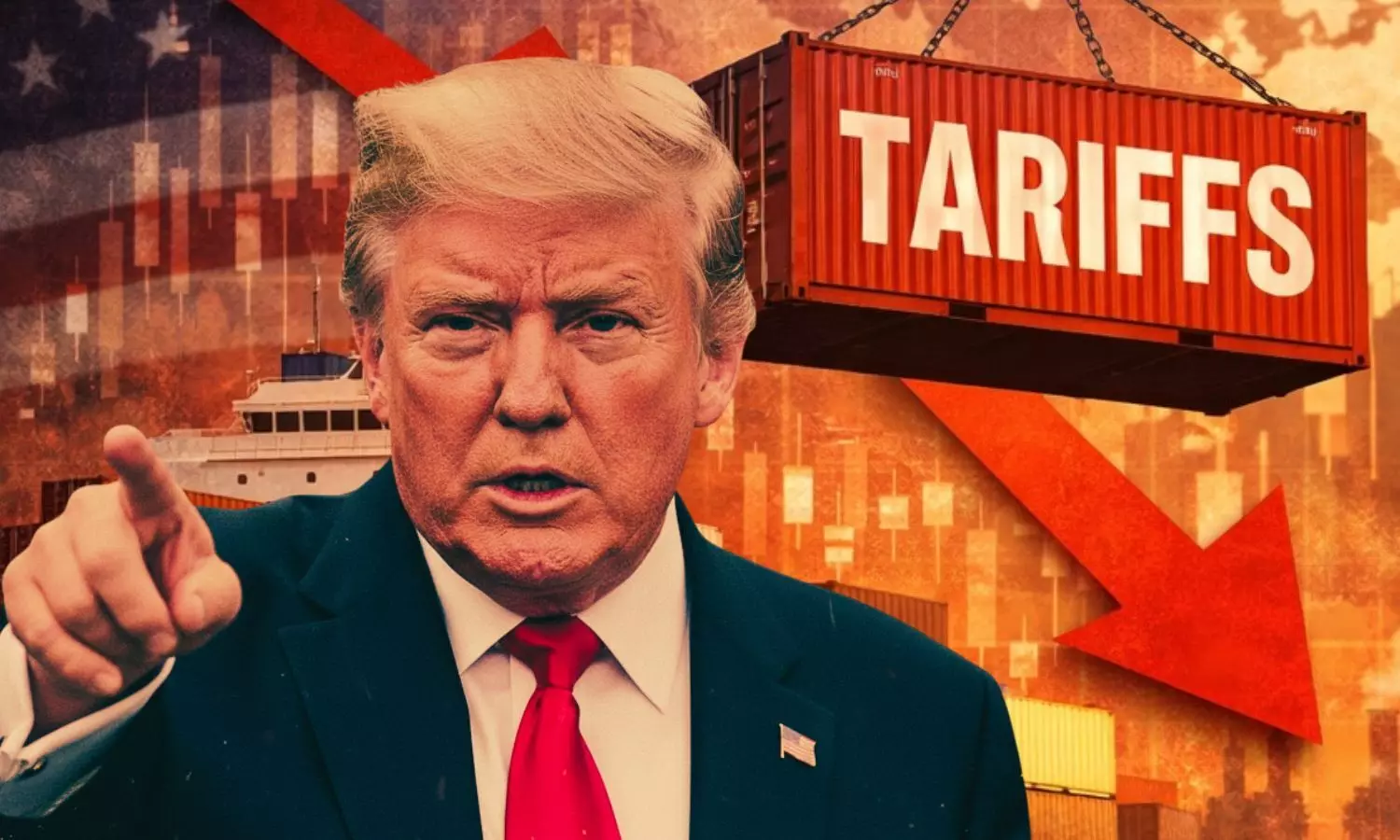
Historically tariffs never worked for America. The Great Depression of the 1930’s is a solid proof that tariffs damage the economy, according to analysts
President Donald Trump’s latest decision to reimpose tariffs worldwide is as much a political signal as it is an economic policy. In the face of a U.S. Supreme Court ruling that struck down large portions of his earlier emergency tariff actions, Trump moved swiftly to assert control. He has long characterised duties as central to his trade strategy, famously describing the word tariff as the most beautiful word in the english dictionary. The repeated imposition, adjustment and expansion of these levies has made Trump’s tariffs a defining, and divisive, element of his second‑term economic posture.
In a statement following the Supreme Court’s ruling, the White House framed its actions as necessary to address fundamental imbalances in the U.S. economy. The administration invoked Section 122 of the Trade Act of 1974, an authority rarely used by any US President, to impose a temporary import duty on a wide range of goods. According to the proclamation, the move was designed to help rebalance trade relationships to benefit American workers, farmers, and manufacturers and to address what the administration described as a serious balance‑of‑payments deficit.
Under this authority, the U.S. initially set a 10 % tariff on most imports from all trading partners effective 24 February 2026 at 12:01 a.m. Eastern Standard Time. This levy was scheduled to remain in place for up to 150 days unless extended with congressional approval.
Shortly after imposing the 10 % baseline, the administration announced that the rate would be raised to 15 %, the maximum allowed under Section 122. This sudden move followed the Supreme Court’s decision with the explicit aim of maintaining broad import duties despite the legal setback.
Section 122 of the Trade Act of 1974 allows the President to impose temporary tariffs up to 15 % for 150 days to address sudden and serious balance‑of‑payments issues, but it has never been used in modern history until now. Historians and trade lawyers point out that since its enactment, no President had invoked this provision to levy broad tariffs on most imports.
The statute was originally drafted in an era when the U.S. economy operated under very different global financial conditions. Critics note that whether the current economic situation satisfies the legal prerequisites of Section 122 is a subject of debate, and further legal challenges may arise.
GREAT CONFUSION
Despite official statements, there remains great uncertainty about the exact reach and application of Trump’s tariffs. While the 15 % surcharge is described as global in scope, overlapping trade rules and exemptions have created a murky environment. For instance: Certain categories of imports — such as critical minerals, energy products, pharmaceuticals and some electronics — are exempted from the Section 122 levy.
A central justification for Trump’s tariffs is to reduce the U.S. trade deficit — the amount by which imports exceed exports — and, implicitly, to strengthen domestic industry. Yet, recent data show that the U.S. trade deficit remains high, and in some measures has widened. Economists note that broad tariffs alone are unlikely to reverse entrenched trade imbalances, and may even increase costs for American consumers and firms that rely on imported inputs.
TARIFFS RAISE THE COST TO AMERICAN CONSUMERS
In practice, tariffs raise the cost of foreign goods, which can feed into higher prices domestically and reduce purchasing power. Some sectors of the American economy that depend on global supply chains report higher input costs and logistical pressures. These outcomes raise questions about the effectiveness of Trump’s tariffs as a tool for sustainable economic growth.
Tariffs Hurting America Too
The impacts of Trump’s tariffs are not confined to foreign exporters. Domestic American producers who rely on imported components face increased costs, slowing investment decisions and complicating production plans. Retailers report that higher tariffs feed through to consumer prices, eroding demand in a fragile economic climate.
Financial markets have reacted with caution, as businesses reassess long‑term plans in light of uncertain tariff outlooks. Analysts warn that tariff volatility could reduce capital expenditure and dampen broader economic confidence illustrating that the policy designed to protect American interests may also create economic headwinds at home.
Impact on India‑U.S. Trade Negotiations
The reverberations of Trump’s tariffs have also hit India hard. India and the United States postponed a planned three‑day meeting of trade negotiators that was scheduled to begin in late February, primarily due to uncertainty surrounding the tariff regime following the Supreme Court’s ruling and the subsequent reimposition of duties. Officials from both countries indicated that they would reconvene after fully assessing the developments.
PROBE
