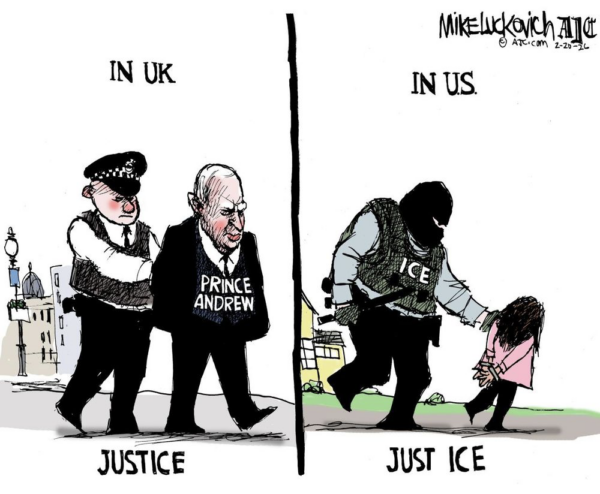
A BBC cartoon highlighting the growing international perception that justice in the United States stops at the doors of power. Justice for the powerful has become optional.
When Power Becomes a Get-Out-of-Jail Card, Justice Dies
By Ya Libnan Editorial Board
The arrest of Britain’s Prince Andrew did more than embarrass the royal family. It delivered a devastating indictment of the United States—a country that endlessly lectures the world about justice while shielding its own elites from it.
In Europe, prosecutors acted. In America, excuses prevailed.
The criminal empire of Jeffrey Epstein thrived largely on U.S. soil. Underage girls were trafficked, abused, silenced, and discarded while powerful men boarded private jets, attended lavish parties, and returned safely to positions of influence. Yet in the end, only Ghislaine Maxwell went to prison.
Not one powerful American man followed.
Epstein’s network included presidents, billionaires, celebrities, and corporate titans. Figures such as former president Bill Clinton and Microsoft co-founder Bill Gates saw reputations bruised—but reputational damage is not justice. It is cosmetic accountability, designed to fade with time.
What truly shocked the nation was not what prosecutors did—but what they refused to do.
Deputy Attorney General Todd Blanche recently declared that after reviewing the Epstein files, the Justice Department found nothing that justified further prosecutions.
Nothing.
No charges. No indictments. No names. No trials.
This is not a failure of evidence. It is a failure of will.
Members of Congress from both parties have said what millions of Americans already know. Representative Nancy Macesaid plainly that the United Kingdom has done more to prosecute Epstein predators than the United States itself.
“A nation that allows the powerful to escape justice,” she warned, “is not a nation of laws—it is a nation of exceptions.”
Her colleague Thomas Massie called for immediate action from Attorney General Pam Bondi and FBI Director Kash Patel. So far, silence.
Then came the moment that stripped away any remaining illusion.
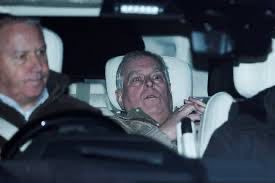
Andrew Mountbatten Windsor, younger brother of Britain’s King Charles, formerly known as Prince Andrew, leaves Aylsham Police Station on a vehicle, on the day he was arrested on suspicion of misconduct in public office, after the U.S. Justice Department released
President Donald Trump, speaking aboard Air Force One, called Prince Andrew’s arrest “a shame”—mourning the damage done to the royal family. No mention of victims. No condemnation of abuse. Only sympathy for power, from a man who himself once socialized with Epstein.
That is the moral rot.
In America today, justice is aggressively enforced against the weak and endlessly negotiated for the powerful. If you are poor, punishment is swift. If you are rich, famous, or connected, the law becomes flexible, patient, and forgiving.
This is not justice. It is class privilege enforced by silence.
The victims of Epstein were not abstract names in a file. They were children—many from broken homes, lured by lies, coerced by money, and crushed by a system that decided their suffering was inconvenient.
When a nation chooses to protect predators rather than confront them, it forfeits its right to speak of morality.
When prosecutors fear power more than injustice, the rule of law becomes theater.
And when shame attaches only to exposure—not to crime—then fame and shame truly become the same.
America does not suffer from a lack of evidence.
It suffers from a lack of courage.
And until the powerful are held to the same standard as the powerless, justice in America will remain selective—and therefore unjust.
