You Cannot Be a Peacemaker While Siding With the Aggressor
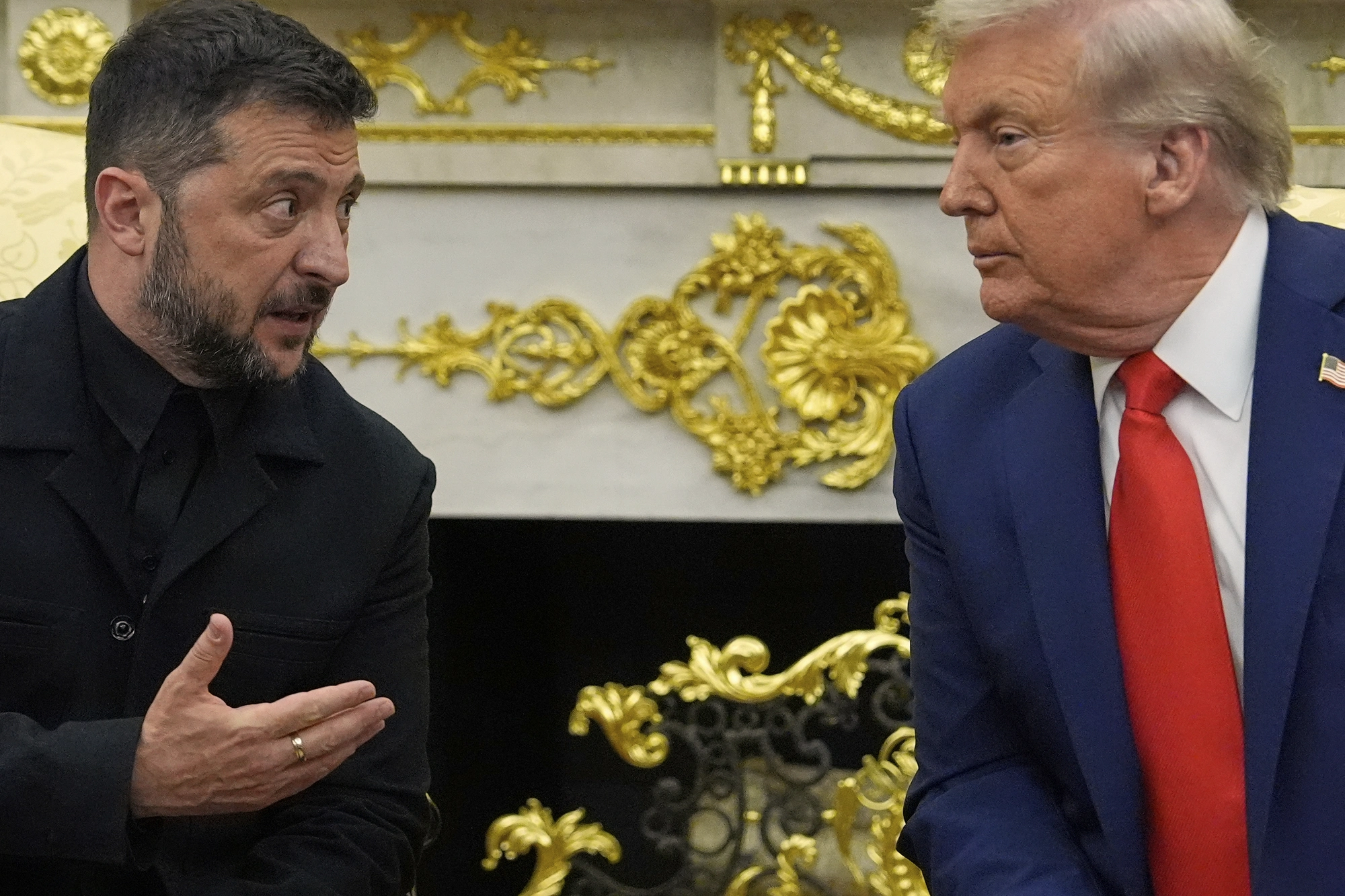
File photo- President Donald Trump and his Ukrainian counterpart president Volodymyr Zelenskyy. . Zelenskyy said Saturday as he addressed the Munich Security Conference that Washington too often asks Kyiv to make concessions in peace talks but not Russia,
By Vlad Green, Op. Ed.
The United States cannot credibly claim to defend democracy, sovereignty, and international law while repeatedly pressuring the victim of aggression to make concessions—and sparing the aggressor from accountability. That imbalance was laid bare by Ukraine’s president, Volodymyr Zelenskyy, when he addressed the Munich Security Conference.
“Washington too often asks Kyiv to make concessions in peace talks,” Zelensky warned, “but not Russia.”
That statement captured the core injustice of today’s diplomacy. Ukraine is asked to give up land, security, and its future, while Russia—the country that launched an unprovoked invasion—is asked to give up nothing.
This moral imbalance is reinforced by the conduct and rhetoric of key U.S. intermediaries. Steve Witkoff has repeatedly spoken admiringly of Vladimir Putin, calling him a “great guy,” “super smart,” and insisting, “I don’t regard Putin as a bad guy.” He even claimed, “I liked him. I think he was honest.”
Such statements are not harmless personal impressions. They legitimize an autocrat who has bombed cities, abducted Ukrainian children, and attempted to erase a sovereign nation from the map.
Ukrainians were understandably alarmed. Zelensky said his people were “very disturbed” by Witkoff’s remarks and believed they reflected the influence of Russian disinformation. Journalist Stephen Pollard put it bluntly: Witkoff may mean well, but he is dangerously outmatched by a former KGB officer who views diplomacy as psychological warfare.
Those fears were confirmed in April 2025 when Witkoff met Putin in Moscow without bringing his own interpreter, relying instead on Kremlin-provided translators—an extraordinary lapse that handed narrative control to the very regime Ukraine is fighting.
Worse still, on November 19, 2025, Axios revealed that Witkoff had co-drafted a 28-point U.S. “peace plan” with Russian envoy Kirill Dmitriev. The proposal demanded that Ukraine cede territory, cap its military, and permanently renounce NATO membership. Russia, meanwhile, was asked for no comparable sacrifice.
This is precisely the imbalance Zelensky warned about in Munich: concessions demanded from Kyiv, indulgence granted to Moscow.
The pattern extends beyond Witkoff. Jared Kushner, who played a key role in shaping Trump-era foreign policy, helped secure Russia’s cooperation during the 2016 election and remains influential in Trump–Putin relations. The throughline is unmistakable—accommodation of Russia at the expense of allies.
Peace built on injustice is not peace. It is surrender.
Ukraine did not start this war. Ukraine did not violate borders or commit mass atrocities. Russia did. If the United States continues to pressure Ukraine to yield while excusing Russian aggression, it will not only betray Ukraine—it will teach every authoritarian ruler that conquest works.
Zelensky’s message in Munich was clear: fairness is not optional. And history will judge America by whether it stood with the victim—or negotiated on behalf of the villain.
