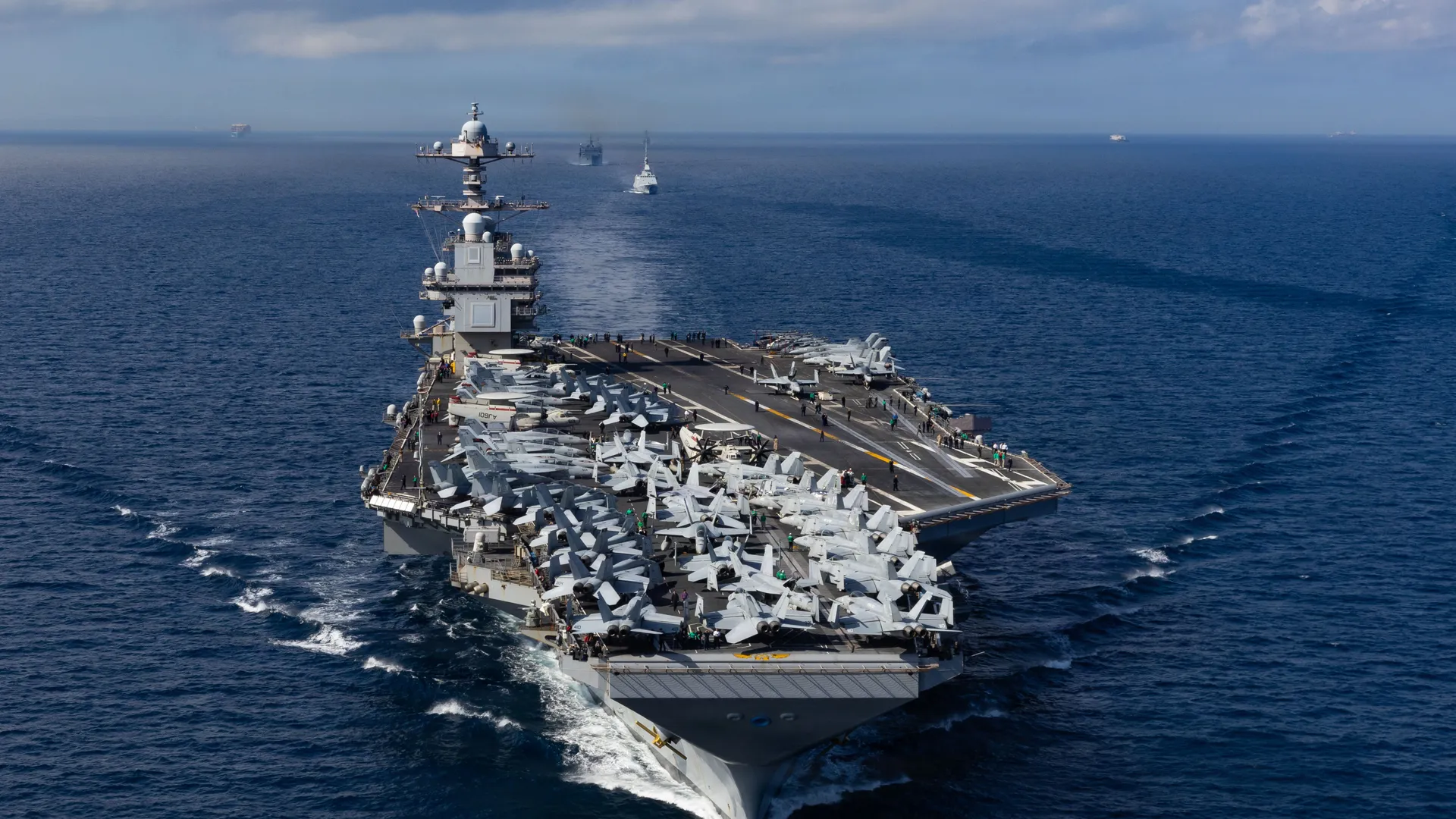
President Trump ordered the Pentagon to send the USS Gerald R. Ford aircraft carrier and its strike group to the Middle East to boost U.S. forces in the region amid tensions with Iran, two U.S. officials confirmed.
Why it matters: The move will increase the pressure on Tehran during the nuclear negotiations with the Trump administration, making the U.S. military threat even more menacing.
- The Ford, which is now in the Caribbean, will need three or four weeks to arrive in the region. That’s in line with the timeline Trump mentioned on Thursday, when he claimed he wanted to finalize a deal next month and would change course if no agreement could be reached.
- The Ford, America’s largest warship, will join the USS Abraham Lincoln and its strike group, which includes fighter jets, Tomahawk missiles and several ships. The U.S. had two carriers in the region during much of the war in Gaza.
Trump told Axios on Tuesday ahead of his meeting with Israeli Prime Minister Benjamin Netanyahu that he was considering sending another aircraft carrier to the region.
- He made the final decision to send the Ford after that meeting, a source with knowledge said. The decision to send the Ford to the region was reported first by the New York Times.
- A U.S. official said Trump and Netanyahu decided in their meeting to continue putting pressure on Iran while negotiations take place.
- Before returning to Israel, Netanyahu said he remained skeptical a deal could be reached, but that Trump was more optimistic.
- “I said that any agreement must include … not just the nuclear issue, but also the ballistic missiles and the Iranian proxies in the region,” Netanyahu said.
- Trump has signaled that the nuclear issue is his top priority, though he also told Axios the deal should cover missiles.
Talking to reporters in the Oval Office on Thursday, Trump said Iran has to make a deal, “otherwise it is going to be very traumatic.”
- Trump said he will hold talks with Iran “for as long as I like,” but stressed he wants to get a deal within the next month. “It should happen quickly. They should agree very quickly.”
What to watch: It’s unclear how the decision to send a second aircraft carrier might influence Iran’s willingness to compromise.
- The Iranians have said publicly several times in recent weeks that they will not negotiate under the threat of a U.S. military strike.
- A second round of talks is expected next week, but no official date has been set.
Trump sent the Ford to the Caribbean in November as part of the operation that led to the capture of Nicolás Maduro.
- Adm. Daryl Caudle, the chief of U.S. naval operations, in January told reporters the Ford is an “invaluable option” but stressed he did not want to overwork the warship and its crew.
- “I am a big non-fan of extensions, because they do have significant impact,” he said at the time.
- AXIOS
