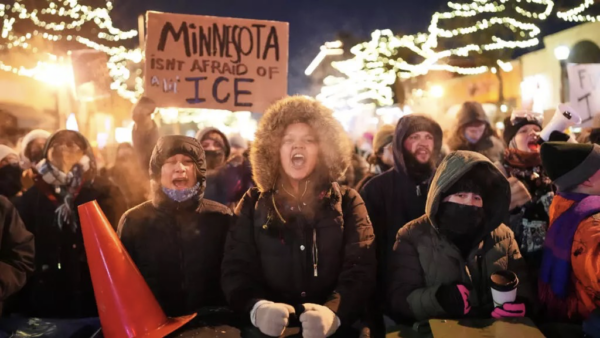
Protesters chant and bang on trash cans as they stand behind a makeshift barricade during a protest in response to the death of 37-year-old Alex Pretti, who was fatally shot by a US Border Patrol officer earlier in the day on January 24, 2026, in Minneapolis. © Adam Gray, AP
US President Donald Trump’s mass deportation programme has given rise to a social media spectacle of shaved and shackled detainees being rounded up by force. But on the streets of Minneapolis and Saint Paul, thousands of locals have launched their own campaign to document ICE’s often-violent operations, filming masked immigration agents wherever they go.
By: Paul MILLAR
On the streets of the Twin Cities, Minnesotans have turned the surveillance state inside out. As thousands of masked, armed and armoured Immigration and Customs Enforcement (ICE) agents continue to seize and detain people accused of lacking the legal status to live and work in the US, they find themselves followed and filmed at every turn by thousands of volunteers monitoring their every move.
Bound by the hope that the weight of public scrutiny will keep their neighbours safe from harm, these observers have taken to the streets to record and document the massive ICE deployment dubbed “Operation Metro Surge”, a weeks-long action that has sent some 3,000 federal agents to the North Star state.
Since December, these officers have arrested around 3,400 people through traffic stops as well as militarised raids on homes and workplaces. Many of those taken have been sent to an overcrowded detention centre on the other side of the country in Texas.
By holding these faceless agents fixed in a smartphone’s unflinching eye, many of those mobilising on the streets of Minneapolis and Saint Paul hope to one day hold their agencies accountable for their actions.
These observers are only the most visible sign of a surge in non-violent resistance to ICE’s operations that has brought community and faith-based organisations, trade unions and centres for immigrant workers together in response to the raids.
As workers stay home for fear of being stopped by ICE during their commute and schools switch to remote learning as parents pull their children from class, many of these groups have set up mutual aid networks to deliver groceries and supplies straight to their doors.
Chelsie Glaubitz Gabiou, the president of the Minneapolis Regional Labor Federation that brings together unions representing some 80,000 workers, said that Minnesotans’ readiness to turn out in force has its roots in the widespread demonstrations that followed the 2020 police killing of an unarmed black man, George Floyd.
“This isn’t the first time Minneapolis has had to respond in a powerful way under the watchful eye of the entire nation,” she said. “We’re coming up on six years now, almost, of the murder of George Floyd in our communities, and we were just getting back to vibrancy and feeling like we had rebuilt from that crisis.”
Glaubitz Gabiou said the aftermath of Floyd’s murder laid the groundwork for how Minnesota residents would organise in the future.
In the years since, “our community groups, our unions have never ceased to continue to try to work together and create inflection points”, she explained. “So we have a high level of trust. We don’t all agree on everything that we’re working on together here, but we know we cannot be fractured – and that we have to do this together.”
Somewhere between 50,000 and 100,000 people took part on Friday in what some organisers – though not the unions, many of whom have “no-strike” clauses in their collective bargaining agreements – dubbed a general strike following the fatal shooting of poet and mother Renee Good. Some 700 hundred businesses also closed their doors for the day of action.
Truth as a weapon
ICE agent Jonathan Ross shot Good three times as she drove away from a traffic stop – a shooting that quickly spread across social media, filmed from several different angles.
As the ICE operation drags on, unions and community organisations continue to organise regular trainings on nonviolent direct action, as well as “constitutional observer” trainings that encourage participants to document law enforcement interactions – without, the trainers stress, obstructing or escalating the situation
Glaubitz Gabiou said that the urgency of recording what was happening on the streets was hammered home during the starkly partisan coverage of the protests that followed Floyd’s killing.
“There have been a lot of untruths, even going back to George Floyd and a lot of things that have happened in our community without the cameras rolling,” she said. “And so now that the cameras are rolling … this is about people telling the truth. People are making up lies … they’re trying to make you not believe what you’re seeing with your own eyes – and it cost a life. But we need to tell people, ‘Believe what you are seeing. This is what is happening.’ And that person should still be here with us today.”
That person, of course, is Alex Pretti. Pretti, a registered intensive care nurse at the Minneapolis Veterans Affairs hospital and a member of the American Federation of Government Employees union, was shot dead by a federal Border Patrol officer on Saturday while filming ICE agents with his phone.
After standing between a woman and the agent that pushed her down, Pretti was dragged to the ground, disarmed of the handgun he was legally entitled to carry and shot 10 times.
“Our union members and our workers are a part of this amazing, beautiful constitutional observer network that is out filming what is happening in our communities – and it got one of our union members killed on Saturday,” Glaubitz Gabiou said.
Video evidence of Alex Pretti’s killing contradicts Trump administration’s account
In the wake of Pretti’s killing, senior figures within the Trump administration insisted the agents had been acting in self-defence. Department of Homeland Security Secretary Kristi Noem and White House deputy chief of staff Stephen Miller, a staunch advocate for militarised mass deportations, both accused Pretti of being a “domestic terrorist” without offering any evidence to support their claims.
Then commander-at-large for the US Border Patrol, Gregory Bovino, accused Petti of attempting to “massacre” the ICE agents. As more and more footage of the shooting made its way onto social media, these claims quickly fell apart. Bovino was later transferred from Minneapolis.
Stephanie Schwartz, assistant professor of international relations at the London School of Economics and Political Science, said that on-the-ground efforts to record ICE’s often brutal encounters with the public might not necessarily find the audience they needed.
“I think we need to be mindful of what we see, what is algorithmically put on my feed and other’s feeds, and how we already know – and there’s been reporting – on how some of those images have been altered.
Not only are today’s algorithms highly personalised, she notes, but fake images made with AI are more prevalent than ever.
“So we don’t necessarily know what different audiences are seeing,” she said.
“There is an effort from folks on the ground in Minnesota – and this is so exceptionally important – to provide that kind of … truth of images and description of what is actually happening, contrary to some of the distorted images that have been circulated, including by government accounts.”
Consolidating executive power
The footage of federal immigration agents shooting two people dead seems to have fuelled more significant opposition to Trump’s agenda. Senate Democrats have said they will not vote for a spending bill this week that would further fund the Department of Homeland Security, which oversees both ICE and CBP.
Blocking the package would lead to a partial government shutdown – although both agencies would likely continue operating, with last year’s “One Big Beautiful Act” having already allocated $170 billion over four years for immigration enforcement.
A drawing of Alex Pretti is displayed at the scene where 37-year-old Pretti was fatally shot by a US Border Patrol officer over the weekend, Tuesday, January 27, 2026, in Minneapolis. © Julia Demaree Nikhinson, AP
Schwartz said that despite the deepening public backlash to Trump’s high-profile campaign of mass deportations, the administration’s continued efforts to swell the ranks and budget of ICE was not just about cracking down on undocumented migrants.
“The question of whether that spectacle is backfiring for the administration – I don’t think so,” she said. “I think that if we take a step back and look at what the goals are here, it’s to consolidate executive power. And they’ve consolidated executive power in a number of other ways that are unrelated to immigration. But what immigration does through organisations or arms of the federal government, like Customs and Border Protection and ICE, is give them coercive power and the threat of the use of force.”
She cited a letter from Attorney General Pam Bondi to Minnesota Governor Tim Walz, urging him to allow the Department of Justice access to the state’s voter rolls in return for putting an end to ICE’s crackdown. Critics say voter data could be used to cast doubt on future election results or disenfranchise certain voters.
While resisting at the grassroots level is important, Schwartz said, more action is needed among the political class.
“What we need is leadership to attenuate the broader structure of how the executive is using ICE and immigration enforcement to consolidate power,” Schwartz said. “So, for example, that starts with funding for ICE and an evaluation of ICE’s mission. I wouldn’t say that [the public response in Minnesota] is not an important counterweight – it’s an absolute necessity. But it is not sufficient with these broader patterns in mind.”
In the Twin Cities, the struggle continues. Glaubitz Gabiou said that Pretti’s killing had only galvanised a public already set on holding ICE to account for a crackdown that has now claimed the lives of at least two Minnesotans.
“It’s having the opposite of a chilling effect,” she said. “After the murder of Renee Good, the desire for our non-violent direct-action trainings and our constitutional observer trainings went through the roof. We are training thousands of people across this community every day, and as quickly as we can get the trainings up and staffed and posted, they are filling up.”
The momentum is on the side of the protesters, she said.
“I think this is why you’re starting to see some of the cracks in the administration now – because we just are not stopping.”
FRANCE24/AFP
