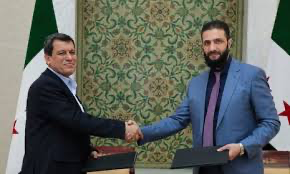
Syrian interim President Ahmed al-Sharaa with Syrian Democratic Forces (SDF) chief Mazloum Abdi after the signing of an agreement in Damascus on March 10, 2025. (AFP)
The deal is a major blow to Kurdish aspirations and hopes to preserve the de facto autonomous administration built during Syria’s civil war
Syrian President Ahmed al-Sharaa announced an agreement with Kurdish fighters on Sunday, after launching an offensive against areas under their control in the country’s north and east.
The 14-point agreement provides for a ceasefire between the Syrian army and the Kurdish-led Syrian Democratic Forces (SDF).
Here’s what we know about the deal:
The agreement stipulates the integration of the Kurdish forces — numbering nearly 100,000, according to the Kurds — into the Syrian army and security forces.
The two sides had signed an agreement in March to integrate Kurdish civil and military institutions into the state, but failed to agree on its implementation.
Under Sunday’s deal, the SDF will be integrated into the defense ministry while the Kurdish security forces will join the interior ministry.
But while the Kurds had insisted during negotiations that their forces remain in separate units based in their areas, the latest agreement stipulates they will be integrated “on an individual basis”.
The fate of the all-female Women’s Protection Units was unclear, as the Syrian army and security forces do not include women.
Sharaa said on Sunday that “in certain sensitive regions, the security personnel will be from those regions in order to prevent tensions”.
The agreement stipulates that the Kurds will immediately hand over to the government the administration of the Deir Ezzor and Raqa provinces, which are predominantly populated by Arabs and have been under Kurdish control.
The Syrian government is also taking immediate control of border posts and oil and gas fields throughout Kurdish-controlled territory.
The text also outlines the “integration of all civil institutions” in the Kurds’ stronghold of Hasakeh province into the state. Sharaa is set to issue a decree appointing a governor for the province — likely to be Kurdish.
The SDF leadership will submit candidates for “senior military, security and civil positions”.
The agreement also stipulates that the Syrian state will become responsible for Islamic State group prisoners.
Supported by the United States, the SDF spearheaded the fight against IS, and the group’s defeat in Syria in 2019 enabled the Kurdish-led fighters to take control of more territory.
Years after the defeat of IS, camps and prisons run by the Kurdish administration in northeast Syria still house tens of thousands of suspected fighters and their relatives, including many foreigners.
The deal is a major blow to Kurdish hopes to preserve the de facto autonomous administration built during Syria’s civil war, including institutions that administered and controlled parts of the north and northeast.
The agreement also ends Kurdish aspirations for decentralised rule, despite their earlier insistence on the issue during negotiations with Damascus.
Before announcing the deal, Sharaa issued a decree on Friday recognising the national rights of the Kurdish minority, making their language official and granting Syrian nationality to some members who had been deprived of it in the past.
The Kurds said the announcement fell short of their expectations.
BARRONS / AFP
FULL TEXT OF SYRIA – SDF DEAL (translated from Arabic )
Ceasefire and Full Integration Agreement
1: A comprehensive and immediate ceasefire on all fronts and points of contact between the Syrian government forces and the Syrian Democratic Forces (SDF), in parallel with the withdrawal of all SDF military formations to the area east of the Euphrates as a preliminary step for redeployment.
2: The immediate and complete administrative and military handover of the governorates of Deir ez-Zor and Raqqa to the Syrian government. This includes the handover of all civilian institutions and facilities, with the immediate issuance of decrees to confirm the employment of current staff within the relevant ministries of the Syrian state. The government commits to not targeting SDF employees and fighters, or the civilian administration in the two governorates.
3: The integration of all civilian institutions in the Hasakah governorate into the Syrian state institutions and administrative structures.
4: The Syrian government’s takeover of all border crossings and oil and gas fields in the region, and their protection by regular forces to ensure the return of resources to the Syrian state
5: Integrating all military and security elements of the SDF into the structures of the Syrian Ministries of Defense and Interior on an individual basis, after conducting the necessary security vetting, while granting them military ranks and the corresponding financial and logistical entitlements, and protecting the autonomy of the Kurdish regions.
6: The SDF leadership commits to not incorporating remnants of the former regime into its ranks and to submitting lists of officers from the remnants of the former regime present in the areas of northeastern Syria.
7: Issuing a presidential decree appointing a candidate to the position of governor of Hasakah, as a guarantee of political participation and local representation.
8: Removing the heavy military presence from the city of Ain al-Arab/Kobani, forming a security force from the city’s residents, and maintaining a local police force administratively subordinate to the Syrian Ministry of Interior.
9: Integrating the administration responsible for the file of ISIS prisoners and camps, in addition to the forces responsible for protecting these facilities, with the Syrian government, so that the Syrian government assumes full legal and security responsibility for them.
10: Adopting the list of nominated leaders submitted by the SDF leadership to fill senior military, security, and civilian positions in the central state structure to ensure national partnership.
11: Welcoming Presidential Decree No. 13 of 2026, which stipulates the recognition of Kurdish cultural and linguistic rights, and addresses the legal and civil issues of unregistered persons and the restoration of property rights accumulated from previous decades.
12: The SDF commits to expelling all non-Syrian leaders and members of the PKK from the borders of the Syrian Arab Republic to ensure sovereignty and the stability of the region.
13: The Syrian state commits to continuing the fight against terrorism (ISIS) as an active member of the international coalition, in joint coordination with the United States in this regard, to ensure the security and stability of the region.
14: Working to reach understandings regarding the safe and dignified return of the residents of the Afrin and Sheikh Maqsoud areas to their homes.
President of the Syrian Arab Republic
Ahmed al-Sharaa
Commander of the Syrian Democratic Forces
Mazloum Abdi
