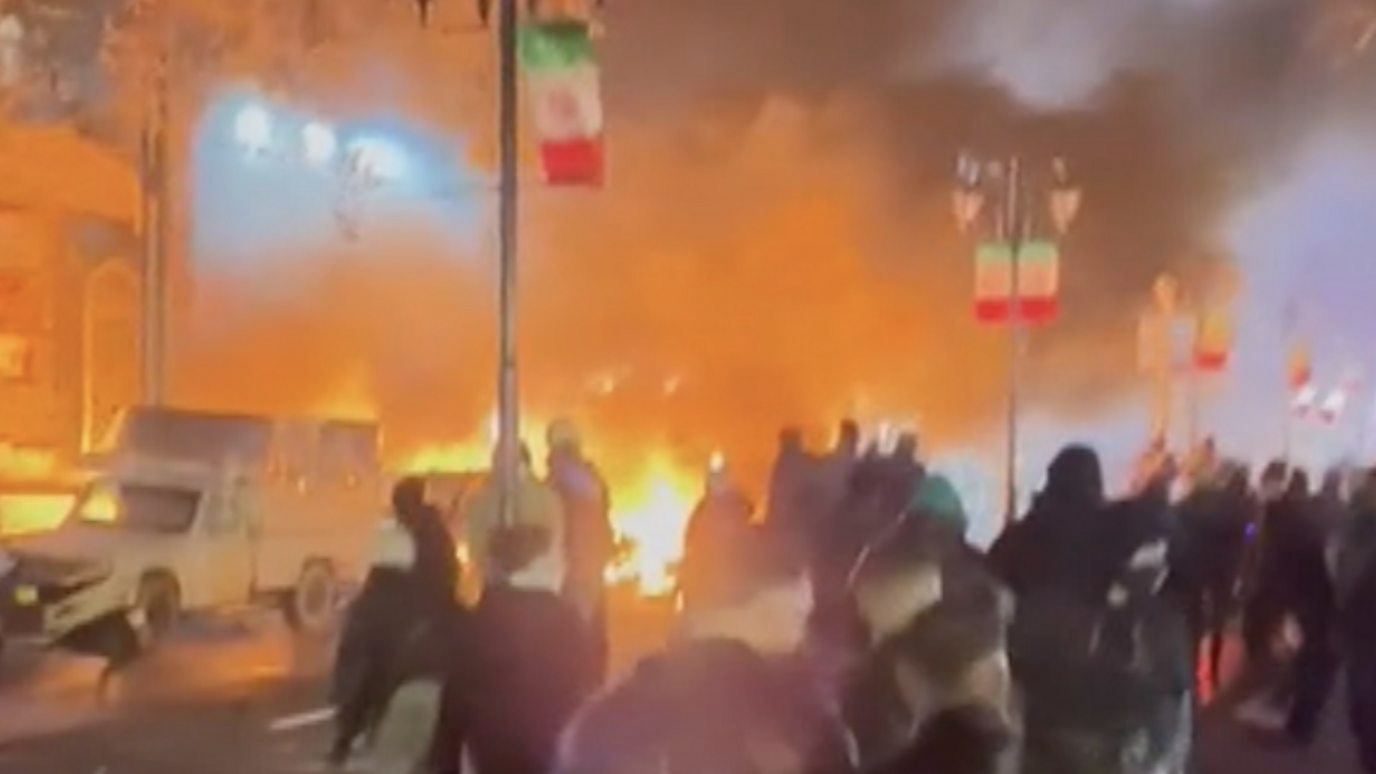
FILE: Protesters in Iran set buildings on fire
For almost two weeks, Donald Trump has seemed on the verge of intervening in Iran.
From his January 2nd threat to come to the “rescue” of protesters if the Iranian authorities used violence against them, to his promise this week that “help is on its way,” the US president has sounded resolute.
On Tuesday, a CBS journalist covering the president’s visit to Detroit asked how Mr Trump would respond if the Iranian authorities started to execute detainees.
Iranian activists said the family of Erfan Soltani had been told the 26-year old shopkeeper had been sentenced to death for participating in the protests.
“If they do such a thing, we will take very strong action,” the president replied, saying his endgame in Iran was “to win”.
Throughout Wednesday, there were growing signs that US military action might be imminent.
American, Qatari and British personnel stationed at the giant Al-Udeid air base in Qatar were being relocated.
US embassy staff and civilians in Saudi Arabia were told to remain vigilant, recalling similar instructions last June, hours before US bombers attacked Iran’s nuclear facilities.
Amid reports of airspace being closed and flights cancelled, it appeared that the coming hours would bring word of American strikes. The only question seemed to be how big.
But then, speaking to reporters at the White House mid-afternoon, Trump suddenly changed his tune.
“We’ve been told that the killing in Iran is stopping,” he said. “And there’s no plan for executions… I’ve been told that on good authority.”
The president did not reveal the nature of the good authority, except to say that the information had come from “very important sources on the other side”, and that the US had been given “a very good statement by people that are aware of what’s going on”.
But has the moment of crisis passed, or is this just a pause?
Trump clearly has not ruled out military action. He said he was going to “watch and see what the process is”, before deciding what to do next.
In Washington, there are plenty of voices urging caution.
“US military action taken under the premise of helping these protesters risks doing the opposite: silencing an organic movement, strengthening the regime’s narrative, and inflicting civilian harm,” Gregory Meeks, the ranking Democrat on the House Foreign Affairs Committee warned in a statement.
Reports from the Gulf suggested that some of Washington’s allies, including Saudi Arabia, Qatar and Oman, also harbor grave misgivings about the likely impact of US military intervention.
Saudi Arabia and Qatar have both found themselves in the crosshairs of Iranian retaliation in the past.
In 2019, Iran fired drones and cruise missiles at Saudi Arabia, hitting key oil facilities and temporarily halving the kingdom’s oil production. Iran denied being involved, saying the attack was carried out by the Houthis in response to Saudi Arabia’s military involvement in Yemen.
Saudi’s allies, including the US, France, Germany and Britain all agreed that Tehran was responsible.
On 23 June last year, Iran fired a number of medium-range ballistic missiles at Al-Udeid in response to the US attack on Iran’s nuclear facilities the day before.
Tehran telegraphed its intentions ahead of time and there were no casualties, but the warning was clear: Iran is capable of lashing out.
The Gulf monarchies, which have worked to shore up their relations with Iran in recent years, fear the sort of widespread regional instability that a major US military operation might trigger.
As always with President Trump, the aim seems to be to keep everyone guessing.
BBC
