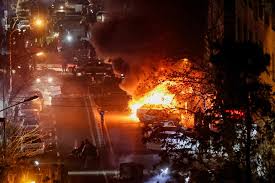
Cars burn in a street during a protest over the collapse of the currency’s value, in Tehran, Iran, January 8, 2026. Stringer/WANA (West Asia News Agency) via REUTERS
German Chancellor Friedrich Merz said on Tuesday he assumes Iran’s leadership is in its “final days and weeks” as it faces widespread protests.
Demonstrations in Iran have evolved from complaints about dire economic hardships to calls for the fall of the clerical establishment in the Islamic Republic.
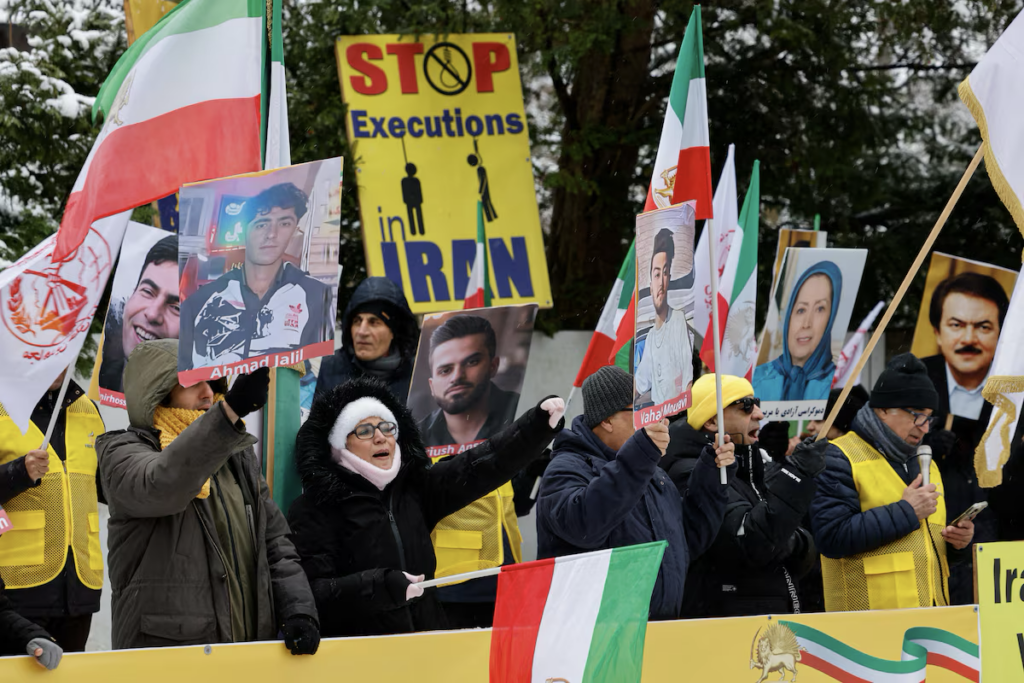
Supporters of the Iranian opposition group, the National Council of Resistance of Iran, protest to demand an immediate stop to the violence against protesters in Iran and an end to detentions and repression, in Berlin, Germany, January 3, 2026. REUTERS/Axel Schmidt
“I assume that we are now witnessing the final days and weeks of this regime,” Merz said during a trip to India, questioning the Iranian leadership’s legitimacy.
“When a regime can only maintain power through violence, then it is effectively at its end. The population is now rising up against this regime.”
Merz said Germany was in close contact with the United States and fellow European governments on the situation in Iran, and urged Tehran to end its deadly crackdown on protesters.
He did not comment on Germany’s trade ties with Iran.
U.S. President Donald Trump said on Monday that any country that does business with Iran will face a tariff rate of 25% on trade with the United States.
Germany maintains limited trade relations with Iran despite significant restrictions, making Berlin Tehran’s most important trading partner in the European Union.
German exports to Iran fell 25% to just under 871 million euros ($1.02 billion) in the first 11 months of 2025, representing less than 0.1% of total German exports, according to federal statistics office data seen by Reuters on Tuesday.
($1 = 0.8575 euros)
( REUTERS)
