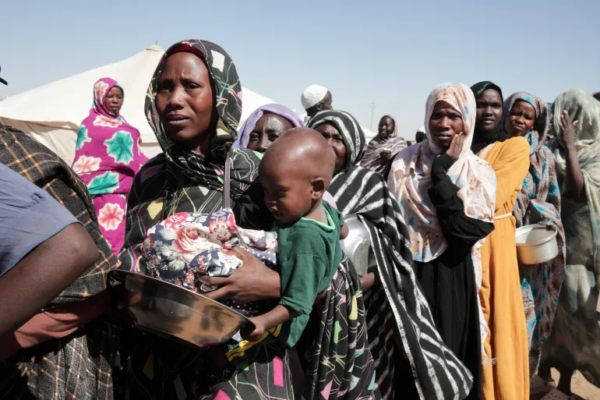
Women displaced from el-Fasher stand in line to receive food aid at the newly established el-Afadh camp in al-Dabba, in Sudan’s Northern State [File: Marwan Ali/AP Photo]
Sudan‘s Prime Minister Kamil Idris announced on Sunday the government’s return to Khartoum, after nearly three years of operating from its wartime capital of Port Sudan.
In the early days of the regular military‘s war with the paramilitary Rapid Support Forces (RSF) in April 2023, the army-aligned government fled the capital, which was quickly overrun by rival troops.
It has pursued a gradual return to Khartoum since the army recaptured the city last March.
“Today, we return, and the Government of Hope returns to the national capital,” Idris told reporters in Khartoum, promising “better services” for residents.
For close to two years, the Sudanese capital – composed of the three cities of Khartoum, Omdurman and Khartoum North (Bahri) – was an active battlefield.
Entire neighbourhoods were besieged, rival fighters shot artillery across the Nile River and millions of people were displaced from the city.
Between March and October, 1.2 million people returned to Khartoum, according to the UN.
Many found a city with barely functioning services, their homes destroyed and neighbourhoods pockmarked by makeshift cemeteries authorities are now exhuming.
The war is estimated to have killed tens of thousands of people in the capital alone, but the complete toll is unknown, as many families are forced to bury their dead in makeshift graves.
Idris said the government was committed to improving electricity, water, healthcare and education services.
According to the UN, the rehabilitation of the capital’s essential infrastructure would cost some $350 million.
In recent months, the government has held some cabinet meetings in Khartoum and launched reconstruction efforts.
The city has witnessed relative calm, though the RSF has carried out drone strikes, particularly on infrastructure.
Battles rage elsewhere across the vast country. South of Khartoum, the RSF has pushed through the Kordofan region, after dislodging the army from its last stronghold in Darfur last year.
The conflict has left 11 million people displaced internally and across borders, and created the world’s largest displacement and hunger crises.
The Rapid Support Forces (RSF) in Sudan have been accused of receiving significant military and financial support from the
United Arab Emirates (UAE)
UAE is widely considered the primary external backer of the RSF. Reports from UN experts, human rights organizations, and the U.S. government indicate the UAE has provided weapons, ammunition, and financial support, often disguised as humanitarian aid. The UAE has also been a crucial outlet for the RSF’s gold smuggling operations, which finance their war effort.
RSF supply lines run through Libya, and the LNA, led by General Khalifa Haftar, has been accused of supporting the RSF by helping to smuggle weapons and potentially sending fighters.
UAE has reportedly used Chadian territory to funnel weapons to the RSF. Chadian nationals have also reportedly been recruited into the RSF due to ethnic connections and poverty.
The Sudanese government forces (Sudanese Armed Forces, or SAF), led by General Abdel Fattah al-Burhan, are primarily receiving help from
Iran, Egypt, and Turkey, according to reports from UN experts and media outlets
(FRANCE 24 with AFP)
