
LEBANON – Egypt has begun supplying approximately 50 million cubic feet per day of natural gas to Lebanon through the Arab Gas Pipeline, just days after starting similar deliveries to Syria.
A senior Egyptian government source stated that agreements concluded by Cairo with Damascus and Beirut aim to provide gas for electricity generation during the winter months, with the total supplied volume reaching about 100 million cubic feet per day.
Egypt imports shipments of liquefied natural gas (LNG) on behalf of both countries, which are offloaded via a floating regasification vessel in the Jordanian port of Aqaba. Egypt covers the vessel rental costs, while Syria and Lebanon pay for the gas, in coordination with the United States.
This comes after Egypt signed two memorandums of understanding with Syria last week to supply gas and petroleum products, in an effort to address Syria’s severe electricity deficit, which exceeds 80% of its needs.
The source also revealed that Egypt renewed the lease of the regasification vessel in Aqaba for an additional six months, including paying transit fees to Jordan.
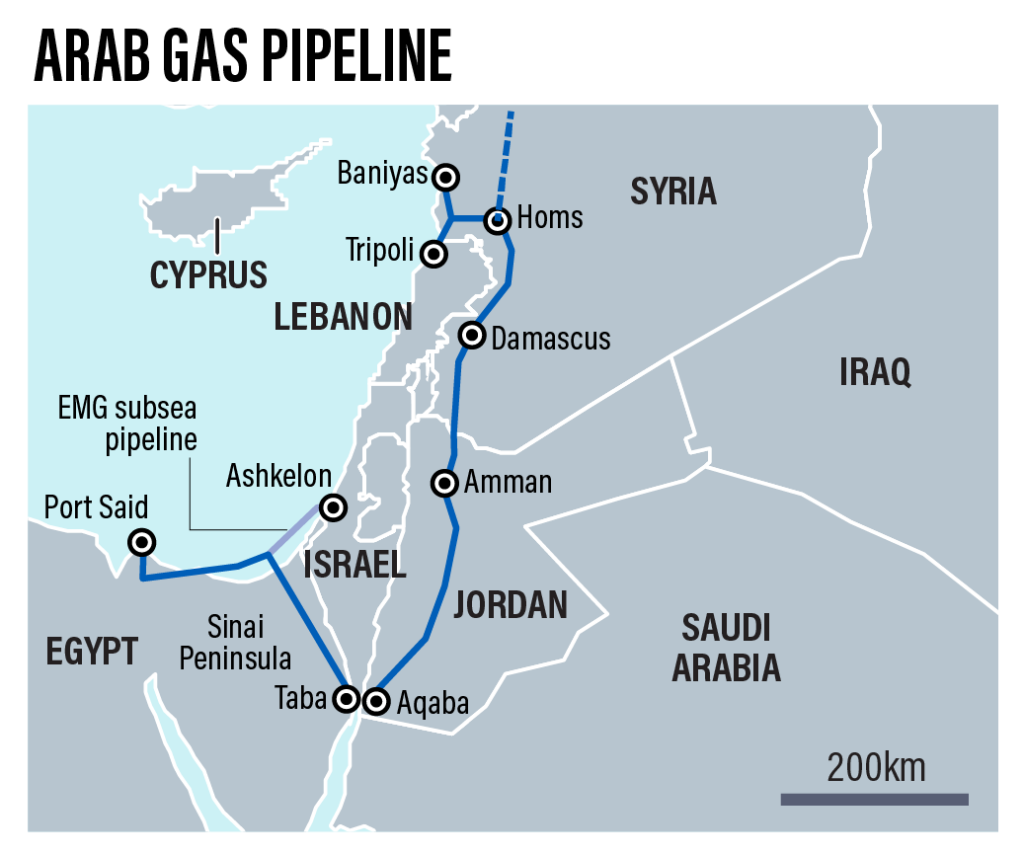
Through the plan, Lebanon seeks to lower energy production costs for Électricité du Liban—long unable to provide reliable power—while reducing dependence on fuel oil. Under the proposal, the Deir Ammar power plant in northern Lebanon would be supplied with natural gas, a cheaper and cleaner fuel.
Egypt’s Ministry of Petroleum and Mineral Resources reportedly plans to export around 2 billion cubic feet of natural gas per month to Lebanon via the Arab pipeline.
In parallel, the Lebanese government plans to lease a floating storage and regasification unit (FSRU) to regasify liquefied natural gas (LNG) imported by ship for the Deir Ammar plant.
This development comes after the US lifted its sanctions on Syria and after Israel announced a $35 billion gas deal with Egypt, described by Israeli PM as “the largest gas deal in Israel’s history.”
Less than two weeks after this historic agreement was announced, Lebanon signed a Memorandum of Understanding (MoU) with Cairo on December 29 to purchase natural gas from the country.
Egypt’s reliance on Israeli gas has increased as its domestic production declined, making it a critical but sometimes vulnerable supplier, leading to increased LNG imports when needed.
Egypt also imports LNG from Algeria as part of broader efforts to secure gas supplies amid energy shortages
