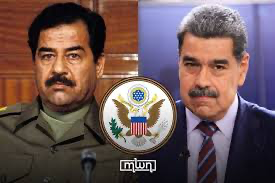
File photo: Saddam Hussein and Nicolás Maduro
From Baghdad to Caracas: when wishful thinking replaces strategy
By : Ya Libnan Editorial Board, Op.Ed
The past week has laid bare a striking contradiction at the heart of U.S. policy toward Venezuela. On one hand, President Donald Trump has declared that Washington now “runs Venezuela,” following the dramatic capture of Nicolás Maduro, and has urged American oil companies to invest billions in the country’s energy sector. On the other hand, the U.S. government is urgently warning its own citizens to leave Venezuela immediately due to rising violence and instability.
If the United States truly controls the situation, why is it telling Americans to flee?
This is not America’s first strategic delusion. In 2003, senior U.S. officials, including Defense Secretary Donald Rumsfeld and Vice President Dick Cheney, confidently predicted that Iraqi citizens would greet American troops with flowers and sweets as “liberators.” That fantasy collapsed quickly. While a few symbolic welcomes did occur, Iraq soon descended into a deadly insurgency, sectarian violence, and years of chaos that cost hundreds of thousands of lives and trillions of dollars.
Venezuela now risks becoming another Iraq — a place where confidence replaces planning and slogans replace strategy.
Removing a president does not mean controlling a country. Armed militias still roam the streets. Power remains fragmented. Law and order are fragile. Washington may claim authority, but it clearly cannot guarantee basic security — not even for its own citizens.
Yet at the same time, the administration quietly sent a State Department delegation to Caracas to explore reopening the U.S. embassy, signaling a return to “normal” diplomacy in a country that is anything but normal. You cannot reopen embassies, encourage foreign investment, and issue emergency evacuation orders in the same breath without exposing a deeply confused strategy.
The push for massive oil investment only deepens the contradiction. Investors are told Venezuela is open for business while ordinary Americans are warned it is too dangerous to stay. What CEO would risk billions in a country their own government considers unsafe?
History is repeating itself. Iraq taught America a painful lesson: toppling a leader is easy — stabilizing a nation is not.If Washington truly wants to help Venezuela, it must stop pretending control equals stability and start offering a real roadmap instead of empty bravado.
This is what happens when energy ambitions override coherent policy. Washington wants access to Venezuela’s oil but lacks a credible plan for governance, security, and political transition. The result is mixed messaging that undermines U.S. credibility and invites chaos.
If America truly wants to help Venezuela stabilize, it must stop pretending control equals stability. Real leadership requires a clear roadmap — not slogans, not oil deals, and not contradictory warnings.
