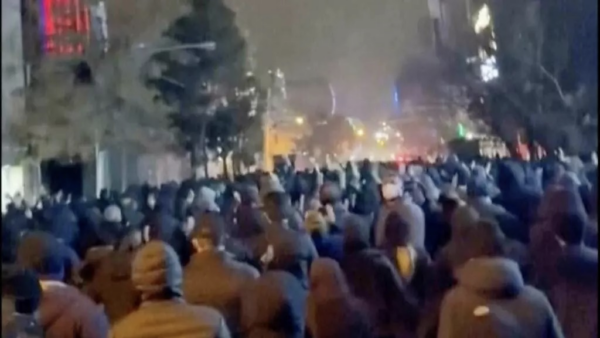
Screengrab from footage on social media shows protesters on the streets of Tehran January 10, 2026. © AP via UGC
Iran’s parliament met on Sunday to discuss ongoing mass protests, with the speaker warning that the US military and Israel would be “legitimate targets” if America strikes the country, as threatened by President Donald Trump. The death toll linked to the protests rose to 116, a US-based human rights groups said Sunday, as an internet blackout crossed the 60-hour mark.
TEHRAN – Iran‘s parliament met on Sunday to discuss deadly, nationwide protests that have raged for over two weeks. During a parliamentary session broadcast live on state TV, Speaker Mohammad Bagher Ghalibaf warned that the US military and Israel would be “legitimate targets” if America strikes the Islamic Republic, as threatened by President Donald Trump.
Ghalibaf, a hardliner who has run for the presidency in the past, gave a speech applauding police and Iran’s paramilitary Revolutionary Guard, particularly its all-volunteer Basij, for having “stood firm” during the protests.
“The people of Iran should know that we will deal with them in the most severe way and punish those who are arrested,” he said.
He went on to directly threaten Israel, “the occupied territory” as he referred to it, and the US military, possibly with a pre-emptive strike.
“In the event of an attack on Iran, both the occupied territory and all American military centres, bases and ships in the region will be our legitimate targets,” said the speaker. “We do not consider ourselves limited to reacting after the action and will act based on any objective signs of a threat.”
The parliamentary session, which saw lawmakers rush the dais, shouting: “Death to America,” came as US news website Axios reported that US Secretary of State Marco Rubio on Sunday discussed Gaza, Syria and the protests in Iran in a phone call with Israeli Prime Minister Benjamin Netanyahu.
While US and Israeli officials confirmed the phone call, details of the topics were not revealed.
Anti-regime rallies have continued in several Iranian cities and towns, with the death toll linked to the protests rising to more 116, according to Iranian rights group HRANA.
Meanwhile the internet shutdown in Iran remains in place and has now lasted more than 60 hours, monitor Netblocks said on Sunday.
“The censorship measure presents a direct threat to the safety and wellbeing of Iranians at a key moment for the country’s future,” it said on X, adding that the blackout is “now past the 60 hour mark”.
New protests erupt despite threats
Online videos sent out of Iran, likely using Starlink satellite transmitters, purportedly showed demonstrators gathering in northern Tehran’s Punak neighbourhood. There, it appeared authorities shut off streets, with protesters waving their lit mobile phones. Others banged metal while fireworks went off.
🚨 Huge crowds chanting "Death to the dictator" in Iran's capital Tehran tonight, day 12 of #IranProtests
— M. Hanif Jazayeri (@HanifJazayeri) January 8, 2026
After decades of dictatorship, first under the Shah and then under Khomeini/Khamenei, the people of Iran are determined to liberate themselves & build a democratic Republic. https://t.co/fZP4zNU5GE pic.twitter.com/XiEYxHsp5J
Other footage purportedly showed demonstrators peacefully marching down a street and others honking their car horns on the street.
“The pattern of protests in the capital has largely taken the form of scattered, short-lived, and fluid gatherings, an approach shaped in response to the heavy presence of security forces and increased field pressure,” said HRANA. “At the same time, reports were received of surveillance drones flying overhead and movements by security forces around protest locations, indicating ongoing monitoring and security control.”
In Mashhad, Iran’s second-largest city, some 725 kilometres (450 miles) northeast of Tehran, footage purported to show protesters confronting security forces. Flaming debris and dumpsters could be seen in the street, blocking the road. Mashhad is home to the Imam Reza shrine, the holiest in Shiite Islam, making the protests there carry heavy significance for the country’s theocracy.
Protests also appeared to happen in Kerman, 800 kilometres (500 miles) southeast of Tehran.
Iranian state television on Sunday morning took a page from demonstrators, having their correspondents appear on streets in several cities to show calm areas with a date stamp shown on screen. Tehran and Mashhad were not included. They also showed pro-government demonstrations in Qom and Qazvin.
Iran’s Supreme Leader Ayatollah Ali Khamenei has signaled a coming clampdown, despite US warnings. Tehran escalated its threats Saturday, with Iran’s attorney general, Mohammad Movahedi Azad, warning that anyone taking part in protests will be considered an “enemy of God,” a death-penalty charge. The statement carried by Iranian state television said even those who “helped rioters” would face the charge.
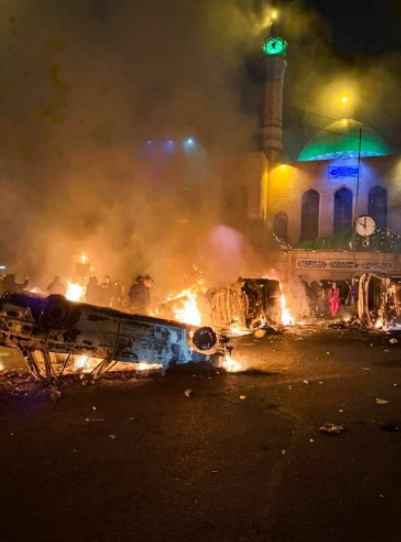
Overturned cars burn outside a mosque amid the chaos in Tehran AFP
Iran’s theocracy cut off the nation from the internet and international telephone calls on Thursday, though it allowed some state-owned and semiofficial media to publish. Qatar’s state-funded Al Jazeera news network reported live from Iran, but they appeared to be the only major foreign outlet able to work.
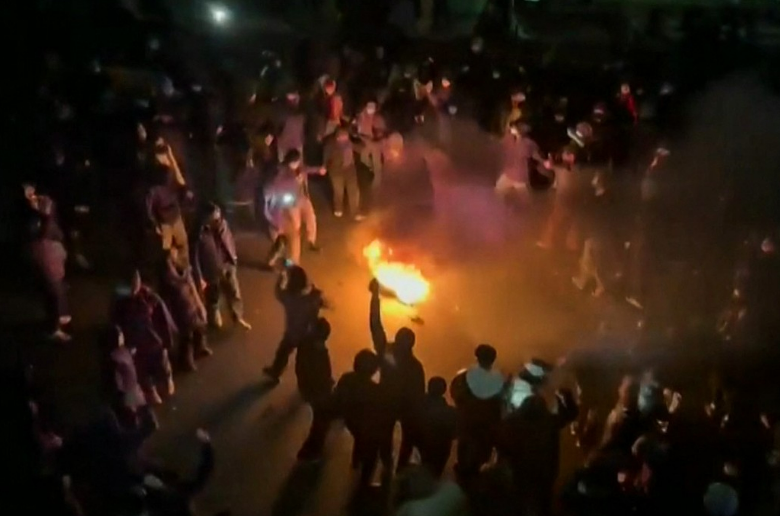
Protesters are raging through the streets of TehranCredit: AFP
Iran’s exiled Crown Prince Reza Pahlavi, who called for protests Thursday and Friday, asked in his latest message for demonstrators to take to the streets Saturday and Sunday. He urged protesters to carry Iran’s old lion-and-sun flag and other national symbols used during the time of the shah to “claim public spaces as your own”.
Pahlavi’s support of and from Israel has drawn criticism in the past – particularly after the 12-day war. Demonstrators have shouted in support of the shah in some protests, but it isn’t clear whether that’s support for Pahlavi himself or a desire to return to a time before the 1979 Islamic Revolution.
The demonstrations began December 28 over the collapse of the Iranian rial currency, which trades at over 1.4 million to $1, as the country’s economy is squeezed by international sanctions in part levied over its nuclear program. The protests intensified and grew into calls directly challenging Iran’s theocracy.
(FRANCE 24 with AP, AFP and Reuters)
