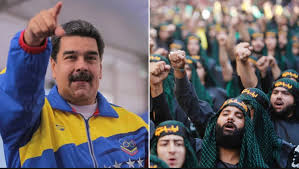
A poster of ousted Venezuelan President Nicolas Maduro and Hezbollah supporters. Several Western and Arab countries designated Hezbollah as a terrorist group. The Iranian backed group stands accused of criminal activities in Venezuela linked to drug trafficking, arms sales and money laundering.
Venezuelan president Nicolas Maduro’s capture also marks an advance towards the US goal of uprooting Lebanese Shiite group Hezbollah from Latin America, where the movement stands accused of criminal activities linked to drug trafficking, arms sales and money laundering. Washington has warned that it will no longer tolerate the presence of Hezbollah or its Iranian backers in Venezuela.
CARACAS-The shockwaves unleashed by the deadly US strikes on Caracas and the capture of Venezuelan president Nicolas Maduro were felt all the way to the southern suburbs of Beirut, the stronghold of Lebanese Shiite group Hezbollah
Washington has used Maduro’s abduction to send an unmistakable signal to the militant group’s leadership as well as its Iranian backers, with Secretary of State Marco Rubio directly threatening them the morning after the attack.
“It’s very simple,” he told US broadcaster CBS. “In the 21st Century, under the Trump administration, we are not going to have a country like Venezuela in our own hemisphere in the sphere of control and the crossroads for Hezbollah, for Iran and for every other malign influence in the country, in the world. That’s just not going to exist.”
Rubio later told NBC News that the new dispensation would mean the outright elimination of any Hezbollah or Iranian presence on Venezuelan soil, where they have been welcomed for the past three decades in the name of a shared antipathy to the United States. The US designated Hezbollah as a foreign terrorist organization in 1997. Rubio called on the Venezuelan regime – now under the interim leadership of Maduro’s vice president, Delcy Rodriguez – to break with both Iran and Hezbollah. The Islamic Republic, facing mounting protests first triggered by a cost-of-living crisis, has also found itself under pressure, with US President Donald Trump even threatening to intervene if Iranian security forces kill peaceful protesters.
The US has long been monitoring Hezbollah’s activities in the region. The US Drug Enforcement Administration (DEA) has said since 2008 that the movement, then led by Hassan Nasrallah, had been financing itself through drug-trafficking, arms sales and money laundering across Latin America and beyond. According to DEA figures, these activities earned Hezbollah about $1 billion a year.
As for Venezuela in particular, US investigators say that Maduro was even more permissive than his predecessor, Hugo Chavez, and that Venezuela had become a safe haven for the Shiite movement, which reportedly set up command structures in the capital Caracas.
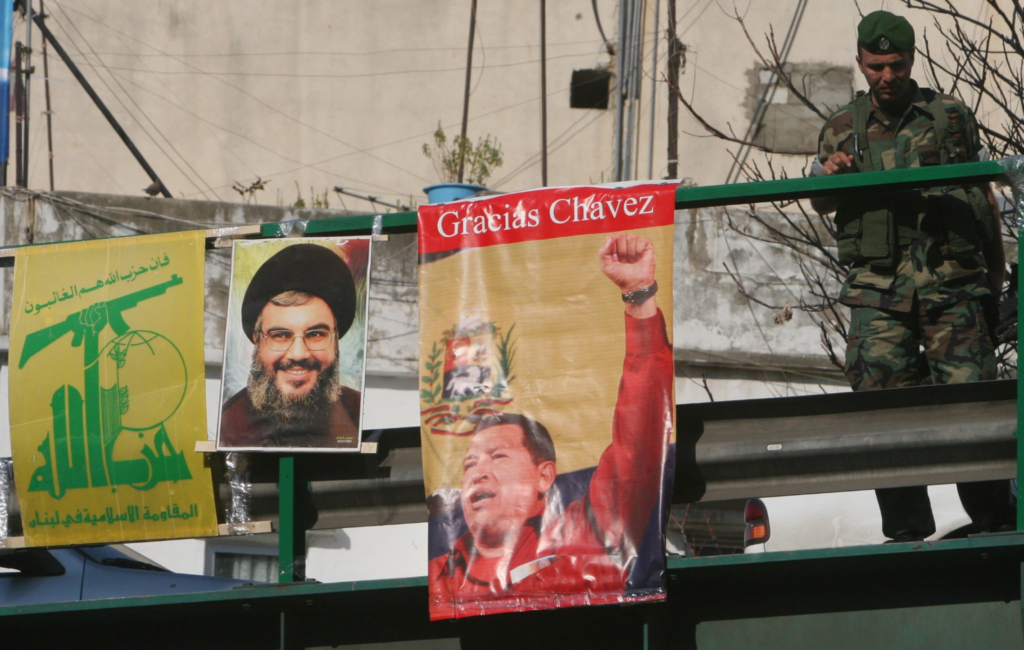
Posters of Hezbollah’s spin leader Hassan Nasrallah and Venezuela’s former leader Hugo Chavez, the Iran backed Lebanese terrorist group has helped to turn Venezuela into a hub for the convergence of transnational organized crime and international terrorism.
Both Venezuela and Hezbollah have strongly denied these allegations, with the latter insisting that drug trafficking and related activities are “forbidden by Islam”. Despite this, the self-described “Party of God” appeared to have played a key role, alongside Bashar al-Assad’s regime, in trafficking the illicit drug captagon across the Middle East during the Syrian Civil War.
Safe haven
US investigators have long accused Hezbollah of extending its operations into Venezuela in part through the region’s Lebanese and Syrian diaspora.
“In Venezuela, Hezbollah’s support network operates through compartmentalized, familial clan structures that embed into the Maduro regime-controlled illicit economy and the regime’s political apparatus and bureaucracy,” according to a 2020 report by the Washington-based Atlantic Council think tank. “Many of the clans are assimilated within the Venezuelan state and society through the robust Lebanese and Syrian communities that extend to neighboring Colombia.”
Links between Caracas and the Shiite movement “are mutually beneficial, allowing Hezbollah a safe space to conduct its global crime-terror operations and providing the Maduro regime with increased illicit support from the Middle East”, the report says.
Caroline Rose, the director of military and national security priorities at the Washington-based New Lines Institute for Strategy and Policy, said the Latin American drug trade had given Hezbollah access to badly needed financing.
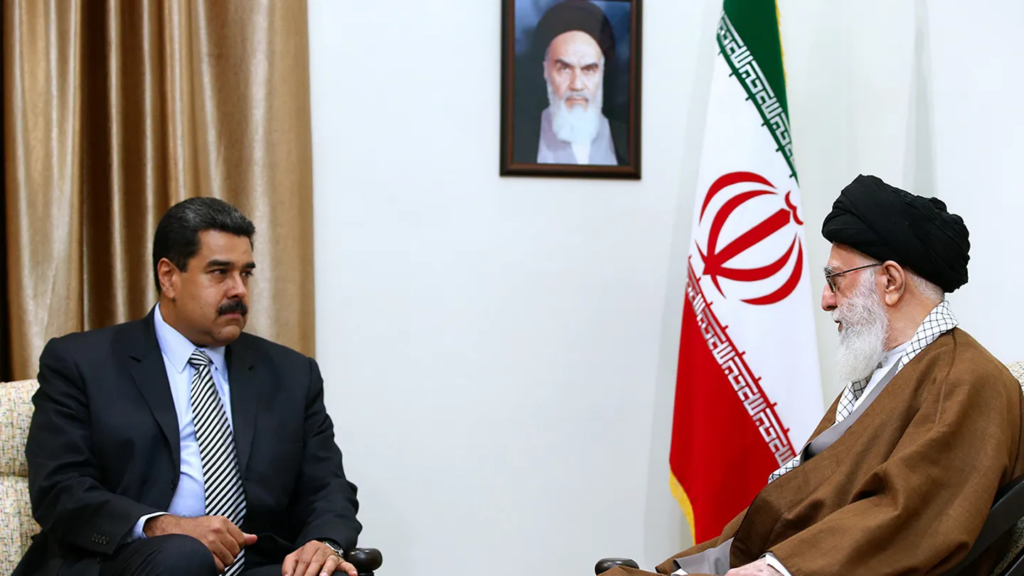
Fie-Venezuelan President Nicolas Maduro (L) meets the Supreme Leader of Iran, Ali Khamenei during his visit in Tehran, Iran on Oct. 22, 2016. (Pool / Supreme Leader Press Office/Anadolu Agency/Getty Image). Iran is very active in Venezuela. The relationship between the two countries has strengthened Iran’s broader influence in Latin America and enabled its proxies, such as Hezbollah and Hamas, to evade U.S. sanctions and facilitate transnational crime.
“The relationship that Hezbollah has developed with the Maduro regime and the embedded Cartel de los Soles syndicate (a term used for Venezuelan officials the US accuses of having links to drug trafficking) is extremely nuanced, often simplified by reductionist assertions that Venezuela is a ‘base’ for Hezbollah’s terrorist operations,” she said. “Rather, the picture has been more complex, with the group exploiting Venezuela’s proximity to established drug smuggling routes – just as they have in Western Africa – as a way to diversify alternative revenue streams through the trafficking of drugs, arms, and money laundering schemes.”
Rose said that the sudden death of Chavez in 2013 had only intensified Hezbollah’s activities in Venezuela after his hand-picked successor Maduro took office.
“The relationship has grown since Venezuela’s Chavez era, with reports that Hezbollah has particularly taken advantage of informal ports and smuggling routes off the coast of Venezuela’s Margarita Island,” she said.
This sun-drenched island in the country’s northeast is believed to serve as a key logistics hub for Hezbollah, used for financial activities, espionage and possibly drug trafficking. Margarita Island was described in 2011 during a congressional hearing of the Subcommittee on Counterterrorism and Intelligence as having “eclipsed” the infamous “Triple Frontier” between Paraguay, Brazil and Argentina as the movement’s favored bastion in the Americas. This border region served for decades as one of Hezbollah’s strongholds in Latin America, used by the group as both sanctuary and center of operations.
More recently, former assistant secretary for terrorist financing at the US Treasury Marshall Billingslea told a Senate hearing in October 2025 that “under Hugo Chavez, Venezuela opened its doors to Hezbollah, allowing the group establish a major footprint, including a paramilitary training site, on Margarita Island”.
New world order
Lebanon’s media have made much of the fact that Rubio’s threats come at a tense moment for the Shiite group and its new leader, Naim Qassem, who is under intense US and Israeli pressure to disarm.
Despite having been severely weakened both militarily and politically during its most recent conflict with Israel – losing longtime leader Nasrallah and most of its military leadership, as well as the abrupt collapse of its Assad ally in Syria – Hezbollah has categorically refused to lay down arms.
According to Rose, “2025 has been a transition year for Hezbollah”. And it may now need to consider its remaining options.
“Israel has imposed a severe blow on Hezbollah’s command and control, infrastructure and finances, creating an incentive for the organization to lay low in Lebanon while pursuing alternative revenue-generating schemes, such as drug trafficking, elsewhere,” she said.
“In that same vein, risk-taking behavior from both Israel and the Trump administration – demonstrated through Israeli strikes on Qatar and Iran, as well as the US’s recent capture of Maduro and designation of cartels as terrorist organizations – could also serve as a deterrent against any major Hezbollah entrenchment in Venezuela,” she added.
For Rose, Trump’s attack on Venezuela, and threats of more to come, could well push Hezbollah to redirect its operations to parts of the world less directly menaced by Washington’s military reach.
“The Trump administration’s violation of international law – and brazen impetus to act against actors that could be brandished as ‘narco-terrorists’ – could make South America a more risk-ridden zone for outside players like Hezbollah,” Rose observed.
“I believe that with so much attention and pressure against any organization that engages in illicit smuggling that encompasses an armed component – militarized cartels, terrorist organizations, and mafia networks – Hezbollah will do its best to quiet its activities in South America. Likely, it will turn its attention towards existing enclaves in Western Africa, as well as seek to charter new potential inroads, such as Southeast and Central Asia.”
FRANCE24/ AFP
