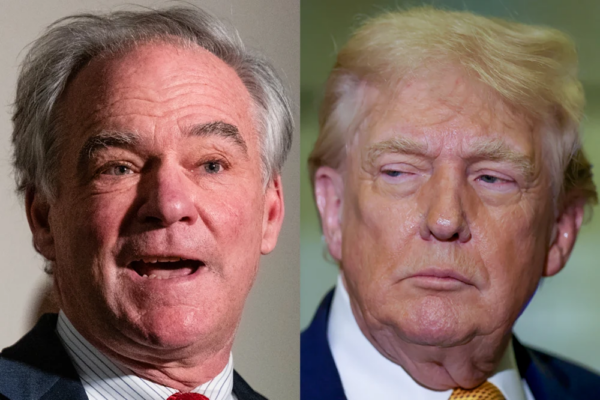
Sen. Tim Kaine, D-Va., led the bipartisan war powers resolution as President Donald Trump’s struck Venezuela.
WASHINGTON — The US Senate fired a warning shot at President Donald Trump, voting Thursday to advance a bipartisan resolution to block him from using military force “within or against Venezuela” unless he gets prior approval from Congress.
The vote of 52-47 on the war powers measure came after an unsuccessful plea by Republican leaders to sink it and preserve Trump’s authority, as he threatens a “second wave” of attacks on Venezuela. Trump has declared that the U.S. would “run” the country temporarily after he ordered a military operation last week to capture and extradite leader Nicolás Maduro.
Five Republicans joined all 47 Democrats in voting yes on the motion to advance the resolution to the Senate floor.
The legislation, led by Sen. Tim Kaine, D-Va., was cosponsored by Sen. Rand Paul, R-Ky., Sen. Adam Schiff, D-Calif., and Senate Minority Leader Chuck Schumer, D-N.Y.
“Instead of responding to Americans’ concerns about the affordability crisis, President Trump started a war with Venezuela that is profoundly disrespectful to U.S. troops, deeply unpopular, suspiciously secretive and likely corrupt. How is that ‘America First?‘“ Kaine said. “Trump’s war is also clearly illegal because this military action was ordered without the congressional authorization the Constitution requires.”
The procedural motion Thursday sets up a full Senate vote on the measure next week; that will also require a simple majority and is expected to pass. It is subject to House approval and a presidential signature, making it unlikely to become law. But it sends a significant message to Trump that could impact his foreign policy moves going forward — in Venezuela and other countries.
“To my Senate colleagues: enough is enough,” he said. “You were sent here to have courage and to stand up for your constituents. That means no war without a debate and vote in Congress.”
Along with Democrats and Paul, the Republicans who voted for the measure were Sens. Susan Collins of Maine, Lisa Murkowski of Alaska, Todd Young of Indiana and Josh Hawley of Missouri.
Paul said some members of Congress want to “shift the burden of initiating war to the president” rather than take responsibility.
“But make no mistake, bombing another nation’s capital and removing their leader is an act of war, plain and simple,” the Kentucky Republican said. “No provision in the Constitution provides such power to the presidency.”
The vote represents an early test of the Republican appetite to slap limits on Trump’s power to use military force after his capture of Maduro. Trump has suggested he is open to U.S. boots on the ground there and also threatened Iran, Greenland and Colombia on Sunday, adding that Cuba “is ready to fall.”
“I believe invoking the War Powers Act at this moment is necessary, given the President’s comments about the possibility of ‘boots on the ground’ and a sustained engagement ‘running’ Venezuela, with which I do not agree,” Collins said.
Murkowski said Congress must “affirm our role under Article 1.”
Ahead of the vote, Senate Majority Whip John Barrasso, R-Wyo., urged senators to reject the war powers measure, calling the U.S. military capture of Maduro a law enforcement operation.
“It does not make America stronger. It makes America weaker and less safe,” Barrasso said in a written statement. “It would weaken the President’s legitimate, constitutional authority. This body, the United States Senate, is being asked whether the President of the United States has the authority to arrest indicted criminals. Of course he does.”
NBC
