Brookings experts weigh in Scott R. Anderson, Alex Brockwehl, Marcela Escobari, Vanda Felbab-Brown, Samantha Gross, Michael E. O’Hanlon, Ted Piccone, Elizabeth N. Saunders, Caitlin Talmadge, David G. Victor, Valerie Wirtschafter, and Kelebogile Zvobgo
On January 3, 2026, the United States launched a special operation to exfiltrate Venezuelan President Nicolás Maduro and his wife from Caracas. Below, Brookings experts consider the immediate implications of this operation for the United States and Venezuela.
SCOTT R. ANDERSON:
The Maduro operation demonstrates the president’s broad authority to use military force—and may point towards some limits
The operation to capture Nicolas Maduro underscores the extraordinarily broad authority that modern presidents exercise over military force—and, potentially, its limits.
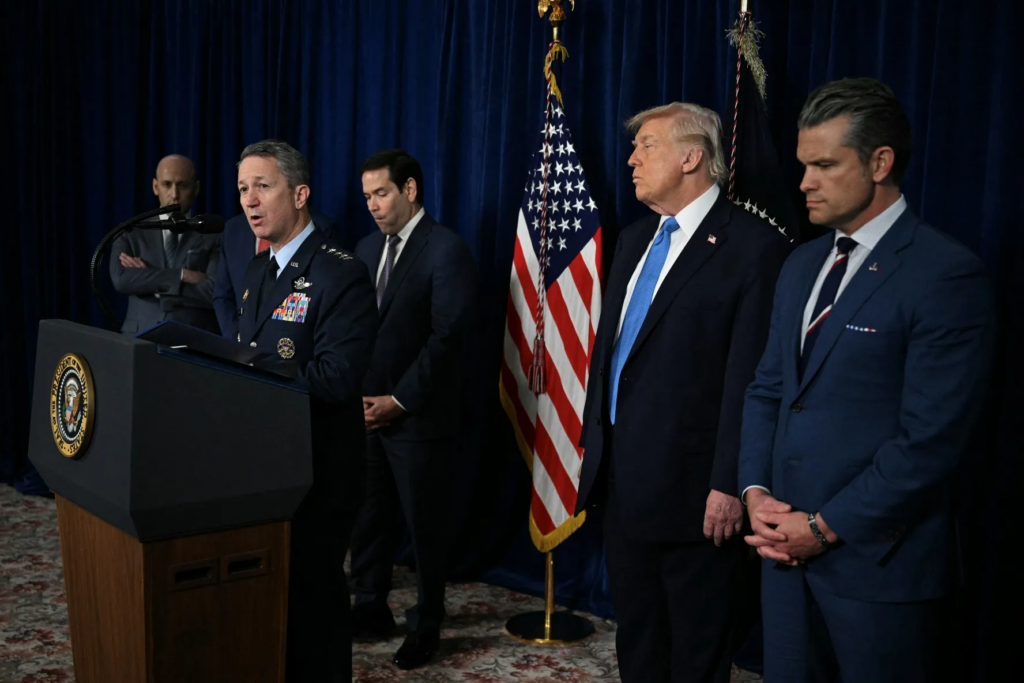
US President Donald Trump (2R) looks on as Chairman of the Joint Chiefs of Staff General Dan Caine (2L) speaks to the press following US military actions in Venezuela, at Trump’s Mar-a-Lago residence in Palm Beach, Florida, on January 3, 2026. (Jim Watson/AFP via Getty
The executive branch maintains that the president has the constitutional authority to use military force without congressional authorization, so long as it supports U.S. interests and is not expected to result in “prolonged and substantial military engagements.” It’s also argued that this authority is not constrained by international law. Thus it’s not entirely surprising for the Trump administration to argue that the president can take targeted military action like the Maduro operation, even where hugely consequential for Venezuela and contrary to international law.
These views have never been vindicated by the federal courts, which generally avoid war powers issues, absent a conflict with Congress. But this reticence also leaves the executive branch free to rely on its own views without judicial repudiation.
Yet there may still be limits. When asked why congressional authorization wasn’t needed for the Maduro operation, Secretary Rubio responded, “This wasn’t an invasion, we didn’t occupy a country”—suggesting some broader campaigns might still be beyond the president’s unilateral authority. An extended military campaign could also trigger time limits imposed by the 1973 War Powers Resolution. And legislators are introducing measures that would impose further statutory constraints if enacted, creating the sort of interbranch conflicts that federal courts might take on.
In short, the Maduro operation may not have encountered serious legal limits. But a “second wave” of the sort threatened by President Trump still might.
MARCELA ESCOBARI AND ALEX BROCKWEHL:
Venezuela after Maduro: a narrow window for democratic transition
Maduro is gone, but what comes next is unclear. His ouster creates a real but narrow opportunity for a durable democratic transition that puts Venezuela on a path to recovery. Three elements are critical: political legitimacy, economic stabilization, and military realignment.
Political legitimacy exists. In 2024 elections, Venezuelans voted overwhelmingly for opposition leader Edmundo González—a result that the Maduro regime rejected by clinging to power. Maintaining Delcy Rodríguez, a close Maduro ally, as president indefinitely would not only undermine the clearly expressed will of the Venezuelan people but likely prevent the reestablishment of rule of law that will be essential for Venezuela’s rebuilding. Threatening force to keep the Rodríguez government in line may work in the short term but is not a sustainable strategy for courting the kinds of long-term investment that Venezuela will need to truly rebuild.
A credible stabilization will require much more than investments from a few U.S. companies. Venezuela’s economy contracted roughly 80 percent over the last decade, the largest peacetime collapse recorded in modern history. Basic infrastructure—electricity grids, water systems, transportation networks—is severely deteriorated. A workable stabilization effort therefore requires scale, starting with an IMF-anchored package of over 50 billion over 18–24 months, combining balance-of-payments support, fiscal financing and debt restructuring, as well as parallel World Bank and Inter-American Development Bank programs. This must be paired with large-scale immediate humanitarian assistance for the nearly 8 million Venezuelans in acute need.
The transition hinges on the Venezuelan military. Venezuela’s armed forces are fractured, criminalized, and complicit—but not monolithic. A transition requires immediate unity of command under civilian authority; conditional off-ramps—amnesty and reintegration for mid-level officers not implicated in atrocities—paired with targeted prosecutions for grave crimes and the dismantling of irregular armed groups. Justice must be real but sequenced to avoid creating more recruits for the narco-gangs currently operating with impunity within Venezuela.
The United States cannot—and should not—do this alone. While multilateral efforts failed to bring about Maduro’s exit, they can be instrumental in facilitating what comes next.
A secure, democratic, and prosperous Venezuela is in the U.S. interest. Focusing narrowly on oil access or prioritizing creditor repayment over recovery would risk creating a small set of rent-seekers while keeping Venezuela’s failed institutions largely intact. The courage and persistence of the Venezuelan people has drawn admiration from across the globe. If the United States makes a stable, democratic Venezuela its goal, it can align its interests with those of many allies across the region and beyond.
VANDA FELBAB-BROWN:
Contradictory visions for Venezuela
The operation to capture Nicolas Maduro underscores the extraordinarily broad authority that modern presidents exercise over military force—and, potentially, its limits.
The executive branch maintains that the president has the constitutional authority to use military force without congressional authorization, so long as it supports U.S. interests and is not expected to result in “prolonged and substantial military engagements.” It’s also argued that this authority is not constrained by international law. Thus it’s not entirely surprising for the Trump administration to argue that the president can take targeted military action like the Maduro operation, even where hugely consequential for Venezuela and contrary to international law.
These views have never been vindicated by the federal courts, which generally avoid war powers issues, absent a conflict with Congress. But this reticence also leaves the executive branch free to rely on its own views without judicial repudiation.
Yet there may still be limits. When asked why congressional authorization wasn’t needed for the Maduro operation, Secretary Rubio responded, “This wasn’t an invasion, we didn’t occupy a country”—suggesting some broader campaigns might still be beyond the president’s unilateral authority. An extended military campaign could also trigger time limits imposed by the 1973 War Powers Resolution. And legislators are introducing measures that would impose further statutory constraints if enacted, creating the sort of interbranch conflicts that federal courts might take on.
In short, the Maduro operation may not have encountered serious legal limits. But a “second wave” of the sort threatened by President Trump still might.
SAMANTHA GROSS:
Oil revenues will NOT fund operations in Venezuela
In his news conference on January 3, 2025, President Trump made clear that the military operation in Venezuela was largely about oil. He said that the United States will “run” Venezuela for a time and will maintain “a presence in Venezuela as it pertains to oil.” He seems to believe that oil revenues will fund the ongoing presence, stating that, “We’ll be selling large amounts of oil to other countries,” and that running Venezuela “won’t cost us anything.”
This is nonsense.
The oil industry in Venezuela is a shambles. Venezuela’s national oil company, Petróleos de Venezuela Sociedad Anónima (PDVSA), was once a well-run company, but decline began when former president Hugo Chávez fired thousands of employees in 2002-03 after a strike that pressured Chávez to hold early elections. Lack of investment and mismanagement at PDVSA have since resulted in dwindling production over more than 20 years. Production was about 3.2 million barrels per day (mbd) in 2000 and is now about a million mbd. Restoring production to its peak would require years and billions of dollars in investment.
Trump acknowledged the slump in Venezuela’s oil industry, but he has unrealistic ideas about its prospects for rapid recovery. The current environment does not support the needed level of investment. Venezuela’s vast oil reserves consist primarily of very heavy, sour crude, generally similar to Canada’s oil sands. Such oil is expensive and complex to produce and sells at a discount compared to lighter, non-sulfurous oil. Many refineries in the U.S., especially on the Gulf Coast, are equipped to process this crude, but those refineries are already running at very high utilization rates. Oil markets today are well-supplied and prices are falling, narrowing the profit margins for expensive-to-produce crudes. Finally, companies require a stable political environment to make large investments. It’s not clear when Venezuela might achieve political stability, and growing oil revenues certainly won’t be available to ease that transition.
We’ve heard this story before, when oil revenues were intended to fund the reconstruction of Iraq. It wasn’t true then, and it won’t be true now.
CONTINUE READING IN
BROOKINGS
