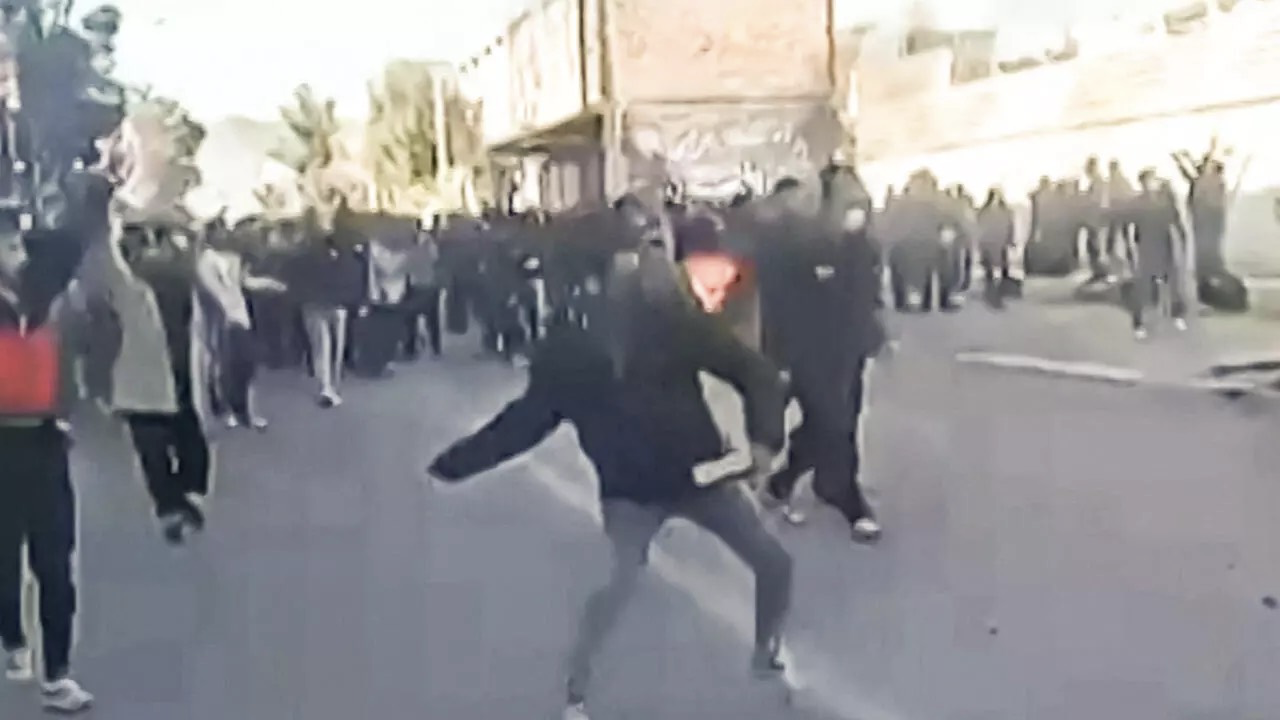
This grab taken January 2, 2026, from UGC images posted on social media on December 31, 2025, shows protestors attacking a government building in Fasa, southern Iran. © UGC via AFP
Tehran has been tightening its grip on protests sparked by hyper-inflation and the rising cost of living, with hundreds of demonstrators – many of them under 18 – arrested or wounded. But the state’s crackdown may only be radicalising a nationwide wave of opposition that shows little sign of slowing.
On Nazila Maroofian’s Instagram page, photographs of young Iranian protesters who have been seized by security forces follow one after the other: Kimia Hadadian, 17, Kourosh Kheiri, 13, Amirhossein Karimpour, 17.
“This child was struck by a bullet and apparently arrested during demonstrations in Naziabad (Tehran) around 8pm on January 4, 2026,” Maroofian wrote under a picture of missing 14-year-old Sogand Mansouri.
“She was wearing a grey jacket and no information about her condition or place of detention is available at the moment … If someone has news of her, absolutely please let us know.”
Living as a refugee in France since 2023, Maroofian, 25, was herself arrested in 2022 during the widespread protests triggered by the death of Mahsa Amini in custody.
Maroofian was detained for having interviewed Amini’s father after the young Kurdish-Iranian woman was arrested by the country’s morality police for allegedly wearing her headscarf improperly.
Through her contacts with those now taking to Iran’s streets, Maroofian has taken it upon herself to act as a public conduit for the latest wave of protests, which have sparked a crackdown by the Islamic Republic’s security forces.
A series of strikes against hyper-inflation by shopkeepers in Tehran and other major cities erupted on December 28. This latest social movement has since increasingly taken on a political character, with some crowds shouting slogans explicitly calling for the government’s fall.
The demonstrations have spread to the universities, and a number of young Iranians are now joining the protests daily. Teachers’ unions have reported that several high-schoolers have been arrested across the country; their families have been kept largely unaware of their whereabouts.
Under lock and key
Iranian security forces have killed at least 27 protesters, including five minors, since late December, the Norway-based NGO Iran Human Rights said on Tuesday.
“At least 27 protesters have been killed by gunfire or other forms of violence carried out by security forces in eight provinces. Five of those killed have been verified to have been children,” the NGO said after 10 days of protests, adding that over 1,000 people had been detained
The NGO on Sunday expressed concern about the fate of young Iranians detained during the demonstrations, particularly underage protesters believed to be imprisoned in Isfahan Central Prison.
Several wounded detainees have been transferred to the prison’s infirmary, the group said in a statement, including 16-year-old Soroush Azarmehr, 17-year-old Payam Aminzadeh and 16-year-old Saman Shahamat, who were arrested after being injured in the head and back.
In a prison in the conservative city of Qom, a bastion of theological universities in southern Iran, Soroush Javidi, 17, lost consciousness after suffering major blood loss, the organisation said.
“It is unclear whether he received appropriate medical care after being admitted to the prison infirmary,” the statement said. “On January 3, around 100 prisoners were transferred to Qom Central Prison, where they were all crammed into a single hall.”
Open fire
According to a January 5 report by Human Rights Activists News Agency, which tracks rights in Iran, at least 1,203 people have been arrested since the demonstrations began in late December. Official figures say that at least 12 people, including members of Iran’s security forces, have been killed.
According to Iran Human Rights, AK-47 assault rifles and possibly even machine guns were used on January 3 to repress street protests in Malekshahi county, an area with a large Kurdish population.
The latest protests have affected at least 45 mostly small to mid-sized towns across Iran, mainly in the country’s west, according to an AFP analysis of media coverage and official announcements. Protests have broken out in at least 25 of Iran’s 31 provinces.
“Each time, there are a few dozen to a few hundred people protesting,” said FRANCE 24 correspondent Siavosh Ghazi. “But the movement is gaining momentum, spreading, and becoming increasingly radical.”
Fighting back
In one viral video taken on January 4 in Hamedan, a city in Iran’s west, protesters – including several women – set upon a pro-government militiaman who had just fired upon them. A number of protesters hurl themselves on a uniformed member of the Basij paramilitary force and disarm him, dragging him to the ground and beating him while others try to stop him from being killed in the street.
Other images shared on social media show similar scenes, with protesters hurling stones at riot police or throwing petrol on a militiaman before setting him ablaze.
In other scenes, demonstrators drop to their knees in front of motorbike-riding security forces in a non-violent display of resistance, seemingly without fear of being arrested.
Gholamhossein Mohseni Ejei, head of the country’s judiciary, said on Monday that he recognised protesters have the right to demonstrate peacefully over economic concerns. But there will be “no leniency or indulgence” towards “rioters”, he said.
Supreme Leader Ayatollah Ali Khamenei, who had mostly maintained his silence since the new protests erupted, echoed this sentiment during a Shiite festival in Tehran on Saturday. While protesters’ economic demands were “just” he said, “rioters” needed to be “put in their place”.
Iran Human Rights warned that the supreme leader’s statement amounted to a blank cheque to security forces to escalate their repression.
“On 3 January, Ali Khamenei, the Supreme Leader of the Islamic Republic, implicitly issued an order to crack down by referring to protesters as ‘rioters’ and ‘agents of the enemy’,” the group said in its statement.
FRNCE24/AFP
