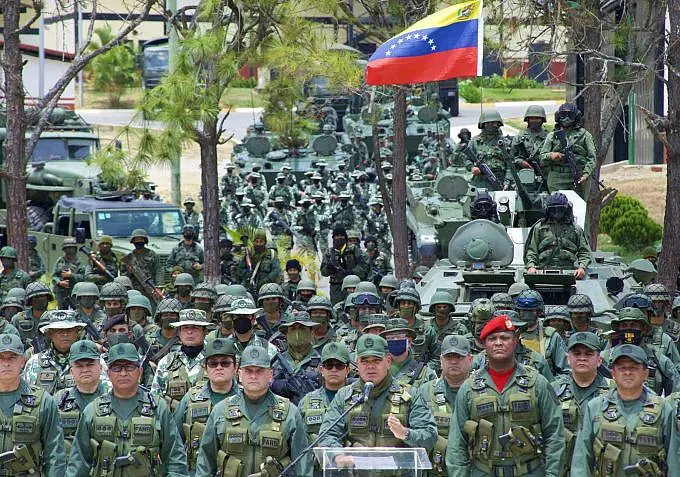
In the aftermath of Operation Midnight Hammer, the primary question dominating military circles is not just how the U.S. captured Nicolás Maduro, but why the Bolivarian National Armed Forces (FANB)—a military force of over 150,000 personnel—remained largely paralyzed during the 30-minute assault on January 3, 2026.
According to intelligence reports and tactical analysts, the Venezuelan military’s lack of response was the result of a “perfect storm” of technological suppression and internal structural collapse.
1. Total Electronic Blindness (The “Blackout”)
The primary reason for the lack of response was a massive, pre-emptive electronic warfare (EW) strike.
- Radar Suppression: U.S. Navy EA-18G Growlers deployed “Next Generation Jammer” pods that completely blinded Venezuela’s Russian-made S-300VM air defense systems.
- Communications Jamming: Key communication antennas, including those at Cerro El Volcán, were neutralized within the first minutes. This created a “Fog of War” where regional commanders were unable to receive orders or verify the situation in the capital.
2. A “Hollowed” Military Structure
Despite years of public displays of loyalty, the FANB was fundamentally unprepared for a high-intensity, peer-level conflict.
- Economic Attrition: Rank-and-file soldiers, earning as little as $100 a month, faced a severe morale crisis. Intelligence suggests that desertion rates spiked the moment the first explosions hit Fuerte Tiuna and La Carlota Airbase.
- Decapitation Strike: By capturing Maduro and his inner circle within the first half-hour, the U.S. effectively cut the head off the snake. Without a clear chain of command, lower-level officers were hesitant to engage in a potentially suicidal counter-attack.
3. The “Negotiated Exit” Hypothesis
Several opposition sources, including those cited by Sky News, suggest that the silence was not entirely accidental.
- Internal Defections: There are unconfirmed reports that high-ranking generals may have been in secret negotiations with U.S. intelligence. By choosing not to fire, these commanders may have secured immunity or a role in the transitional government.
- Wait-and-See Approach: In many modern coup or intervention scenarios, military units often wait to see which side is winning before committing to a fight. The overwhelming speed of the U.S. Delta Force operation made the outcome clear before a response could even be organized.
4. Overwhelming Technological Asymmetry
President Donald Trump noted in his Mar-a-Lago press conference that “all Venezuelan military capacities were rendered powerless.”
- The “TV Show” Operation: U.S. forces utilized stealth assets that the Venezuelan military simply could not track. The use of night-vision and thermal-equipped special forces against a military experiencing a city-wide power outage gave the U.S. a “predatory advantage” in the dark.
CUBANS GUARDING MADURO
Cuba announced on Monday that 32 of its citizens were killed in combat during the U.S. raid on Venezuela.
The raid on Saturday, which saw U.S. forces arrest and extract Venezuelan President Nicolas Maduro to New York, reportedly saw a large part of his security team killed.
(PINGTVINDIA)
