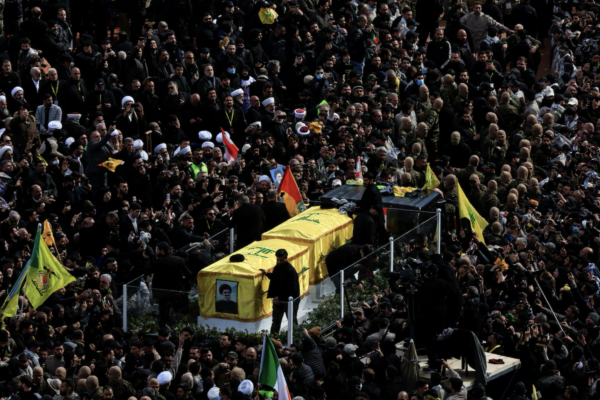
PHOTO- Funeral ceremony for former Hezbollah leaders Hassan Nasrallah and Hashem Safieddine, outskirts of Beirut, February 23, 2025. REUTERS/Thaier Al-Sudani
By: Naji Al Boustani, Op-Ed
Since the ceasefire agreement came into effect on November 27, Israeli violations and attacks on Lebanon have continued daily!
Has Hezbollah lost the deterrent capability it boasted of, which it claimed protected Lebanon from the end of the July 2006 war until very recently?
To refresh our memory, it is worth recalling that on December 2, 2024, just a few days after the ceasefire agreement came into effect, Hezbollah attempted to reinstate the “balance of terror” theory by firing a few rockets at an Israeli army position and issuing a statement, numbered one, which read in part: “(…) Since appeals to the relevant parties to stop these violations have failed, the Islamic Resistance carried out this Monday evening an initial, warning defensive response targeting the Ruweisat al-Alam site of the Israeli enemy army in the occupied Lebanese hills of Kfar Shuba,” and concluded its statement with the phrase, “He who has been warned has been given fair warning!” However, the Israeli army quickly thwarted this attempt in its infancy by raiding approximately 30 targets in various parts of Lebanon, resulting in numerous martyrs and wounded, accompanying this exaggerated field response with a statement of threats and warnings. Since the aforementioned security operation, the party has not launched any attack against Israel, despite the continued daily Israeli attacks. Paradoxically, the Israeli side is convinced that the time is right to press ahead with its attacks on Hezbollah, inflicting as much damage as possible and compelling the Lebanese government to enforce the principle of exclusive control of weapons by the state and legitimate security forces, given the significant American pressure supporting this approach.
Israel is expected to try to prolong its occupation in the south, while simultaneously continuing aerial surveillance operations and conducting periodic raids on what it considers threats in various Lebanese areas. It plans to force Lebanon to sign new agreements in the future and is actively working to create a rift between the Lebanese army and Hezbollah.
Conversely, Hezbollah finds itself in a very difficult position. It has lost the opportunity to launch a surprise attack on the Galilee, and its ability to capture Israeli soldiers or even strike Israeli units in the occupied Lebanese border areas from close range has diminished. Although it is still capable of attacking Israelis with rockets and drones, the problem lies in the anticipated Israeli response. Israel is expected to retaliate forcefully and extensively in many Lebanese areas if its positions or forces are attacked by Hezbollah. Based on the foregoing, there are many obstacles preventing Hezbollah from resorting to military action again, the most prominent of which are:
First: It is inconceivable that Hezbollah would launch a limited security operation and then be forced to tolerate and endure the anticipated Israeli military responses, given the significant additional material and moral damage this would entail. Secondly, it is out of the question to initiate a full-scale battle again under the current circumstances, especially given the disruption of the “Party’s” supply lines through Syrian territory and the lack of alternatives to compensate for the currently lost logistical support.
Thirdly, it is unthinkable to cause further human casualties and material damage at a time when rubble still litters the streets, houses are destroyed, and the necessary compensation funds are not yet available.
Fourthly, it is inconceivable to escalate the already raging internal political conflict, especially as the new official authority attempts to impose its influence under broad international cover, and while a very large segment of the Lebanese population longs for a period of relative calm to escape the economic and security tragedies they have endured over the past few years.
Based on all of the above, yes, Hezbollah has lost its deterrent power, and it will only resort to the military option again reluctantly and under duress, in only one scenario: if Israel once again displaces the population from the southern suburbs and all areas under the “Party’s” control. Therefore, if this happens, the “Party” will be driven to all-out war based on the principle that it has nothing left to lose! Currently, the “Party’s” highest hope is to weather the current storm with the least possible damage, relying on international developments that could change the existing reality, or on a regional development such as a US-Iranian agreement that might salvage what can be salvaged. Its opponents, however, are banking on regional developments, also centered on Iran, but ones that would tighten the noose around Hezbollah rather than the opposite. They believe that the failure of negotiations with Tehran will lead to a new, large-scale military strike against Iran’s military capabilities and what remains of its allied forces. While awaiting a clearer picture of the regional situation, what options remain for Hezbollah, and will it surrender its weapons? Details can be found in the fifth article of this comprehensive report.
Translated from Arabic
Source: El Nashra
