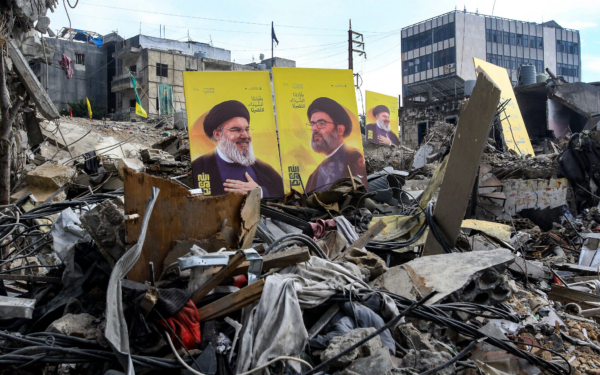
Posters of Hezbollah’s slain leaders Hassan Nasrallah (L) and Hashem Safieddine are placed amid destruction caused by Israeli strikes against the Iran backed- group in the southern Lebanese city of Nabatieh on December 4, 2024. (Mahmoud Zayyat/AFP)
By: Naji Al Boustani
After a long period of intensive preparations and training, and after arduous efforts in armament and mobilization, Hezbollah was eager for a battle with Israel, due to its significantly increased strength and capabilities compared to the 2006 war. However, the course of the battle proved disappointing, and its results did not match the years of threats and warnings. So what happened, and why did many observers agree that Hezbollah lost the war?
First Reason:
Hezbollah suffered a deep and serious intelligence breach. This began with Israel’s ability to compile comprehensive lists of its cadres and members due to its open and public participation in the Syrian war. This continued with Israel’s success in creating detailed maps of many of its positions and storage facilities by hacking thousands of its radio and pager devices, not to mention the hacking of the wired landline telephone network it had built. The breach was completed as a result of years of aerial surveillance using the latest technical monitoring and surveillance equipment, not to mention the successful recruitment of field agents. All of this played a crucial role in disrupting the party both morally and operationally, leading to the premature exposure of its plans, the destruction of many of its positions and centers even before they were used, and the assassination of many of its cadres and fighters.
Second reason
Israel’s success in eliminating a large number of the first and second-tier military cadres of Hezbollah dealt a fatal blow to the leadership hierarchy, leading to confusion and disarray at the operational level on the ground. The new leaders, appointed hastily, struggled to fill the void under relentless bombardment.
Third reason
Hezbollah’s decision in the initial phase not to engage in a full-scale war, and its attempt to limit the confrontation as much as possible, allowed the Israeli army to bomb and destroy a large number of long-range missile sites and depots. These missiles could have provided a degree of balance in a war of attrition and mutual destruction. Those missiles that survived became vulnerable to the constant surveillance of Israeli aircraft, and susceptible to destruction, especially since the launch platforms for this type of missile are not highly mobile and require time to prepare for launch.
Fourth reason
The Israeli political leadership’s decision to evacuate all areas of northern Israel rendered Hezbollah’s use of short- and medium-range missiles largely ineffective. While some material and economic damage could be inflicted, it was impossible to cause a sufficient number of casualties to generate significant Israeli public pressure to stop the war.
Fifth reason
Israel managed to strike important depots containing large numbers of drones that Hezbollah had been relying on in the conflict. The remaining drones that Hezbollah used in the fighting were insufficient to significantly alter the balance of power. Although some drones managed to evade Israeli air defenses and reach their targets, the small size of the explosive devices they carried, necessary to maintain their long-range flight and maneuverability, limited their destructive capabilities.
Sixth reason
Since Hamas launched Operation Al-Aqsa Flood and Hezbollah entered the war of attrition, which gradually escalated, Hezbollah lost the element of surprise it had been counting on during its preparations for war. It had hoped to use this element to storm positions in the Galilee and capture Israeli soldiers in the event of a full-scale confrontation. However, the loss of the element of surprise deprived Hezbollah of this valuable asset.
Seventh reason
The air defense missile depots that Hezbollah had successfully transferred to Lebanon, hoping to use them against Israeli aircraft in the war, were subjected to preemptive strikes by the Israeli army at the beginning of the confrontation. This policy continued over time, with the most significant preemptive strike occurring on the morning of Sunday, August 25, 2024, when approximately one hundred Israeli warplanes attacked Hezbollah positions as the group was preparing to launch a massive attack on Israel with missiles and drones.
In conclusion, it can be said that the Israeli army prevailed over Hezbollah in the recent major battle, applying the principle of “preemptive war” and the adage “the best defense is a good offense,” and benefiting from crucial intelligence and highly advanced technology. This stripped Hezbollah of many of its strengths before the actual battle even began. Despite the prevailing view that Hezbollah generally lost the recent war, the party insisted on claiming “victory.” What kind of “victory” are they referring to? The details can be found in the third article of this comprehensive report.
Translated from Arabic
Source: El Nashra
