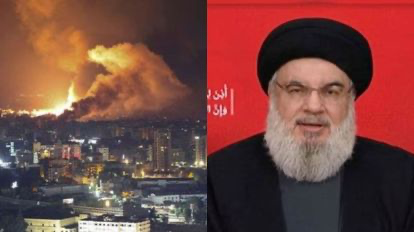
File – Smoke billows following Israeli strikes over Beirut’s southern suburbs, amid ongoing hostilities between Hezbollah and Israeli forces . Hezbollah has issued a statement confirming the death of its secretary general, Hassan Nasrallah, ending his 32-year tenure as the group’s leader.(AP)
By Naji Al Boustani
On September 27, 2024, the Secretary-General of Hezbollah, Sayyed Hassan Nasrallah, was assassinated in targeted airstrikes carried out by the Israeli Air Force, targeting the heart of the southern suburbs of Beirut, under the name of “Operation New Order.” So, what were the mistakes that led to his death, and could they have been avoided?
First mistake
The first mistake was the Hezbollah leadership’s belief that there would be no major war between Israel and the party, given that Hezbollah did not intend to expand the military operations it was conducting under the banner of the “support war” it launched on October 8, 2023. They believed that the Israeli army did not want to fully open a second front in Lebanon, given its involvement in the fierce and exhausting fighting against Hamas. However, it later became clear that the Israeli project was broader than merely seeking revenge against the Palestinians, and included striking the pillars of the “Axis of Resistance” in all its branches, and that the Israeli army, with unlimited military support from the Americans, was capable of fighting simultaneously on several fronts.
Second Mistake
The second mistake was the Hezbollah leadership’s belief that the Israelis would not target Nasrallah personally, given his regional protection, and that any reckless step in this regard could open the doors to a full-scale war in the Middle East. However, it later became clear that Iran was carefully and meticulously calculating every military step to preserve the ruling regime in Tehran and save face—as the saying goes—but without giving its adversaries sufficient justification to launch a war aimed at overthrowing the entire Iranian regime. It also became clear that the Syrian regime of President Bashar al-Assad was attempting to distance itself from any direct conflict in the region, a policy that ultimately failed to prevent a regional and international decision to bring about its downfall, leading to its complete collapse on December 8, 2024. The Iraqi neutral stance fared no better, given its complex internal dynamics and sensitive external relations. The anticipated regional response was limited to the occasional launch of long-range missiles from Yemen, a gesture that did not alter the imbalanced power dynamics.
Third Mistake
The third mistake was the belief of Hezbollah’s leadership that the exact location of Sayyed Hassan Nasrallah was unknown to the Israelis, and that the secrecy of his movements would guarantee his safety. However, it later became clear that the extent of Israeli intelligence penetration was enormous, and that the Israelis had access to data on the locations and headquarters used by all first and second-tier leaders of the party. This information was constantly updated, thanks to a combination of technological superiority, chronic intelligence breaches, and the ability of some agents to operate on the ground.
Four Mistake
The fourth mistake lay in Hezbollah’s leadership believing that even if Israel wanted to wage an all-out war and dared to cross red lines by attempting to assassinate “the Sayyed,” and even if it possessed information about his whereabouts, it lacked the capability to reach him with airstrikes, even using bunker-buster missiles. However, it became clear that the missiles didn’t need to reach the floor where the Hezbollah leadership was sheltering. What is known in physics as the “blast wave” travels through corridors and ventilation shafts, severely affecting a person’s lungs and eardrums, leading to internal ruptures and bleeding, and ultimately, death, without any direct injury from shrapnel or debris, and without any external disfigurement. This is in addition to the toxic gas emissions from the exploding missiles, which also contribute to causing death.
In conclusion, it is clear from the foregoing that this series of fatal errors in judgment and protective measures could have been avoided, especially given the clear evidence in the days and weeks leading up to the assassination operation of the depth of Israeli intelligence penetration into Hezbollah’s structure, and the Israeli leadership’s unrestrained pursuit of exploiting absolute American support to bring about a radical change in the entire balance of power in the Middle East.
Undoubtedly, the assassination played a very influential role in completely altering the regional landscape. In the second article of this comprehensive series, we will examine the reasons that led to Hezbollah’s defeat in the war.
Translated from Arabic
Source: El Nashra
