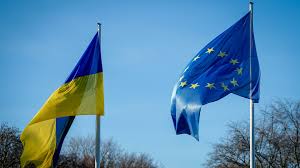
Europe must quickly acknowledge a “new reality” in which it must “take responsibility for its own security,” Ukrainian Defense Minister Denys Shmyhal said at the Washington edition of the Aspen Security Forum.
- “After decades of sleep,” he added, “hesitation is a luxury Europe cannot afford.”
Why it matters: The appeal comes directly from the front lines of war with Russia — a country already sabotaging projects across Europe — and amid uneasy transatlantic attitudes.
- Both Kyiv and Brussels have felt the whiplash of America’s security-aid rollercoaster.
Chatter of European rearmament gained significant steam this year. Four factors worth considering:
- Defense-tech investments and advancements, like Helsing’s factory in southern Germany and the rollout of its CA-1 Europa drone wingman.
- Renewed nuclear weapons debates in France and Poland, among other locales.
- New NATO spending agreements, including a spinoff for critical infrastructure.
- The Trump administration’s latest national security strategy, which was applauded by Moscow.
- The bottom line: “We are living in an era that historians will later call an order transition: a shift from one world order to another. Such transitions are rare; they happen once every 30-50 years, and they are never smooth,” Shmyhal said.
- “Russia has fully mobilized its war machine. And make no mistake, the Kremlin is not just testing Ukraine. The Kremlin is testing Europe and the West.”
TRUMP’S HOSTILITY
The Trump administration is engaged in open hostilities with the European Union, turning long-simmering feuds over free speech, Ukraine and mass migration into official U.S. policy.
The EU’s $140 million fine of Elon Musk’s X platform lit the fuse on a conflict the Trump administration was already primed for — and which it formalized in a new National Security Strategy that casts Europe as a geopolitical villain.
- “They’re destroying their countries,” Trump told Politico, slamming European nations as “decaying” and “weak.”
- The newest flashpoint comes with the U.S. and its European allies also at loggerheads over Ukraine and the future of European security.
The EU penalized X after regulators found the platform had misled users, obscured key advertising information and blocked researchers from accessing public data.
- A furious Musk responded by accusing the EU of stifling free speech through “bureaucratic tyranny” — rallying far-right leaders and millions of followers behind the hashtag #AbolishTheEU.
- Poland’s Foreign Minister Radoslaw Sikorski, a strident defender of the EU, shot back in the midst of Musk’s tweet storm: “Go to Mars. There’s no censorship of Nazi salutes there.”
- Senior U.S. officials quickly piled on, with Secretary of State Marco Rubio calling the fine “an attack on all American tech platforms and the American people.”
- Vice President Vance, widely known as the administration’s most outspoken Euroskeptic, called the fine “garbage” and the product of X’s refusal to accept EU “censorship.”
- Sen. Ted Cruz (R-Texas) urged Trump to impose sanctions on the EU “until this travesty is reversed” — an extraordinary escalation typically reserved for U.S. adversaries.
- The fight over X springs from the worldview formalized in Trump’s National Security Strategy, which accuses the EU of “regulatory suffocation” and “subversion of democratic processes.”
- At the heart of the allegations is mass migration: The White House argues that European elites have unleashed demographic change through open borders, while silencing critics who warn of its consequences.
- Musk and Vance — who previewed many of these arguments in a blistering speech at the Munich Security Conference — have championed far-right parties in Europe, including Germany’s AfD.
- (AXIOS)
