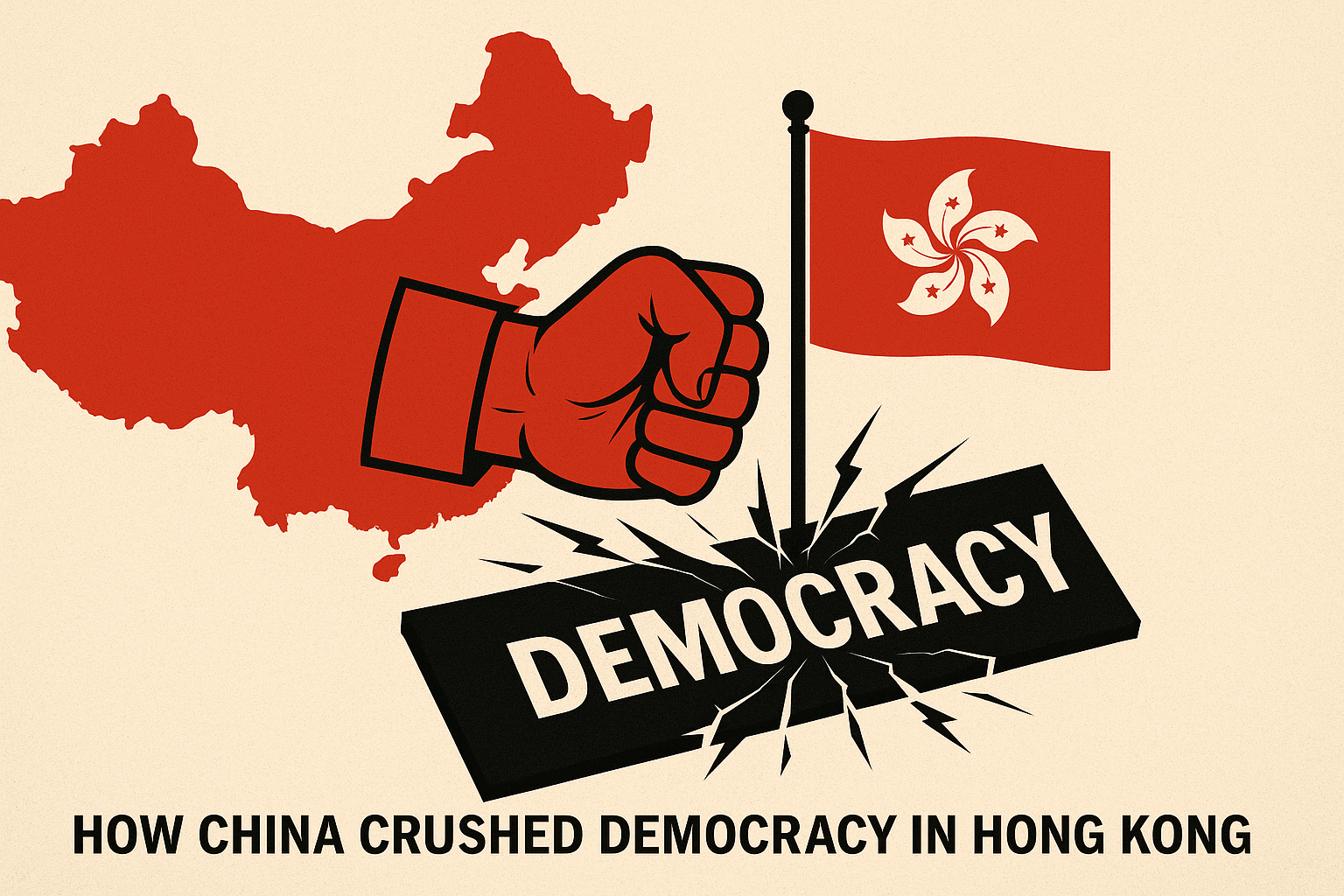
The final disbanding of Hong Kong’s last democratic party marks the definitive end of the “One Country, Two Systems” promise. What Beijing pledged in 1997—50 years of autonomy, civil liberties, and an independent legal system—has been systematically dismantled long before the agreement’s 2047 expiration date.
This outcome should surprise no one.
China’s commitment under the Sino-British Joint Declaration was clear: Hong Kong would retain freedom of speech, freedom of assembly, freedom of the press, and the rule of law. Instead, those freedoms have been replaced by arrests of journalists, criminalization of dissent, loyalty tests, mass surveillance, and a sweeping national security law designed not to protect society—but to silence it.
The forced dissolution of the last democratic party is not an isolated event. It is the final chapter in a carefully executed strategy to eliminate political pluralism and erase any remaining space for opposition.
Communism and freedom do not coexist.
Authoritarian systems cannot tolerate independent institutions, free elections, or an uncensored press. These are not minor inconveniences to one-party rule—they are existential threats. A free society questions authority. A free press exposes corruption. Independent courts limit power. For a communist system built on control, such freedoms are simply unacceptable.
Hong Kong’s tragedy lies not only in the loss of its liberties, but in the global lesson it offers. Treaties with authoritarian regimes are honored only as long as they serve the regime’s interests. When power is consolidated and scrutiny fades, promises become disposable.
The international community must confront an uncomfortable truth: silence enabled this outcome. Economic interests, access to Chinese markets, and diplomatic caution consistently outweighed the defense of democratic principles.
Hong Kong was not “returned” to China in 1997—it was handed a countdown clock. The clock has now run out.
What remains is a warning to Taiwan, to smaller nations negotiating with Beijing, and to democracies everywhere: freedom cannot survive on paper guarantees alone. It survives only when defended—early, firmly, and without illusion.
