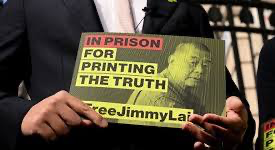
Sebastien Lai, son of jailed media tycoon Jimmy Lai, holds a sign outside 10 Downing Street in London, Britain [File: Jaimi Joy/Reuters]
A Hong Kong court will deliver its verdict on Monday in the trial of former pro-democracy media mogul Jimmy Lai, who’s charged with conspiracies to commit sedition and collusion with foreign forces in a case that marks how much the semi-autonomous Chinese city has changed since Beijing began a wide-ranging crackdown on dissent five years ago.
Lai, 78, was arrested in 2020 under a national security law imposed by Chinese authorities to quell the massive anti-government protests that rocked the city in 2019.
Lai’s 156-day trial is being closely watched by foreign governments and political observers as a test of the judicial independence and media freedom in the former British colony, which was promised it could maintain its Western-style civil liberties for 50 years after returning to Chinese rule in 1997.
Here’s what to know about the landmark trial:
Lai was arrested as China tightened its grip on Hong Kong
Hong Kong was long known for its vibrant press scene and protest culture in Asia. But following months of anti-government protests that brought hundreds of thousands of people into the streets, Beijing began a sweeping crackdown that has chilled most open dissent in the city.
Lai was one of the first prominent figures charged under the National Security Law, which has also been used to prosecute other leading activists and opposition politicians. Beijing deemed the law crucial for the city’s stability.
Dozens of civil society groups have closed, as tens of thousands of young professionals and middle-class families emigrated to destinations like Britain, Canada, Taiwan, Australia and the United States.
Lai’s newspaper was known for its fierce pro-democracy stand
Lai, a rags-to-riches tycoon who formerly owned clothing chain Giordano, entered the media world after the 1989 Tiananmen crackdown.
He described himself as driven by the belief that delivering information is equal to delivering freedom. His newspaper drew a strong following with tabloid-style coverage of politics and celebrities, as well as a strong pro-democracy stance. It often urged its readers to join protests.
Lai took to the streets himself, too, including in the 2019 protests.
Lai was arrested under the security law in August 2020 as about 200 police officers raided Apple Daily’s building. He has been in custody since December 2020.
Within a year, authorities used the same law to arrest senior executives of Apple Daily, raided its offices again and froze $2.3 million of its assets, effectively forcing the newspaper to shut down. The paper’s final edition sold out in hours, with readers scooping up all 1 million copies.
Authorities accused Lai of seeking to get sanctions imposed on China
The most serious accusation against Lai was that he and other people had invited the U.S. and other foreign powers to act against China with sanctions or other measures “under the guise of fighting for freedom and democracy.”
One major issue was whether Lai made such calls after the security law went into effect. Lai did not deny that he’d called for sanctions earlier, but insisted that he stopped once the law came in.
Prosecutors argued that even though Lai didn’t make direct requests for sanctions after the law took effect, he had tried to “create a false impression” of China to justify foreign countries to impose punishment, pointing to articles and his comments in online broadcasts critical of Hong Kong and China.
Lai’s lawyer Robert Pang said his remarks were just armchair punditry, akin to chatter “over the dim sum table.”
Lai said he wrote “without any sense of hostility or intention to be seditious.” Pang also pressed the court to consider freedom of expression and accused the prosecution of treating human rights as a foreign concept, leading to testy exchanges.
“It’s not wrong to support freedom of expression. It’s not wrong to support human rights,” he said. “Nor is it wrong not to love a particular administration or even the country.”
Judge Esther Toh responded that “It’s not wrong not to love the government, but if you do that by certain nefarious means, then it’s wrong.”
AP
