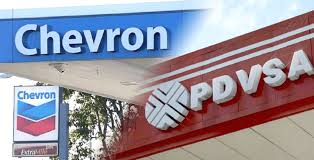
Chevron confirmed this week that it was operating in Venezuela “without disruption and in full compliance with laws and regulations applicable”, according to Reuters, and had exported two cargoes of Venezuelan heavy crude to the US since the seizure of the tanker by the US.
Chevron is driving Venezuela’s oil rebound while China is pulling back. As the fate of President Nicolas Maduro grows uncertain, Washington’s renewed leverage is reshaping the country’s economic and geopolitical future.
Speculation over President Nicolas Maduro’s political future has intensified after US forces seized a Venezuelan oil tanker off the country’s coast. The incident on Wednesday underscored Washington’s longstanding interest in a nation that holds the world’s largest proven oil reserves — an interest shared, albeit for different reasons, by China.
“Whoever comes to power, I can assure you, the first call will be Trump, but the second will be Xi Jinping,” said Parsifal D’Sola Alvarado, a specialist in China–Latin America relations.
D’Sola Alvarado heads the Fundacion Andres Bello (Latin American-Chinese Research Center) based in Bogota, Colombia and the Spanish capital, Madrid. He previously worked with Venezuelan opposition figure Juan Guaido, where he managed contacts with Chinese officials.
Beijing steps back
Speaking with DW, D’Sola Alvarado said he doubts China would stand firmly behind Maduro in the event of a confrontation with Washington.
Beyond diplomatic and political support, he finds it “highly unlikely that China will offer more proactive support to Maduro, selling arms, or new large investments. China doesn’t want more problems with the US.”
China still purchases the majority of Venezuela’s oil. According to the US Energy Information Administration (EIA), nearly two-thirds of Venezuelan crude exports went to China in 2023, while 23% went to the US.
Before Washington imposed sweeping sanctions on Venezuela’s state oil company PDVSA in 2019 — having earlier blocked its access to US financial markets in 2017 — the US had been the country’s largest customer. Production and exports tumbled soon afterward.
OPEC data show that Venezuela’s crude exports fell to just under 500,000 barrels per day (bpd) in 2021, continuing a decline that long predated sanctions. Output had peaked at almost 2 million bpd in 2015 before sliding steadily due to years of mismanagement, corruption and chronic underinvestment.
Chevron revives output
Only in 2023 did production begin to recover, with exports rising to 655,000 bpd in 2024 and reaching 921,000 bpd in November this year.
The rebound owes much to the United States, not China.
In the wake of Russia’s invasion of Ukraine in 2022, Washington eased some restrictions on Venezuela, with the Treasury Department’s Office of Foreign Assets Control granting US oil major Chevron special licenses to resume exports from its Venezuelan joint ventures. In October 2025, the company received fresh authorization to produce oil there.
“The recovery of oil production in Venezuela has happened because of Chevron,” Francisco J. Monaldi, an energy policy specialist at Rice University’s Baker Institute in Houston, Texas, told DW. Chevron now accounts for nearly a quarter of Venezuela’s total output.
Maduro greeted the renewed US permissions with enthusiasm. Speaking on state broadcaster Telesur in July, he said: “Chevron has been present in Venezuela for 102 years, and I hope the company works here for another 100 years without problems.”
China’s fading footprint
While Chevron expands, Chinese investment is limited to smaller-scale projects. China Concord Resources Corp has reportedly begun developing two oil fields, with an investment of about $1 billion (€850 million) planned to boost production to 60,000 bpd by the end of 2026.
But Beijing’s state-backed development lenders such as the China Development Bank and the Export-Import Bank of China have effectively shut their wallets by not issuing new loans to Caracas since 2016, according to the Global Development Policy Center — a think tank based at Boston University in the US.
Much of Venezuela’s roughly $60 billion debt to China has been reduced through restructurings and oil-for-loan deals.
Combined with the lack of new lending, scaled-back diplomacy and quiet outreach to Venezuela’s opposition, D’Sola Alvarado sees unmistakable signs that Beijing is “not completely backing Maduro.”
He notes China had already grown frustrated by 2011, when $8 billion in Chinese funds “just disappeared” from the Sino-Venezuelan Investment Fund. “Chinese authorities were very disappointed how everything turned out and [how] all this crumbled because of corruption,” said D’Sola Alvarado.
A shift with limits
US sanctions, he argues, were not the main reason for China’s retreat, rather “just one more nail in the coffin” of bilateral relations.
Even if power changes hands in Caracas, D’Sola Alvarado believes China would face limited economic consequences and no “major losses.”
The bigger shift would be geopolitical, however, with Beijing no longer having direct access to the Venezuelan government and its networks. ” So it’s always worthy to have one foot inside for the Chinese,” he added.
(DW)
