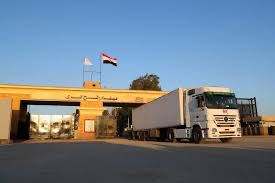
FILE PHOTO RAFAH CROSSING
Since Israel’s Coordinator of Government Activities in the Territories announced that the Rafah crossing would be opened “in the coming days exclusively for the exit of Gaza residents into Egypt,” a political and legal confrontation has erupted between Cairo and Tel Aviv. The dispute goes far beyond a technical disagreement over how to operate a border crossing; it has become a battle over the meaning of the international ceasefire agreement — and over the essence of the Palestinian question itself. Is the goal to alleviate the suffering of Gaza’s population, or to depopulate Gaza?
Two sharply conflicting narratives frame the debate over Rafah.
The Israeli narrative is blunt and unapologetic: a unilateral, one-way opening that enables Gazans to leave for Egypt under the pretext of offering them “a chance to depart.” Israeli officials even declared: “If the Egyptians do not want to receive them, that is their problem.”
Through this logic, Israel tries to shift the moral and political burden onto Cairo: Either you open your territory for Palestinians to leave, or you are accused of blocking their “escape.”
Egypt’s position, by contrast, has been unequivocal: no displacement from Gaza, neither mass nor disguised, and no opening of the crossing except in both directions, for entry and exit, as stipulated in President Donald Trump’s plan and the UN Security Council’s ceasefire resolution.
Egyptian officials firmly denied any coordination to open Rafah solely for outbound movement, stressing that any future arrangement “must allow movement in both directions.” Egypt, they said, will continue receiving the wounded, the injured, and humanitarian cases, and will allow those already inside Egypt to return to Gaza, but it will not serve as an open gateway for population transfer.
Egyptian and Palestinian interpretation of the Israeli proposal is clear; a one-way opening is not a humanitarian measure but a “trap of displacement.”
Palestinian officials described the idea as an attempt to forcibly push Palestinians out and prevent their return, affirming that “the Palestinian Authority and Egypt will not permit such a plan to pass.”
In this sense, “exit” ceases to be a protected humanitarian right and becomes the first step in a pathway of “departure with no return,” a re-engineered version of the Nakba, facilitated by unbearable humanitarian pressure and a single “safe exit” toward Sinai. It is displacement masked as compassion.
Thus, Palestinians and Egyptians hold to a different equation which is: humanitarian corridors, yes; demographic removal, no.
Opening Rafah to receive the wounded, deliver aid, and allow temporary departures is legitimate and necessary. But turning it into a one-direction demographic outlet is an Egyptian, Palestinian, and Arab red line.
A striking irony is that Egypt grounds its stance in the very documents Israel cites. The Trump plan, which forms the framework of the current ceasefire, clearly prohibits forcing Palestinians to leave their land, including Gaza’s population. It also stipulates that Rafah must operate in both directions under agreed arrangements, not through unilateral Israeli decision.
Egyptian officials publicly reminded Israel that Article 12 of the plan does not permit opening the crossing from one side only. Any attempt to impose a “no-return exit” would, therefore, violate both the letter and spirit of the agreement.
Cairo is effectively wielding the Trump plan as a legal and political shield against Israeli maneuvring. If Israel values the agreement, it must honor it fully, not selectively.
When an Israeli official claims: “If Egypt refuses to receive Gaza’s residents, that is its problem,” this is not a casual remark. It is a deliberate attempt to reshape the narrative: Israel appears as the party “opening the door,” while Egypt appears as the party “blocking salvation.”
Egypt, however, sees a very different reality. It believes Tel Aviv is evading its obligations: opening its own crossings, admitting humanitarian aid, and facilitating the gradual restoration of life inside Gaza.
Israel is shifting the burden onto Cairo, hoping to make the Egypt–Gaza border the center of the crisis instead of Israeli occupation and its policies. It is also advancing a discourse that “Gaza is uninhabitable,” and that the “natural solution” is for Palestinians to leave, rather than ending the occupation and rebuilding the territory.
Thus, Egyptian officials repeatedly emphasize: Gaza’s problem is not a “border-crossing dilemma,” but a crisis of occupation and aggression.
Any real solution must begin with Israel honoring the ceasefire, opening all crossings in both directions, and halting its policy of collective punishment.
Egypt’s rejection of a one-way opening is not only a matter of solidarity with Palestinians, but also an act of national self-protection. Sinai’s recent history has shown that sudden, unregulated demographic shifts carry profound security, social, and economic risks.
The mass displacement of hundreds of thousands, or more, from Gaza into Egypt would transform the Palestinian cause from a struggle over land into a refugee crisis inside a neighboring state, placing immense burdens on Egypt and reviving scenarios Cairo has long warned against: the liquidation of the Palestinian cause at Sinai’s expense.
Internationally, Egypt draws on a foundational principle of international law, the prohibition of forced displacement, whether carried out by violence or by creating conditions that make remaining impossible.
By insisting that Rafah must only open in both directions and as part of an integrated ceasefire and reconstruction framework, Egypt is reminding the world that the solution lies not in removing Palestinians from their land but in enabling them to live on it.
The Rafah dispute is, therefore, not a technical dispute over border logistics, but a profound political confrontation: Should Gaza remain part of the Palestinian map, or should it be gradually emptied of its people under humanitarian pretexts?
For Egypt, any scheme that institutionalizes a “one-way opening” is a step toward disguised displacement, regardless of the humanitarian language used to frame it.
For Israel, keeping the option alive maintains pressure on Cairo and offers Tel Aviv a bargaining chip in future negotiations.
Between these two visions, Cairo continues to articulate its principles clearly: no displacement, no shifting of responsibility onto Arab states, and no partial arrangements that rescue the occupation from its core obligations, ending aggression and fully implementing UN Security Council resolutions.
Rafah is not just a border crossing. It is a symbol in the struggle over meaning itself: Does the Palestinian pass through it on his way to a hospital, then return home, or on his way to a permanent exile?
Egypt’s answer, so far, has been unambiguous: A humanitarian gateway, yes. A new Nakba, no.
