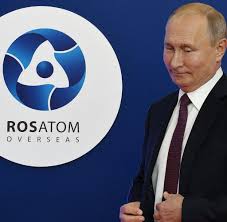
Photo:Rosatom manages Russia’s entire nuclear sector, from weapons to power while President Putin is overseeing and directing its strategic, geopolitical, and economic functions, effectively making it a key tool of the Kremlin’s power and international strategy
By Vlad Green OP-ED
While Washington pressures India and other countries to stop buying Russian oil, the United States itself continues to import nuclear fuel from Russia—fuel that powers American homes, industries, and military facilities. This contradiction is not a minor policy flaw. It is a strategic vulnerability that undermines U.S. credibility and exposes the failure of decades of energy planning.
A Silent Dependency the U.S. Cannot Afford
Despite its status as the world’s leading superpower, the United States relies heavily on Russian enriched uranium. Today, a significant portion of the fuel used in American nuclear reactors originates from Russia or Russian-controlled facilities. If imports were halted abruptly, several reactors would be forced offline, threatening electric reliability across multiple states.
In other words, the U.S. talks tough on Russia—but still needs Russian uranium to keep its lights on.
Washington Pressures Others While Making Exceptions for Itself
India buys Russian oil to meet its growing energy demand. Europe still buys Russian LNG. Turkey runs entire Russian-built nuclear plants. Yet Washington selectively targets India for criticism—while quietly exempting its own imports of Russian nuclear fuel from major sanctions.
This double standard is glaring. It raises a basic question many nations now ask:
How can the U.S. urge others to cut ties with Moscow when it has not cut its own?
How America Became Dependent on a Rival
This dependency did not happen overnight. It is the result of three decades of neglect:
- Post–Cold War complacency: The U.S. shut down much of its domestic enrichment capacity, assuming cheap Russian fuel would always be available.
- Lack of investment: Successive administrations failed to rebuild the nuclear fuel cycle at home.
- Russian expansion: While Washington hesitated, Moscow invested aggressively. Rosatom now dominates global enrichment capacity.
The result is a strategic imbalance: Russia controls a supply chain the U.S. still needs.
A Superpower Should Not Be Vulnerable to Its Adversary
Nuclear energy supplies about 20% of America’s electricity. Dependence on Russian fuel gives the Kremlin leverage over a critical part of the U.S. energy grid. This is not the posture of a secure superpower. It is a self-inflicted weakness.
Before Washington demands that India or any other nation abandon Russian energy, it must first eliminate its own reliance on Russian nuclear materials.
What the U.S. Must Do Now
Restoring credibility requires action, not rhetoric:
- Rebuild domestic enrichment and conversion capacity immediately.
- Strengthen partnerships with Canada, Australia, and European suppliers.
- Acknowledge the problem openly, instead of masking it behind political messaging.
- End the selective pressure on allies while granting itself exemptions.
Only then can the U.S. speak with moral authority on reducing dependence on Moscow.
Conclusion
The United States cannot continue telling the world to stop funding Russia while quietly purchasing the nuclear fuel it needs from the same source. This policy inconsistency is more than embarrassing—it is dangerous.
A true superpower must control its own strategic supply chains.
It is time for Washington to fix this contradiction once and for all.
