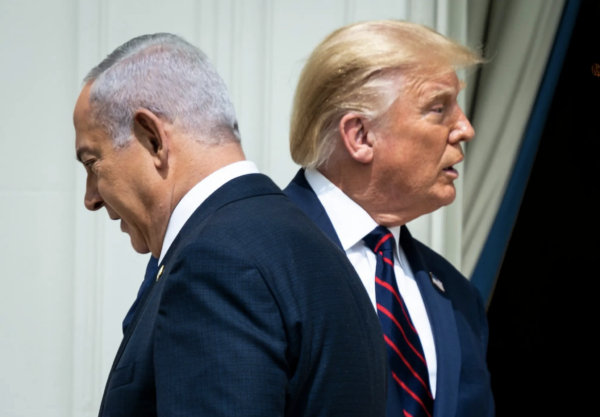
Netanyahu’s reckless strike in Qatar exposes his desperation—and risks dragging America down with him. By killing the messenger in Doha, Netanyahu sabotaged peace talks and undermined Washington’s most trusted Gulf ally.
by ; Ya Libnan Editorial Board, Op-Ed
Israeli Prime Minister Benjamin Netanyahu’s reckless decision to launch an airstrike inside Qatar without U.S. approval has not only endangered American diplomacy but also undermined Washington’s credibility with one of its closest allies in the Gulf. Contrary to Netanyahu’s claim, the U.S. never gave Israel a green light. According to U.S. military reports, Washington was informed only after Israeli warplanes were already in Qatari airspace. By then, the damage was done.
The attack, which killed a Qatari security officer and five Hamas members—including the son of Khalil al-Hayya, Hamas’s exiled Gaza chief—robbed America of any credibility with Qatar, a nation hosting both peace negotiations and thousands of U.S. troops at Al Udeid Air Base.
Trump’s Anger and Public Rebuke
President Donald Trump, usually a staunch backer of Netanyahu, lashed out at Israel in uncharacteristic terms. On Truth Social, he declared:
“Unilaterally bombing inside Qatar, a Sovereign Nation and close Ally of the United States, that is working very hard and bravely taking risks with us to broker Peace, does not advance Israel or America’s goals.”
Trump went further:
“I view Qatar as a strong Ally and friend of the U.S., and feel very badly about the location of the attack.”
In a White House briefing, Press Secretary Karoline Leavitt read a similar statement, signaling rare public displeasure. Later, Trump told reporters he was “very unhappy about every aspect” of the strike, underscoring his frustration at being kept in the dark.
Netanyahu’s Desperation and Trump’s Risk
Netanyahu is a desperate man clinging to power. He knows that once the war in Gaza ends, jail awaits him on corruption charges. That is why he is dead set against peace—and why saving the lives of Israeli hostages has never been his priority. By striking Qatar, Netanyahu quite literally killed the messenger, sabotaging the very mediator working tirelessly to keep diplomacy alive.
Qatar remains the key player in brokering a ceasefire and hostages-for-prisoners exchange, yet Netanyahu chose to humiliate the one country keeping the fragile process alive. His calculation is simple: prolong the war at all costs, even if it means dragging down Israel’s closest ally, the United States, and its president with him.
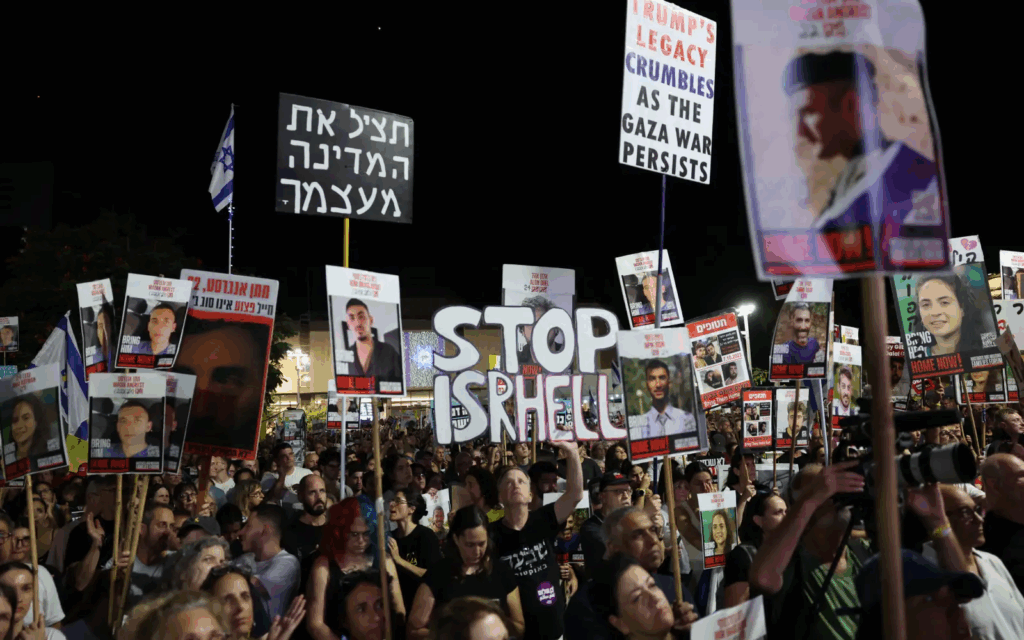
Families of Israeli hostages and supporters protested outside Tel Aviv’s Kirya base, urging a ceasefire deal with Hamas. (EPA Images pic)
Trump must recognize this for what it is. If he allows himself to be shackled to Netanyahu’s desperation, he risks being remembered not as a peacemaker, but as the U.S. president who squandered credibility and influence to protect a failing Israeli leader. Even many Israelis now urge Trump to use his leverage to rein in Netanyahu and bring the war to an end. Yesterday’s reckless strike shows just how far Netanyahu is willing to go—even biting the very hand that feeds Israel. Trump should know better and cut ties now, before it is too late.
A Blow to Peace Efforts
The strike targeted Hamas leaders who were meeting in Doha to discuss Trump’s Gaza peace plan. Whether one supports Hamas or not, undermining talks hosted by a U.S. ally was a reckless move that could derail already fragile negotiations.
By acting unilaterally, Netanyahu not only defied the U.S. but also insulted Qatar, which has been risking its own security to facilitate peace. For Washington, this is more than an embarrassment—it’s a strategic disaster.
Why Trump Must Act
Trump now faces a choice: continue enabling Netanyahu’s reckless adventurism, or put America’s credibility and interests first. While Trump reiterated that eliminating Hamas is a “worthy goal,” he must also recognize that undermining U.S. allies and sabotaging peace initiatives will only prolong the cycle of violence.
Dumping Netanyahu may sound drastic, but continuing to back him blindly risks America’s standing in the Middle East and beyond. If Trump wants to be remembered as the dealmaker who brought peace rather than the president who lost America’s last shred of credibility, he must act decisively—and soon.
