
A Diplomatic Failure That Strengthens Washington’s Rivals
Photo: Russia’s Vladimir Putin, China’s Xi Jinping and North Korea’s Kim Jong Un (L-R) at the parade in Beijing. Photo: Sergey Bobylev/pool via Getty
By Vlad Green, Op-Ed
Thanks to President Trump, images beamed around the world this week from Beijing offered a striking vision of where America’s adversaries see themselves heading. The leaders of China, Russia, and North Korea strode together at a massive military parade — an unprecedented tableau of three nuclear-armed strongmen united in defiance of Washington’s alliances, sanctions, and “rules-based order.”
From afar, Trump responded with astonishing nonchalance, telling Xi Jinping to “please give my warmest regards to Vladimir Putin and Kim Jong-un as you conspire against the United States of America.” His words underscored just how unserious and dangerous U.S. leadership has become.
A Show With Limits
While the optics looked alarming, the reality behind the parade is less solid than advertised. This “axis” has clear limits. Not one of these states lifted a finger when Israel and the U.S. rained bombs on Iran. China provides Russia with oil revenues, but not arms. And Pyongyang’s saber-rattling is often more spectacle than substance.
Still, the symbolism matters. Perception can become reality in geopolitics — and this spectacle was designed to project American weakness.
Behind the Curtain: A Diplomatic Failure
If anything, the show of force reflected the failure of American and Indian diplomacy. Washington has sought to contain China and isolate Russia, yet instead their leaders are parading side by side with Kim Jong-un — a visual rebuke to years of sanctions and pressure.
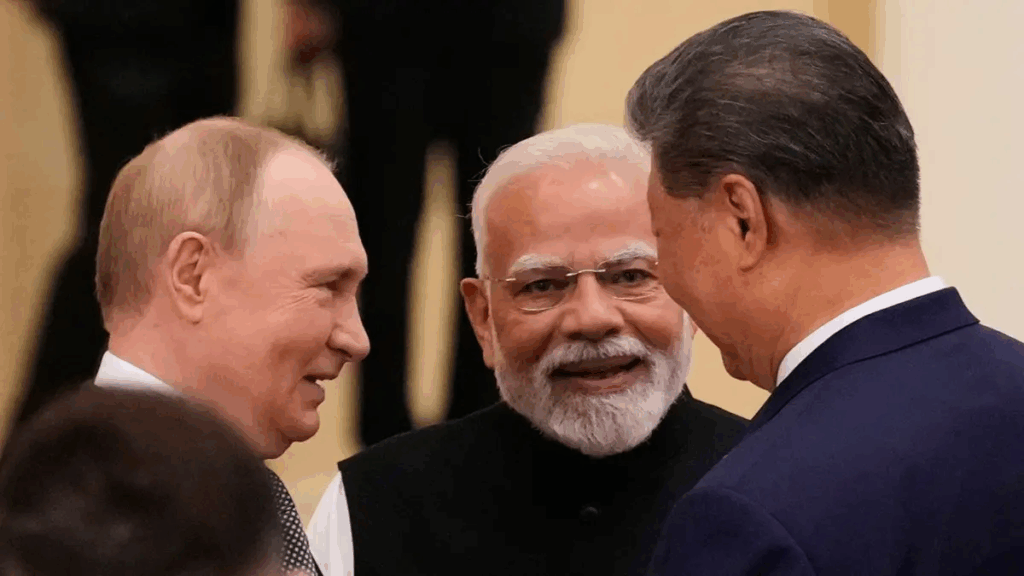
Russian President Vladimir Putin (left), India’s Prime Minister Narendra Modi (center) and Chinese President Xi Jinping (right) at the Shanghai Cooperation Organization Summit in Tianjin, China. Photo: Sergey Bobylev/Kremlin Press via Getty
India, for its part, has tried to play both sides, deepening ties with the U.S. while keeping its long-standing relationship with Moscow. But the Beijing parade exposes the limits of that balancing act. New Delhi has not been able to pull Russia away from China’s orbit, nor prevent this spectacle of adversarial cohesion.
What was intended as a strategy of divide and contain has, for the moment, produced the opposite: a dramatic show of unity among Washington’s rivals.
The Bottom Line
Trump may boast that he is reshaping America’s global posture, but the images from Beijing tell another story: he is driving America’s adversaries closer together. Even if the bonds among China, Russia, and North Korea are brittle, the fact that they chose to stand shoulder to shoulder signals something profound — that U.S. leadership is faltering and its diplomacy is failing.
Unless corrected, this perception of failure could harden symbolic unity into real strategic alignment — the most dangerous consequence of all.
