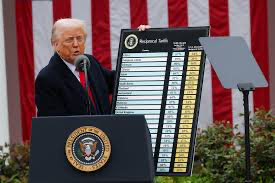
FILE U.S. President Donald Trump holds a chart next to U.S. Secretary of Commerce Howard Lutnick as Trump delivers remarks on tariffs in the Rose Garden at the White House in Washington, D.C., U.S., April 2, 2025. REUTERS/Carlos Barria
The Trump administration asked the Supreme Court on Wednesday night to weigh in on its appeal to keep a broad set of tariffs in place after a lower court ruled they were illegal.
Why it matters: Global trade is in a new state of limbo over whether the bulk of President Trump’s trade agenda might be overturned.
- If the Supreme Court ultimately upholds the lower court ruling, the overwhelming majority of tariffs implemented under Trump would be canceled.
A federal appeals court on Aug. 29 held that Trump exceeded his authority by enacting widespread tariffs under the International Emergency Economic Powers Act (IEEPA).
- The court, however, allowed the tariffs to remain in place through Oct. 14.
- That decision does not apply to sector tariffs — including those on steel, aluminum and autos — which were implemented under a separate trade authority.
The filings, copies of which were seen by Axios, asks the Supreme Court for a swift ruling, with the government noting that the “stakes of the case could not be higher.”
- The government said the lower court decision “eviscerates a critical tool for addressing emergencies through fuzzy reasoning that improperly transforms judges into foreign-policy referees.”
- In a statement posted on X, Jeffrey Schwab, a lawyer on the team representing businesses suing the government, said he hoped for a “prompt resolution of this case.”
From development to delivery, learn how USP quality standards support people’s health.
The intrigue: Trump has said the nation would face an economic reckoning if the suite of tariffs were not allowed to continue.
- Few economists outside the White House believe that is the case, though the tariffs were projected to contribute meaningfully to the nation’s federal revenues.
- The Congressional Budget Office previously estimated that Trump’s tariffs would lower deficits by $4 trillion over the next 10 years.
- Treasury Secretary Scott Bessent recently revealed that the administration could fall back on Section 338 of the Smoot-Hawley Tariff Act of 1930—a law infamous for worsening the Great Depression. Section 338 lets the president impose tariffs of up to 50% for five months on countries that “discriminate” against U.S. commerce.
- The 1930s Depression, formally known as the Great Depression, was a devastating global economic downturn that began with the stock market crash in October 1929 and lasted for a decade, though recovery didn’t fully complete until the start of World War II. Section 338 of the Smoot-Hawley Tariff Act of 1930 that President Trump is eying as plan B triggered the depression
AXIOS
