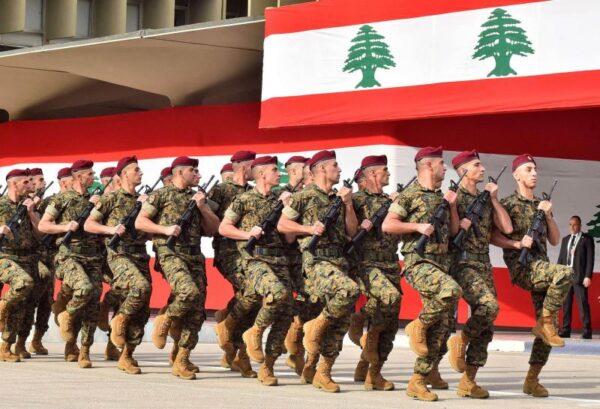
File photo that shows the Lebanese army soldiers marching during a military parade commemorating the 76th anniversary of Lebanese independence from France at the Defence Ministry headquarters in Yarze. The Lebanese Government is meeting on Friday to discuss the army’s plan on restricting the possession of weapons in the country to the state, which effectively calls on Iran’s proxy Hezbollah to disarm.(AFP)
Hezbollah has intensified its criticism of the Lebanese government ahead of its meeting on Friday that is dedicated to discussing the army’s plan on restricting the possession of weapons in the country to the state, which effectively calls on the Iran-backed party to disarm.
The government had last month tasked the army with drafting the plan, which would see the disarmament of all armed groups before the end of the year.
Hezbollah has slammed the government decision and is refusing to lay down its weapons, launching a fierce campaign against the government, especially Prime Minister Nawaf Salam, that has taken a threatening tone.
Before being weakened by Israel during their war last year, Hezbollah would simply dismiss government decisions that don’t align with its interests, saying that they do not concern it. Now, with the massive political changes in Lebanon and the region, the party is unable to ignore government decisions.
This is reflected in its stances where it is calling on the government to go back on its decision, when in the past it would have simply ignored them. This shift demonstrates Hezbollah’s realization of the seriousness of the government’s intention to disarm it and impose state monopoly over arms.
Former Minister Rashid Derbas recalled how the ministers of Hezbollah and its ally the Amal movement walked out in protest of the government session that took the disarmament decision.
In remarks to Asharq Al-Awsat, Derbas said Hezbollah “has grown convinced that the decision has become a local and regional reality. Even though force has not been used to enforce it, the party is not taking it lightly.”
“Hezbollah cannot remain in denial with the current political situation in Lebanon, which largely backs the government decision,” he added.
“The government today is in charge of negotiations, and it is in control after it used to be the mediator between Hezbollah and international envoys,” he noted.
On the fierce campaign against Salam, Derbas said the government “is not worried.”
He revealed that he has been in contact with government officials, and that the stances of President Joseph Aoun and the cabinet make it evident that “everyone is commitment to the decision and going ahead with it.”
“Everyone needs to act rationally, especially given the pressure Lebanon is coming under, most notably from Israel,” Derbas added.
Hezbollah attacks
Hezbollah has throughout the week kept up its attacks on the government and Salam.
On Tuesday, through its Al-Manar television, Hezbollah made an open threat, saying that “if the government remains insistent on the disarmament, then the party may not even cooperate in area south of the Litani” where Hezbollah is supposed to lay down its arms in line with the ceasefire agreement with Israel.
It also accused Salam of seeking “the country’s destruction” and that he has turned “a deaf ear to internal and foreign advice,” revealed sources close to Hezbollah.
On Wednesday, Hezbollah’s parliamentary bloc said: “Defending Lebanon and protecting its national sovereignty demand that the government reconsider its decisions and cease handing out free gifts to the enemy.”
“It must go back on its un-national decision about the resistance’s [Hezbollah] weapons and refrain from adopting plans related to this issue,” it said. “It must go back to reason and the dialogue that Berri had proposed to reach a solution to the crisis that the government landed itself and the country in due to its compliance with foreign dictates.”
Grand Mufti Derian
On the other side of the divide, Grand Mufti Sheikh Abdel Latif Derian declared that imposing state monopoly over arms “is a purely Lebanese demand.”
Speaking on the occasion of the Prophet Mohammed’s birthday, he said: “We have been fortunate that that our state institutions have come together amid such regional upheaval. We have stood behind the president’s swearing in speech and government’s policy statement that called for reclaiming the state and its institutions, army and weapons. This should have happened years and years ago.”
“We may have differences over small or large matters, but we must not differ over reclaiming the state from corruption and the weapons,” he added.
“There can be no country with two armies. The militias present in Arab countries have obstructed the rise of the state for all citizens. The alliance between the weapons and corruption can no longer control Lebanon,” he stressed.
“We must not differ over the state and army. Accusations of treason and dismissing the interests of the nation and its authority are unacceptable. The decision of war and peace must remain in the hands of the state and its institutions,” he urged.
Hezbollah turned its guns inward
“Rather than defending the homeland, Hezbollah has repeatedly turned its guns inward. After the 2006 war, it occupied downtown Beirut—an area rebuilt over 12 years by the late Prime Minister Rafik Hariri—paralyzing Lebanon’s economic and political life. Then, in May 2008, it launched an armed assault on West Beirut and attempted, unsuccessfully, to overrun the Druze and Christian strongholds of Mount Lebanon. These were not acts of national defense, but internal intimidation and political blackmail” , Ali Hussein a prominent Lebanese political analyst was quoted as saying.
“The group’s violence has not stopped at the battlefield. In the wake of Syria’s withdrawal from Lebanon in 2005, a wave of political assassinations began targeting those who opposed Syria’s and Hezbollah’s domination. Among the most prominent was the assassination of Rafik Hariri himself. Journalists, lawmakers, and security officials who dared speak out met similar fates. The message was clear: dissent would be punished by death, Mr Hussein added.
Even more devastating was Hezbollah’s role in the 2020 Beirut Port explosion. In 2013, the group facilitated the illegal storage of 2,750 tons of ammonium nitrate—reportedly to aid the Assad regime’s barrel bomb campaign after Syria surrendered its chemical weapons to the OPCW. When that stockpile ignited, it wiped out entire neighborhoods, killed over 220 people, wounded more than 6,000, and left 300,000 homeless. This was not collateral damage. This was criminal negligence rooted in Hezbollah’s obsession with weapons and war.” He added
“Hezbollah’s own Shiite base has suffered the most. In every war, it is their homes that are destroyed, their families displaced, and their towns left in rubble. And yet, no country in the world is willing to help rebuild as long as Hezbollah remains armed and unaccountable. Their suffering has become the currency Hezbollah uses to justify its next confrontation.” Mr Hussein added
“Let us be clear: Hezbollah’s weapons have not liberated a single inch of Palestine. Instead, they have brought destruction to Lebanon. They have not defended the nation—they have dismantled it. Their continued existence violates UN Resolution 1559 and 1701 , and and the Taif Agreemen which call for the disbandment of all militias in Lebanon, and which mandates one army under one state.” Mr Hussein concluded.
Asharq Al Awsat/ YL
