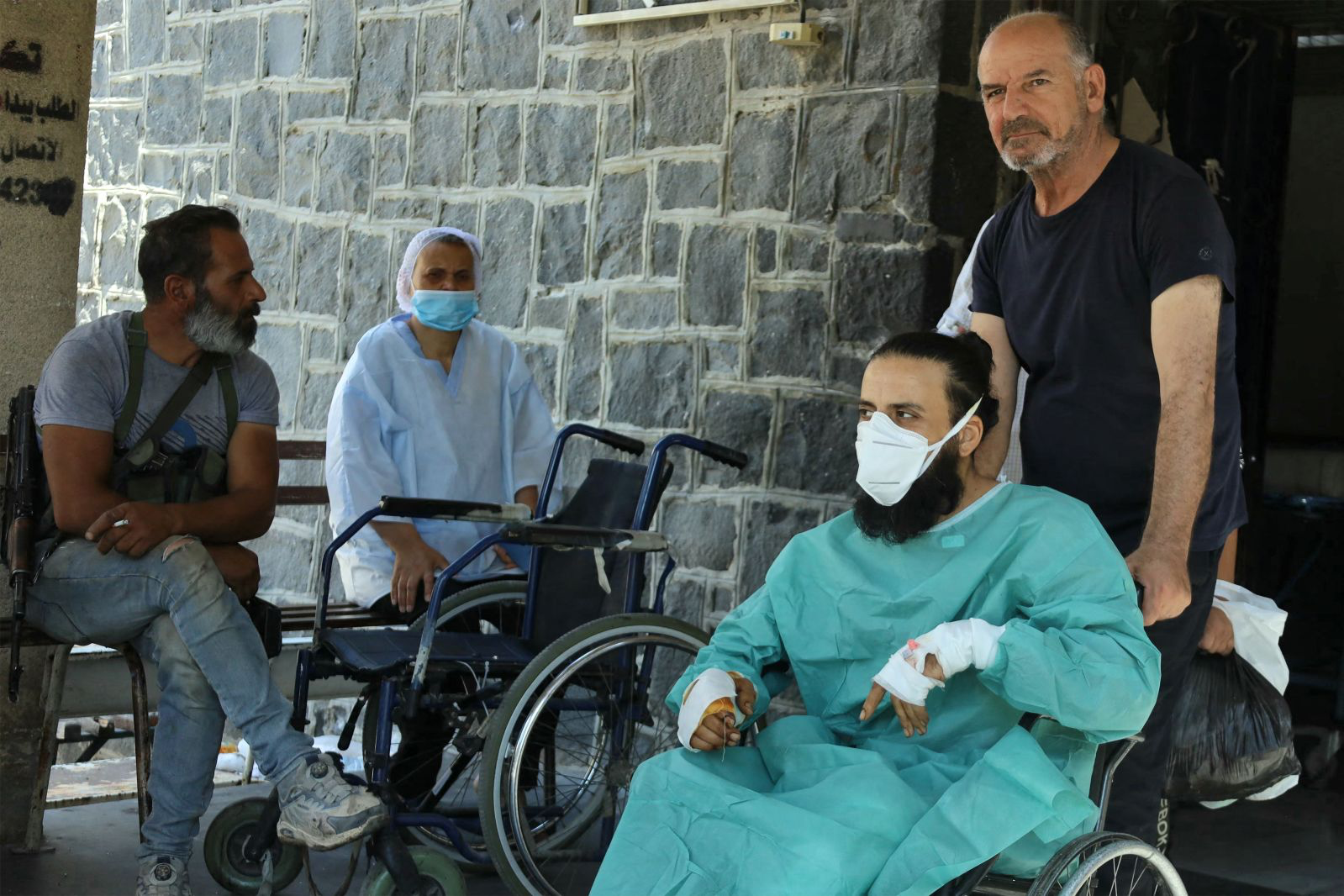
An injured person sits in a wheelchair as he is helped to exit Sweida National Hospital in southern Syria’s predominantly Druze city of Sweida on July 20, 2025. The Violence in Sweida province killed more than 1,000 people . The Syrian security forces of Ahmed Al Sharaa were blamed for the massacre. . Following the massacre, Syrian Security forces entered the Sweida hospital killed and injured several patients and hospital staff members. (Photo by Shadi AL-DUBAISI / AFP)
Staggering violence in various regions is fueling minority demands for autonomy, posing a challenge to President Sharaa’s plans for a strong centralized state.
By Kareem Fahim and Zakaria Zakaria
ARNAH, Syria — A wall of fear is rising around this scenic town in the foothills of Mount Hermon.
Arnah’s many Druze residents say they are wary of straying beyond its borders because of violence or discrimination targeting their religious minority in parts of Syria. The townspeople are just as reluctant to let some outsiders in: The closest government troops remain at a checkpoint in the next town.
In Arnah and other areas home to religious and ethnic minorities, Syria’s Sunni Islamist-led government is increasingly seen as a threat. The alienation represents a perilous turn for the country’s leaders, who took power late last year after ousting the dictatorship of Bashar al-Assad and pledged to unify the country.
Instead, Syria is showing cracks.
In the mountainous Druze redoubts in Syria’s south and west, along the Mediterranean coast where the Alawite religious minority is concentrated and in the Kurdish regions of the northeast, there have been calls for autonomy, decentralization or simply to be left alone. Residents who say they still cherish their Syrian identity fret about their future in the country. Some community leaders are seizing on current fears to press loudly for longtime dreams of independence.
For months after Assad’s dramatic fall, “there was a lot of hope in the new Syria,” said Nabih Kaboul, a Druze resident of Arnah. “Unfortunately, this period is worse than the one we were in.”
The disaffection poses a dire challenge to President Ahmed al-Sharaa’s drive to consolidate his young government’s authority and his plans for national recovery after the long civil war.
Sharaa has advocated for a centralized state led by Damascus, similar in structure to the one before Syria was fractured by its long civil war. His vision, which he says focuses on “development and construction and the unity of Syrian lands,” remains popular with many Syrians. It has also been embraced by influential foreign supporters, including Persian Gulf allies that have pledged Sharaa aid and support.
During Syria’s transition from the Assad years, the government wants “a strong centralized structure that would allow them to make decisions quickly,” said Haid Haid, a fellow in the Middle East and North Africa program at Chatham House. But recent episodes of staggering violence are threatening — even overtaking — such plans. Every week, “things are becoming more alarming rather than better,” Haid said.
The government has frequently blamed Syria’s troubles on remnants of the deposed Assad regime or foreign powers — particularly Israel, because of its military interventions in the country and outreach to the Druze. Such accusations are fueling a political polarization that has left some minorities and government forces viewing each other with mounting mistrust.
“The fear is from both sides,” said Diaa Kheirbeik, a mayor in Jableh, on Syria’s coast, who is trying to calm tensions between government forces stationed there and Alawite residents who are still reeling from a massacre of their relatives and neighbors in March by government forces or fighters aligned with them.
Syria was shaken by another wave of killings last month, in Sweida, a Druze-majority city south of the capital, Damascus. More than 1,000 people died in unrest that was marked by atrocities, including some carried out against Druze civilians by fighters aligned with the state.
Weeks later, Sweida remains restive and isolated, its entrances sealed by government forces while its residents struggle for food and water and hold occasional demonstrations. During the latest protests on Aug. 16, residents provocatively demanded self-determination and protection from Israel, which carried out airstrikes against Syrian troops during the fighting in the city.
The Trump administration’s Syria envoy, Thomas Barrack, who has been a strong backer of Sharaa and his efforts to unite the country, acknowledged after the bloodshed in Sweida that Syria might need to consider alternatives to a highly centralized state.
“Not a federation but something short of that, in which you allow everybody to keep their own integrity, their own culture, their own language, and no threat of Islamism,” he told a group of reporters last month. “I think everyone is saying we need to figure out a way to be more reasonable,” he said.
A pledge to protect minorities
Sharaa has dismissed the possibility of Syria’s partition. “There are desires among some people to divide Syria and try to create local cantons internally, but logically, politically and rationally, this is impossible,” he said in a speech carried by state media Sunday.
He condemned Israel’s interventions in Sweida, saying they were “aimed at weakening the state.” But he also acknowledged his own government’s role in alienating the city, saying that perpetrators of abuses during the fighting would be punished.
Since taking power in December after leading the rebel charge that toppled Assad, Sharaa has struggled to convince skeptics that his vows to protect minorities are sincere. His own history — as a former militant who led al-Qaeda’s Syrian branch — has been a liability. So has the conduct of extremist fighters nominally under his command and linked to a growing catalogue of atrocities.
Efforts by Sharaa’s government to attract foreign investment, ease Syria’s diplomatic isolation and rid itself of international sanctions imposed on Assad have been more successful.
“While that might help,” Syria’s most intractable problems are political, Haid said. The government’s zeal to assert control over the entirety of Syria — including through force of arms — was “not working,” he said. Instead, he advocated a national dialogue among the country’s different communities. “Only time, major engagement and effort build that trust and understanding,” he said, but given the government’s current approach, “things will most likely continue to get worse.”
Syria’s most destabilizing rift may be the dispute between the government and the Syrian Democratic Forces, a Kurdish-led militia that gained control of a large swath of territory in northeast Syria in recent years during the fight against the Islamic State militant group.
The SDF, which is supported by the United States, struck an agreement with the Syrian government in March that in part stipulated “the integration of all civil and military institutions” into the Syrian state.
The deal has yet to be implemented, though, amid disagreements over how much autonomy the region now controlled by the SDF will have. Further complicating the situation is continuing violence between the SDF and militias backed by Turkey. Ankara views the SDF as an adversary because of its links to the Kurdistan Workers’ Party, or PKK, which fought a long insurgency against the Turkish state.
An SDF-sponsored conference of minority communities in the eastern city of Hasakah this month drew the Syrian government’s ire by calling, among other things, for a decentralized state. The gathering did not “represent the Syrian people,” Syria’s foreign minister said a few days later, accusing the participants of trying to “exploit the events in Sweida.”
Killings along the coast
Anti-government sentiment also pools in the villages, towns and cities of Syria’s coastal region. This is the heartland of Syria’s Alawite religious minority, a historically marginalized community that has faced resentment because of its association with Assad, an Alawite, who drew heavily on the sect to fill senior government and military posts.
The coastal killings in March, triggered by attacks by Assad loyalists on government security forces, claimed at least 1,400 lives and further fueled Alawite disaffection. More than 200 government soldiers were killed in the violence. But much of the slaughter targeted civilians on the basis of their sect, the victims gunned down after being asked if they were Alawites, by government forces or fighters aligned with them, according to residents and a United Nations report on the violence.
The coast’s shaken residents say they are now filled with doubts as to whether the government will bring the perpetrators to justice and, more fundamentally, whether their region will be welcomed as part of Syria and not seen as a disloyal appendage, pining for a fallen regime.
Kheirbeik, the mayor of Hay al-Rumeili in the Jableh district, said more than 55 people in his area had been killed during the unrest. Shops he owned below his apartment, including a barbershop, were burned and destroyed. Still, Kheirbeik has persevered as an interlocutor between the government security forces — which continue to maintain a heavy presence in Alawite areas — and local residents.
His work is far from easy. People in the neighborhood, still scared to go out after nightfall, had tarred him as a traitor, he said. The government had ignored his pleas to post locals at security checkpoints, preferring they be staffed by soldiers from Idlib, the Syrian province that Sharaa had ruled before he came to Damascus.
A division of Syria “will not solve our problems,” Kheirbeik said. “We need the wheat of Hasakah,” he added, referring to the province in Syria’s east, on the Iraqi border. “They need the fish of the coast.”
“We need each other.”
Deeply held grievances
In Arnah, Druze residents continue to emphasize the community’s historic connections to Syria and the importance of the Druze in the country’s social fabric.
“We are all Syrian. We are all here together,” said Reem Abu Qais, a student.
She called accusations that Druze are trying to divide the country “misinformation.” Other local residents grew defensive when discussing the role of Israel, which portrays itself as the protector of Syrian Druze.
A day before Washington Post journalists visited Arnah, an Israeli military spokesman posted video of himself at a small Assad-era military outpost on the outskirts of town containing some emptied huts and a few destroyed trucks. Israel’s mission there was “defensive,” the spokesman wrote. The Israeli incursions into Syrian territory and Israel’s demand that Syria demilitarize a swath of the country south of Damascus have angered the government and stoked popular anger, some of it directed toward the Druze.
“They call us traitors,” one resident said. “The Israelis do not ask our permission before they come here,” another added.
They remaineddeeply suspicious of Sharaa’s government, holding it responsible for the violence in Sweida, which began with clashes between local Druze and Bedouin fighters in the city. Among those implicated in the orgy of executions, mutilations and house burnings were government troops, as well as tribal fighters who joined them in support.
But the grievances in Arnah go beyond Sweida. Residents say they have been harassed at checkpoints as they tried to leave town. They complain that fellow Druze had faced discrimination at state institutions, like universities and hospitals.
“We are anxious,” said Hussein Massoud, another resident, “and worried about the future.”
The Washington Post
