By Paul Godfrey
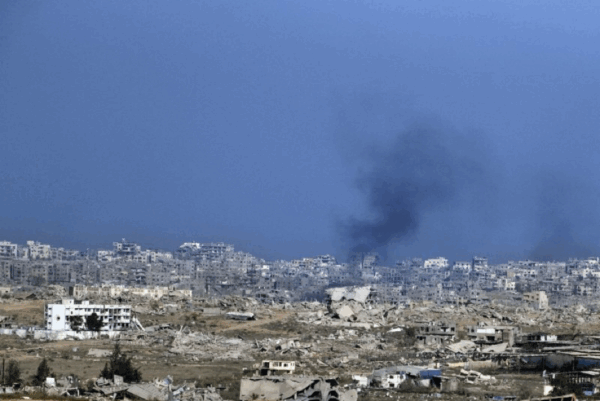
Smoke rises from an airstrike on a target in Gaza on Wednesday, as seen from southern Israel, hours before the conflict entered a new phase as the Israel Defense Forces launched a ground offensive to take over Gaza City. Photo by Jim Hollander/UPI
Gaza- Israel’s military offensive to take over Gaza City got underway on Thursday, sending thousands of Palestinians fleeing from parts of the city of 1 million, according to local officials.
The Israel Defense Forces embarked on the operation after advance troops were able to capture outer areas of the city under the cover of unrelenting airborne attack from airstrikes and artillery fire.
Residents of the Zeitoun and Sabra neighbourhoods were on the move to areas in the city’s northwest.
The overnight escalation came after the military said Wednesday that Israel would “intensify the strikes on Hamas in Gaza City, the political and military stronghold of the terror organization.”
However, it pledged it would endeavor to avoid civilian casualties by issuing evacuation orders.
The offensive by Israel, which has vowed to occupy all of Gaza City as part of a plan to capture the 25% of Gaza it does not already hold, saw U.N. Secretary-General Antonio Guterres intervene, calling for a cease-fire and the unconditional release of hostages.
“It is vital to reach immediately a cease-fire in Gaza” in order “to avoid the death and destruction that a military operation against Gaza City would inevitably cause,” he said.
The World Health Organization warned that the evacuation orders, amid a massive escalation in the level of violence, would only add to already “unbearable pressure” on hospitals by forcing more and more people into ever smaller areas.
It said hospitals in Gaza City were already operating at almost three times their capacity as they battled to cope with a relentless stream of casualties with “complex trauma wounds.”
The offensive came despite a new cease-fire and a hostage-prisoner swap deal negotiated by Egypt and Qatar that Hamas and other Palestinian armed groups have accepted, rising domestic opposition to the war and a deepening rift with Western allies, particularly Australia, poised to recognize Palestinian statehood.
Israeli Prime Minister Benjamin Netanyahu launched a scathing attack on his Australian counterpart, Anthony Albanese, after far-right Israeli politician Simcha Rothman was banned from entering the country for a scheduled speaking tour of Sydney and Melbourne this week.
Netanyahu doubled up attacks leveled at Albanese earlier in the week, telling Australian TV news channel Thursday that Albanese’s reputation was “forever tarnished by the weakness that he showed in the face of these Hamas terrorist monsters.”
Jerusalem retaliated by announcing it would cancel the visas of Australian representatives to the Palestinian Authority.
Earlier, in an online post on Tuesday, Netanyahu claimed history would judge Albanese harshly.
“History will remember Albanese for what he is: A weak politician who betrayed Israel and abandoned Australia’s Jews,” he wrote.
Netanyahu’s comments come a poll by Reuters revealed that the majority of Americans want all the countries in the UN to recognize the Palestinian state.
“A 58% majority of Americans believe that every country in the United Nations should recognize Palestine as a nation, according to a new Reuters/Ipsos poll, as Israel and Hamas considered a possible truce in the nearly two-year-long war. “
The majority of Australians support the recognition of a Palestinian state and only one in four think the recognition of Palestinian state is too soon , according to polls
(UPI)
