By: Vlad Green, Ya Libnan Political analyst , Op-Ed
In Alaska, during the joint press conference with Vladimir Putin, President Trump appeared subdued, hesitant, even intimidated. Gone was the bluster he shows at home; in its place was silence and submission. It was a stunning moment: the leader of the United States shrinking before an adversary. And yet, the U.S. media did not ask why. Not one reporter demanded to know what leverage Putin may hold over Trump, or why the American president suddenly mirrored Moscow’s position on Ukraine.
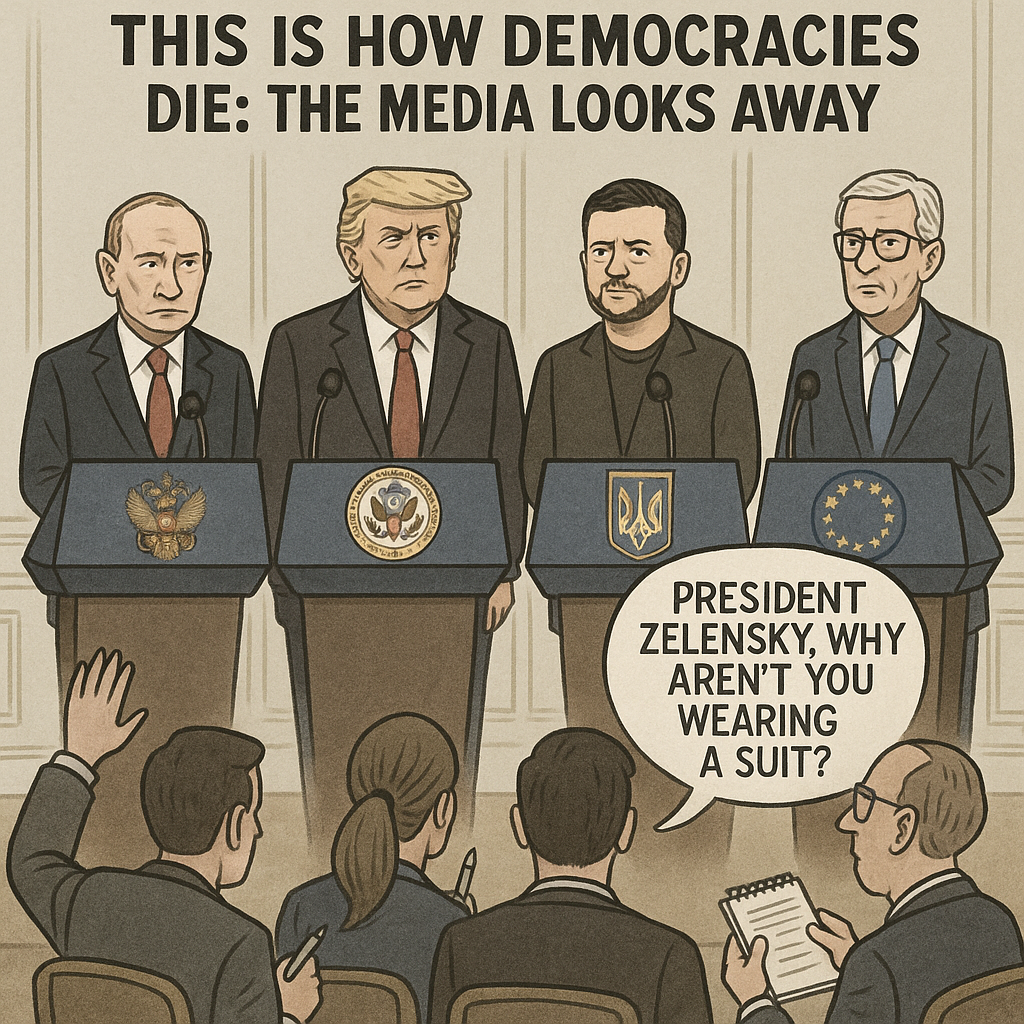
Days later in Washington, the failure of the press was even more glaring. At the White House meeting between Trump, Ukrainian President Volodymyr Zelensky, and top European leaders, the press corps once again chose optics over substance. The most pressing question American journalists could muster was whether Zelensky wore a suit. At a time when the future of Ukraine and the credibility of NATO were on the line, America’s media obsessed over fashion. The stakes could not have been higher, yet the coverage could not have been shallower.
This is not journalism. It is abdication.
Time and again, the U.S. press corps obsesses over optics while ignoring substance. They amplify theater, style, and small talk while failing to press the people in power on decisions that will shape global history. Journalism’s purpose is not to critique fashion choices—it is to demand answers on matters of war, peace, and sovereignty.
At these meetings, every reporter should have asked the questions that hang over Washington like a storm cloud:
- Why did Trump suddenly switch positions on Ukraine, abandoning America’s allies and embracing the terms of an adversary?
- Why does Putin never take Trump seriously, treating him with disdain while extracting concessions?
- Is there kompromat—political or personal leverage—that explains this dangerous pattern of appeasement?
These are the questions of consequence. Yet not one was asked.
A Culture of Appeasement
The meeting in Washington, presented as a forum for unity, was in fact little more than stagecraft designed to protect Trump’s image. And the U.S. media, rather than holding him to account, played along. By refusing to press him on the issues that matter, they gave cover to an administration that appears more interested in appeasing Putin than defending American interests.
Journalists are supposed to make leaders uncomfortable—not provide them with comfort. They are supposed to hold up a mirror, not polish it.
Journalism on Life Support
The failure of the U.S. media at this critical moment is more than embarrassing—it is dangerous. When the press becomes a spectator rather than a watchdog, democracy suffers. When reporters focus on trivia rather than accountability, authoritarians thrive.
The tragedy is not just that Trump appeared weak in Alaska. The tragedy is that the American press allowed him to be weak without consequence. They let the moment slip into history unchallenged, leaving Putin emboldened and America diminished.
The Alaska press conference should have been a turning point—a moment when the U.S. media demanded to know why their president bowed to an adversary. Instead, it became another episode of appeasement. When the press cannot even confront a president visibly intimidated on the world stage, it raises the gravest of questions: if they will not defend democracy in plain sight, when will they?
This is not a minor lapse. It is a warning. When the press looks away, power goes unchecked. When the media falls silent, dictators speak louder. And if this silence continues, it will not be Trump or Putin who kills democracy—it will be the very institutions that failed to defend it.
A Warning America Cannot Ignore
If journalism does not rediscover its purpose—truth over trivia, accountability over access—America will not just lose the war for facts. It will lose the war for democracy itself.
This is how democracies die: not with the roar of dictators, but with the silence of a press corps that looks away.
