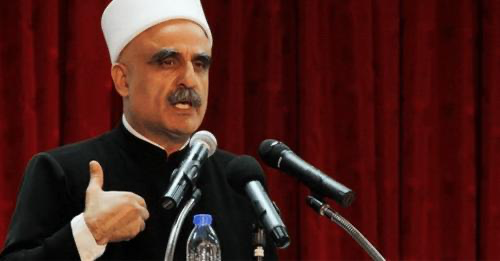
Lebanon’s top Druze spiritual leader Sheikh Al -Aql Dr. Sami Abi Al-Mona, called for immediate “lifting of the siege on the Sweida governorate, releasing the kidnapped, returning the missing men, women and children, and securing humanitarian corridors, because the siege imposed now is more cruel than killing.” He renewed his call for “influential countries and humanitarian organizations to exert efforts to lift the siege, and for the bedouin tribes to withdraw outside the borders of Sweida, in implementation of the agreement.”
During his reception today, at the Druze headquarters in Beirut he said that “what happened in Syria is reprehensible and condemned, and our words always confirm our rejection of what happened and is happening to each other. Jabal al-Arab has been nothing but a mountain of jihad, struggle, patriotism and Arabism since before Sultan Pasha al-Atrash and after him. It never offered martyrs and victims for the sake of independence from Syria, but rather for the sake of the independence of all of Syria. According to history, 12 percent of the youth of the mountain were martyred in 1925 for the sake of Syrian unity and affirming the independence and Arabism of Syria. Jebel Al Arab did not offer martyrs for the sake of the independence of the Druze from Syria
Sweida province in Southern Syria is referred to Jebel Al Arab ( Mountain of the Arabs )
Sultan Pasha Al-Atrash, a prominent Druze leader, is renowned for leading the Great Syrian Revolt against French Mandate rule in 1925. He mobilized various Syrian nationalists and religious groups, sparking a widespread rebellion that challenged French authority.
In July 1925, Sultan Al-Atrash initiated the revolt, fueled by French policies and perceived interference in Druze affairs.
Syria’s interim president Ahmed al-Sharaa has mastered the art of saying the right words about Syria’s future. He speaks of unity, coexistence, and the protection of minorities. Yet his actions tell a starkly different story.
On multiple occasions, Syrian government forces and Sunni rebel factions—bolstered by foreign extremist fighters—have joined hands not to defend Syria’s diversity but to assault it. Al-Sharaa’s repeated vows to protect minorities have proven to be hollow, feeding fears that his true ambition is to transform Syria into a Sunni-only state. Reports that foreign rebels have been granted Syrian citizenship only deepen this suspicion, suggesting an attempt to alter the demographic balance at the expense of Syria’s historic pluralism.
Syria’s crisis is not unique. History has shown us two possible paths for multi-ethnic, multi-religious states.
The first is the tragedy of Yugoslavia. In the 1990s, its leaders failed to build a system that protected all groups equally. Instead, sectarian dominance prevailed, and the country descended into bloody wars that permanently shattered it into fragments. Syria risks the same fate if sectarian rulers continue to impose their vision at the expense of national unity.
The second lesson comes from Switzerland. Once plagued by internal wars between Catholics and Protestants, and divided by language and culture, Switzerland avoided collapse by adopting federalism. Each canton was granted local autonomy while remaining part of a unified state. Diversity was not erased—it was protected—and over time became a pillar of stability.
Syria now stands at a decisive moment. If it continues down the path of hollow promises and sectarian ambitions, it risks repeating Yugoslavia’s destruction. But if it embraces federalism, Syria can secure justice and dignity for all its people—Sunnis, Alawites, Shiites, Christians, Druze, Kurds, and others—while avoiding fragmentation.
Federalism is not division. It is the only system capable of holding Syria together by respecting diversity instead of erasing it. It is the framework through which Syrians can live side by side without fear of domination by any single group.
The minorities in Syria should not be blamed for seeking outside help since they are facing existential threat .Al-Sharaa should be the one to be blamed
According to Gazi Hassan, a Syrian political observer : “Al-Sharaa’s words may soothe, but his actions betray his intent. Syria’s future cannot rest on hollow promises. It must rest on a new social contract—federalism—anchored in equality, autonomy, and mutual respect.“
