When the U.S. president adopts the position of an adversary, allies and adversaries alike wonder who is really calling the shots.
By: Vlad Green, Op-ED
The world watched in disbelief as President Donald Trump stood alongside Vladimir Putin in Alaska and appeared to adopt the Russian leader’s position on Ukraine. For the leader of the United States—the nation long regarded as the guardian of freedom and stability—to echo the demands of an adversary is nothing short of shameful. It has shaken not only Americans but also U.S. allies who rely on Washington’s resolve.
For decades, American presidents, Republican and Democrat alike, have understood that standing firm against Moscow is a matter of principle. Yet what we saw in Alaska was different. Instead of defending Ukraine’s sovereignty and the values of the free world, Trump reversed himself, leaving allies to wonder whether America can still be trusted. The question now echoing from London to Warsaw to Tokyo is simple: why?
A President on the Back Foot
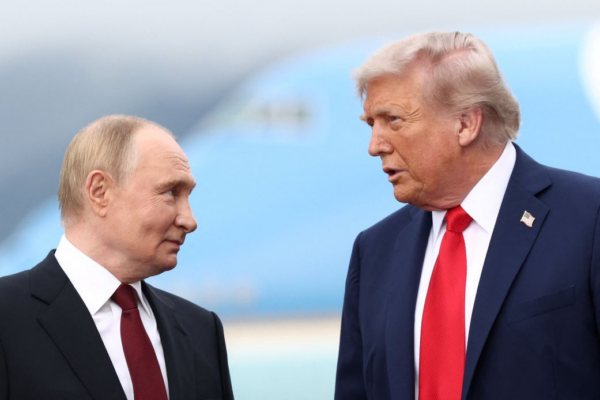
The images from the summit told their own story. Putin looked calm, collected, even triumphant. Trump, by contrast, appeared hesitant and subdued. For all the bravado he displays on the campaign trail, he seemed deferential in the presence of the Russian president.
For allies, this was alarming. If Trump cannot stand firm against Putin, how can he be relied upon to defend NATO in Europe or Taiwan in Asia? The stakes are not limited to Ukraine—they extend to the credibility of U.S. commitments worldwide.
The Blackmail Question
There must be a reason for such a reversal. Former FBI Director James Comey once hinted that Russia may possess kompromat—compromising information—that could explain Trump’s pattern of deference to Putin. No definitive evidence has been made public, but the suspicion lingers.
Even the appearance of blackmail is damaging. Diplomacy depends not only on strength but on perception. If allies believe the U.S. president is compromised, their trust in America erodes. If adversaries believe he can be pressured, they will exploit it.
This is why so many are asking the same uncomfortable question: What does Russia have on Trump?
A Dangerous Message to the World
For Ukraine, Trump’s stance is nothing short of betrayal. For NATO allies, it is a shock to the system. And for U.S. partners in Asia, the fear is clear: if Trump concedes to Putin today, Xi Jinping may take note tomorrow. Beijing is watching closely. If Moscow can pressure Trump into reversing U.S. policy, why not test the same strategy in the Pacific?
Already, Chinese state media has been framing the Alaska summit as proof that American resolve is faltering. This only encourages aggressors and destabilizes the international order.
The Cost of Lost Credibility
America’s power is not measured by tanks or missiles alone. Its greatest strength lies in credibility—the belief among allies that the U.S. will honor its commitments, and the fear among adversaries that America will stand firm. When that credibility is weakened, the entire global order is placed at risk.
The Alaska summit has left America’s credibility hanging by a thread. Allies are hedging, adversaries are emboldened, and the balance of power is shifting before our eyes.
A Call for Transparency
The American people deserve answers. So do America’s allies. Was Trump simply outmaneuvered by a seasoned ex-KGB officer, or is there something deeper at play? Until these questions are addressed, suspicion will continue to corrode U.S. leadership.
Congress and the press must press for transparency. Silence is not an option when the credibility of the United States—and the security of the free world—are at stake.
Conclusion
The Alaska summit was supposed to bring progress toward peace. Instead, it left the world uneasy, allies shaken, and adversaries emboldened. By appearing to side with Putin over Ukraine, Trump did more than weaken American policy—he raised doubts about whether the president of the United States acts freely or under influence.
The question is no longer whispered in diplomatic corridors; it is shouted across the globe: What does Putin have on Trump? Until this question is answered, America’s leadership will remain in doubt—and the world will grow more dangerous.
