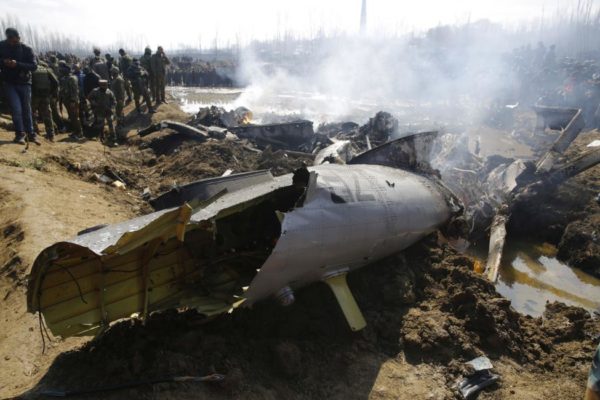
Indian army soldiers stand near the wreckage of the aircraft after it crashed in central Kashmir’s Budgam district. Pakistan has said it has shot down two Indian aircraft. Photo by Farooq Khan/EPA-EFE
From lift-off to impact: What happened on Air India flight 171 in the final seconds before its crash in western India
By Vijdan Mohammad Kawoosa, Adolfo Arranz, Arathy J Aluckal and Han Huang
A preliminary investigation report into the Air India crash on June 12 has revealed what happened on the Boeing Dreamliner during its final moments — a 32-second journey from lift-off to its crash into hospital buildings near the airport.
The crash near Ahmedabad airport killed 241 people on board and 19 on ground. Just one passenger survived.
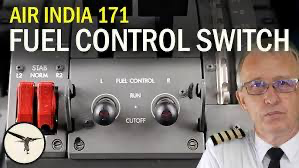
The report focused on the moments after the takeoff, showing the aircraft’s two fuel control switches moved to the ‘cutoff’ position in quick succession. This action cut off fuel supply to the engines, immediately causing the aircraft to lose all thrust.
The switches are on the centre console of the cockpit, just below the engine thrust levers. They are used to control fuel flow to the engines—primarily during engine start-up and shutdown on the ground, or to shut down an engine in the event of an engine failure during flight.
An illustrated graphic showing part of the cockpit of a Boeing 787 Dreamliner, highlighting the location of the fuel switches, flaps lever, speed brake and thrust lever. The metal guards next to the fuel switches are meant to stop anyone touching or activating them accidentally.
The fuel control switches are equipped with a spring-loaded locking mechanism that keeps them in position and prevents unintended movement. You would have to pull the switch up before moving it from run to cutoff, or vice versa.
Aviation experts say a pilot would not have been able to move the fuel switches accidentally. Once moved, the effect would be immediate, cutting off engine power.
A diagram illustrating the function of a fuel control switch in the cockpit of a Boeing 787 Dreamliner. It shows three positions: “Run”, where fuel is supplied to the engines; “Switch Unlocked”, where the switch must be lifted to enable movement; and “Cutoff”, where the fuel supply to the engine is immediately stopped.
The preliminary report highlighted key events before and after the aircraft took off. All systems were reported to be functioning normally up until the moment the aircraft became airborne.
Aerial map of Sardar Vallabhbhai Patel International Airport showing Air India Flight 171’s location 20 minutes before the crash, leaving the terminal.
Aerial map showing the aircraft’s movement path as it begins taxiing toward Runway 23 at Sardar Vallabhbhai Patel International Airport, 13 minutes before the crash.
Aerial map showing the location and movement path of the aircraft. The aircraft is cleared for takeoff 1 minute and 38 seconds before the crash. It begins rolling four seconds later. The aircraft takes off from the runway 32 seconds before the crash.
A series of critical events unfolded in the 32 seconds after the aircraft became airborne, lost thrust and started going down — from the fuel control switches transitioning to the ‘cutoff’ position to the activation of emergency power supply units and the attempted relighting of the engines.
The air inlet door of the Auxiliary Power Unit (APU) begins opening,
consistent with its auto start logic.
Air flow enters
into the APU
The APU is a small gas turbine
engine located in the tail.
APU door
During emergencies or when the main engines are
off, the APU supplies vital power to maintain the
operation of the aircraft’s systems.
15 seconds before crash
(17 seconds after lift-off)
The right engine fuel cutoff switch
transitions from ‘cutoff’ to ‘run’ position.
RUN
CUTOFF
The aircraft was equipped to automatically restart the engines when
the fuel control switches are moved from the ‘cutoff’ to ‘run’ position.
The report said:
The Exhaust Gas Temperature was observed to be rising for both engines, indicating relight.
Left engine’s core deceleration stopped, reversed and started to progress to recovery.
Right engine was able to relight but could not arrest core speed deceleration and reintroduced
fuel repeatedly to increase core speed acceleration and recovery.
6 seconds before crash
(26 seconds after lift-off)
One of the pilots transmits “Mayday Mayday Mayday”,
an emergency distress call used in aviation
to signal a life-threatening emergency.
Air traffic controller enquired, did not get
any response from the pilots, and then saw
the aircraft crashing outside the airport boundary.
13:39:11(local time)
Aircraft’s flight data recorders stop recording.
The aircraft impacted the BJ Medical College hostel,
about 1.6 kilometres from the end of the runway.
According to the report, the wreckage was spread across an area
of approximately 37,000 square metres. Five buildings
shown in the illustration below were impacted and
suffered major structural and fire damage.
Approximate
flight path
Aircraft initially made contact
with a series of trees and an
incineration chimney
Diagram showing the timeline of critical events in the final 29 seconds before the crash of Air India Flight 171, and a graphic of the crash site. Highlights include: 29 seconds before the crash, airspeed reached 180 knots; 24 seconds before, both engines’ N2 values dropped and RAT hydraulic pump activated; 19 seconds before, Engine 1 fuel cutoff switch set to run; 17 seconds before, APU inlet door opened; 15 seconds before, Engine 2 fuel cutoff switch set to run; 6 seconds before, a “Mayday” call was made. Recording stopped at 1:39 p.m. local time, marking the crash.
Both fuel switches were found in the run position at the crash site.
India’s Aircraft Accident Investigation Bureau is leading the investigation into the crash. A final report is expected within a year.
Sources
India’s Aircraft Accident Investigation Bureau; OpenStreetMap
Edited by
Vijdan Mohammad Kawoosa and Andrew Heavens
(REUTERS)
