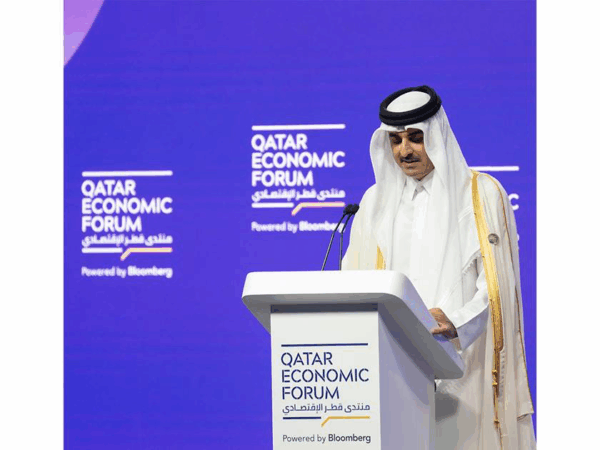
The ruler of Qatar Emir Sheikh Tamim bin Hamad Al Thani is shown at Qatar Economic Forum during his opening speech
By : Ya Libnan Editorial Board
The uproar over Qatar’s recent gift to the United States is unwarranted and unnecessarily politicized. The controversy raises a deeper question: why is this generous gesture from a close ally being twisted into a political issue?
For over two centuries, America has accepted thoughtful and iconic gifts from its international partners—gifts that have helped shape the nation’s image and soul. The Resolute Desk in the Oval Office, gifted by Queen Victoria in 1880, remains a symbol of enduring ties with the United Kingdom. Can we imagine New York without the Statue of Liberty from France? Or springtime in Washington, D.C. without the cherry blossoms gifted by Japan?
So why is the gift from Qatar—a custom-made, American-built aircraft offered to President Donald J. Trump, now serving his second term—being treated differently?
According to reports, some voices in Washington, allegedly influenced by pro-Israel lobbying groups such as AIPAC, have attempted to stir opposition in Congress. Israeli Prime Minister Benjamin Netanyahu is said to be concerned that this gift may increase Qatar’s influence in Washington. But this narrative conveniently ignores Qatar’s long-standing, deep-rooted alliance with the United States.
Qatar hosts Al Udeid Air Base, the largest U.S. military installation in the Middle East, and has been a critical player in U.S. diplomacy for decades. It is a country that has repeatedly proven its value as a partner—whether in counterterrorism efforts, humanitarian diplomacy, or regional stability.
Let’s also be clear: this gift is not about foreign influence. It is about shared values and mutual respect. The aircraft in question is designed and built in America, and is the same model used by U.S. presidents. Far from seeking to gain leverage, Qatar is celebrating American innovation—and honoring its strategic relationship with the United States.
Qatar’s Emir, Sheikh Tamim bin Hamad Al-Thani, addressed the controversy directly during the Fifth Qatar Economic Forum:
“I am not comparing this gift to the Statue of Liberty… It is not something we are doing to buy influence. It is our duty to help when help is needed.”
At the same time, Qatar has committed to investing $1.2 trillion in the U.S. economy—a move that will create American jobs and strengthen our industries. It has also placed the largest single order ever for Boeing aircraft, directly benefiting American workers and manufacturers.
This is not a moment for political games. It is a time to show appreciation for an ally that is standing with America in real, tangible ways. Turning away a gift like this would be both diplomatically tone-deaf and economically self-defeating.
Let’s stop pretending this is about ethics or influence. This is about whether the United States can still tell the difference between a friend and a foe. Qatar has proven itself to be a friend—repeatedly, consistently, and at great cost.
President Trump knows that. So should the rest of Washington.
Did America forget how to be grateful and say Thank you ?
