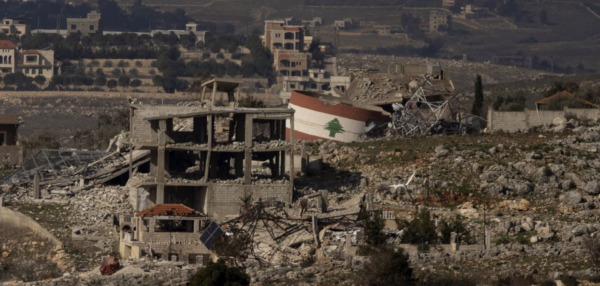
Photo: A Lebanese flag painted on a damaged building in a village in southern Lebanon is seen from a position on the Israeli side of the border on Jan. 23, 2025. Hundreds of Thousands of Lebanese, mostly Shiites want to return to their homes , but their leaders Hezbollah and Amal continue to obstruct the formation of the government that will be able to secure the billions of Dollars needed for rebuilding their homes (Amir Levy/Getty Images)
The formation of Lebanon’s new government remains stalled due to the demands of political factions, particularly the “Shiite Duo” (Hezbollah and the Amal Movement), which is reportedly insisting on obtaining five ministerial portfolios, including the Ministry of Finance.
These conditions are obstructing Prime Minister-designate Nawaf Salam’s efforts to form a 24-member cabinet, with extensive discussions focused on the distribution of ministerial portfolios.
His objective is to create a government capable of implementing the critical reforms that Lebanon needs urgently.
MP Mark Daou, who is familiar with Salam’s deliberations, believes there is still an opportunity for success. Daou warned that if the “Shiite Duo” holds onto its demands, it must bear responsibility for the consequences.
Daou dismissed claims from officials within the “Shiite Duo” that they have secured the Ministry of Finance portfolio, reiterating that the matter is still under discussion. He also highlighted the premier-designate’s previous statements that no ministry is the exclusive right of any party.
MP Razi El Hage from the Lebanese Forces described the cabinet formation process as “constructive and effective,” while accusing his opponents of employing the same procrastination tactics used in the presidential election and the designation of a prime minister.
In a related context, MP Waddah Sadek took to X to stress that the constitution remains the sole reference for government formation. He wrote: “Certain parliamentary blocs must recognize that the constitution is our only framework and that the formation of the government will strictly adhere to this principle.”
Separately, MP Fouad Makhzoumi proposed that Salam form a smaller, 14-member cabinet. On X, Makhzoumi wrote: “I reiterate what I proposed during the non-binding parliamentary consultations with Prime Minister-designate Nawaf Salam: the need to form a rescue government of 14 ministers, composed of specialists and highly competent individuals, equipped with exceptional powers to lead the country through this crisis-laden phase.”
He added: “The new government must meet the aspirations of the Lebanese people and address the unprecedented economic, social, and living challenges. These include resolving the issue of depositors’ funds, advancing the Beirut Port explosion investigation, conducting forensic audits of the Central Bank and state ministries, overseeing reconstruction efforts, ensuring the implementation of Resolution 1701, and solidifying the ceasefire agreement.”
According to analysts Lebanon stands at a critical juncture. With the country still reeling from unprecedented economic and political crises.
For this reason the responsibility falls on the Prime Minister-designate to swiftly form a government and ensure no single political group monopolizes key ministries, especially the Ministry of Finance. It has become evident that the Shiite duo—Amal and Hezbollah—is the primary obstacle to forming a cabinet, while attempting to shift blame onto Christian blocs. However, facts overwhelmingly highlight the role of the duo in obstructing progress, repeating their tactics from the prolonged presidential election stalemate.
This period has been disastrous for Lebanon:
- Economic Collapse: Under Amal and Hezbollah’s watch, Lebanon defaulted on its Eurobonds, leading to the collapse of the Lebanese lira and devastating the economy. Depositors lost access to their savings, and poverty surged to over 80%.
- Beirut Port Explosion: Thousands of tons of explosive chemicals, reportedly stored by Hezbollah for use in Syrian barrel bombs, caused a catastrophic explosion in 2020, devastating the capital.
- Corruption and Mismanagement: The Central Bank, under Riad Salameh, became a symbol of corruption, with investigations and international arrest warrants ignored due to political interference by Hezbollah, Amal and their allies.
- Obstruction of Reconstruction: The Shiite duo has used their control over the Finance Ministry to block projects critical to Lebanon’s recovery, imposing unrealistic conditions and further eroding trust.
The Stakes for Lebanon’s Recovery
Lebanon’s international allies, including Saudi Arabia, Qatar, and the United States, have made it clear that aid and reconstruction funding are contingent on reform and an end to monopolization. The Ministry of Finance, in particular, has become a focal point of concern due to its misuse as a tool for political leverage rather than a means to address the country’s dire financial state.
Without cooperation, displaced Lebanese—mostly Shiites—will continue to bear the brunt of these failures. Reconstruction of tens of thousands of homes destroyed during years of conflict remains on hold, deepening despair among already impoverished communities. Analysts concluded
Asharq Al Awsat / YL
